Read the transcriptTranskript lesen
Hannah: Welcome to the Sedimentary Geochemistry podcast. I'm Hannah.
George: And I'm George. This episode goes with Lecture five: boron isotopes and the end-Permian extinction.
Hannah: Last time we were in the Late Ordovician, with an ice age in a greenhouse world. Where are we going today?
George: To its mirror image. About two hundred and fifty-two million years ago, at the end of the Permian, the largest extinction in the history of animal life. Around ninety per cent of marine species disappeared, and life on land collapsed as well. The Ordovician crisis came with cooling and ice. The Permian crisis came with a huge release of carbon and strong warming. Same question, what killed the animals, but the opposite forcing.
Hannah: And as always we start with carbon and oxygen isotopes.
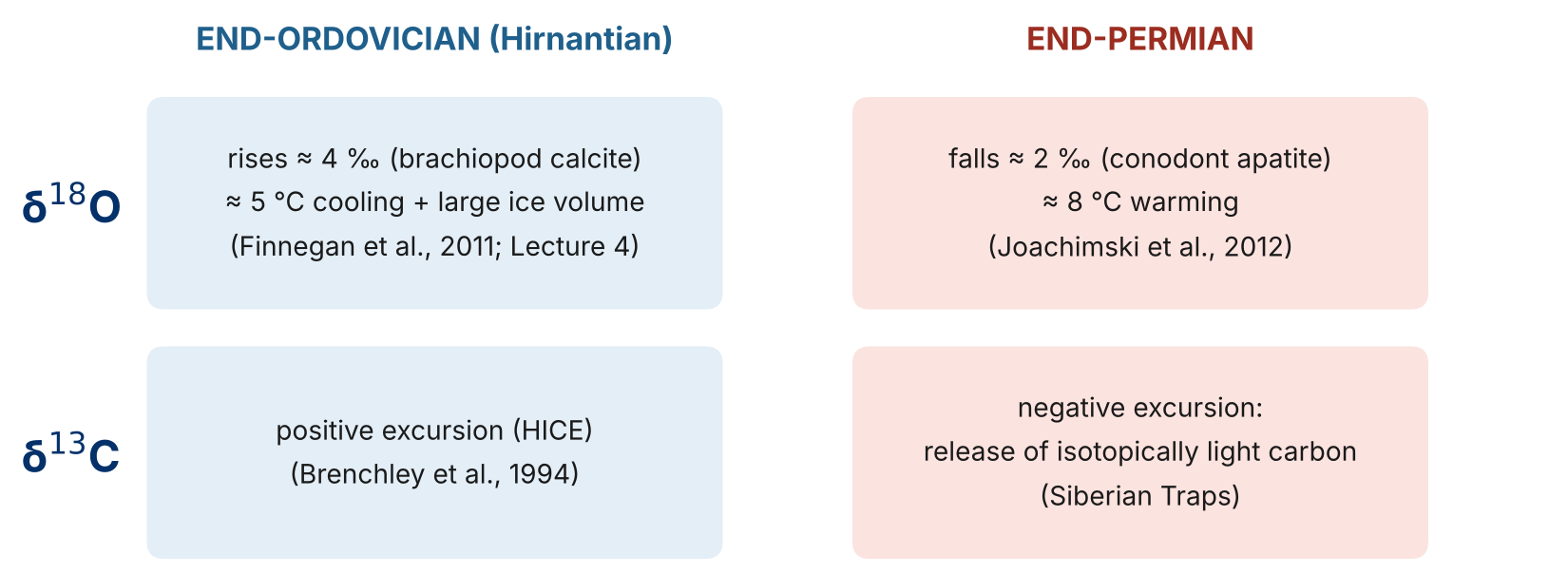
George: Always, because they are the backbone of every extinction study. Look at the two events side by side. In the Ordovician, the oxygen isotope ratio of shells goes up, and carbon isotopes show a positive excursion. At the end of the Permian, oxygen isotopes in conodonts go down, which means warming, and carbon isotopes show a negative excursion: a lot of isotopically light carbon entered the ocean and the atmosphere.
Hannah: So carbon tells us that carbon arrived, and oxygen tells us that it got hot. What is missing?
George: What the ocean did with all that carbon. When carbon dioxide dissolves in seawater, the water becomes more acidic. Carbon and oxygen isotopes cannot tell you how much. For that you need a different instrument, and the best one we have is boron.
Hannah: How can a shell remember the pH of the sea?
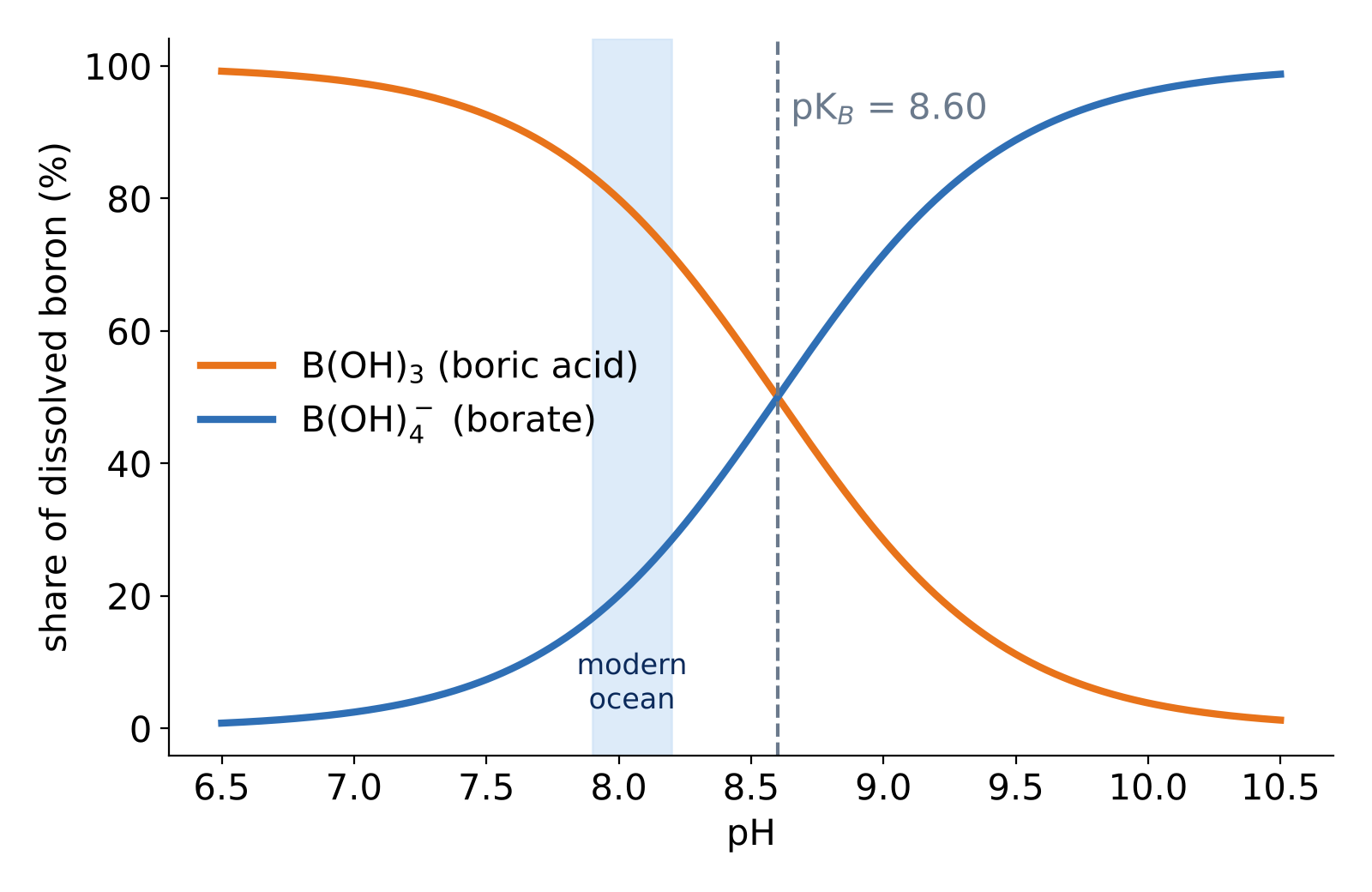
George: It starts with the chemistry of boron in seawater. Dissolved boron exists in two forms. Boric acid, a neutral molecule, and the borate ion, which carries a negative charge. The balance between them depends on pH. At low pH you have mostly boric acid, at high pH mostly borate. Half and half is reached at a pH of about eight point six. Today's ocean is at about eight point one, so roughly a quarter of the boron is borate.
Hannah: And the isotopes?
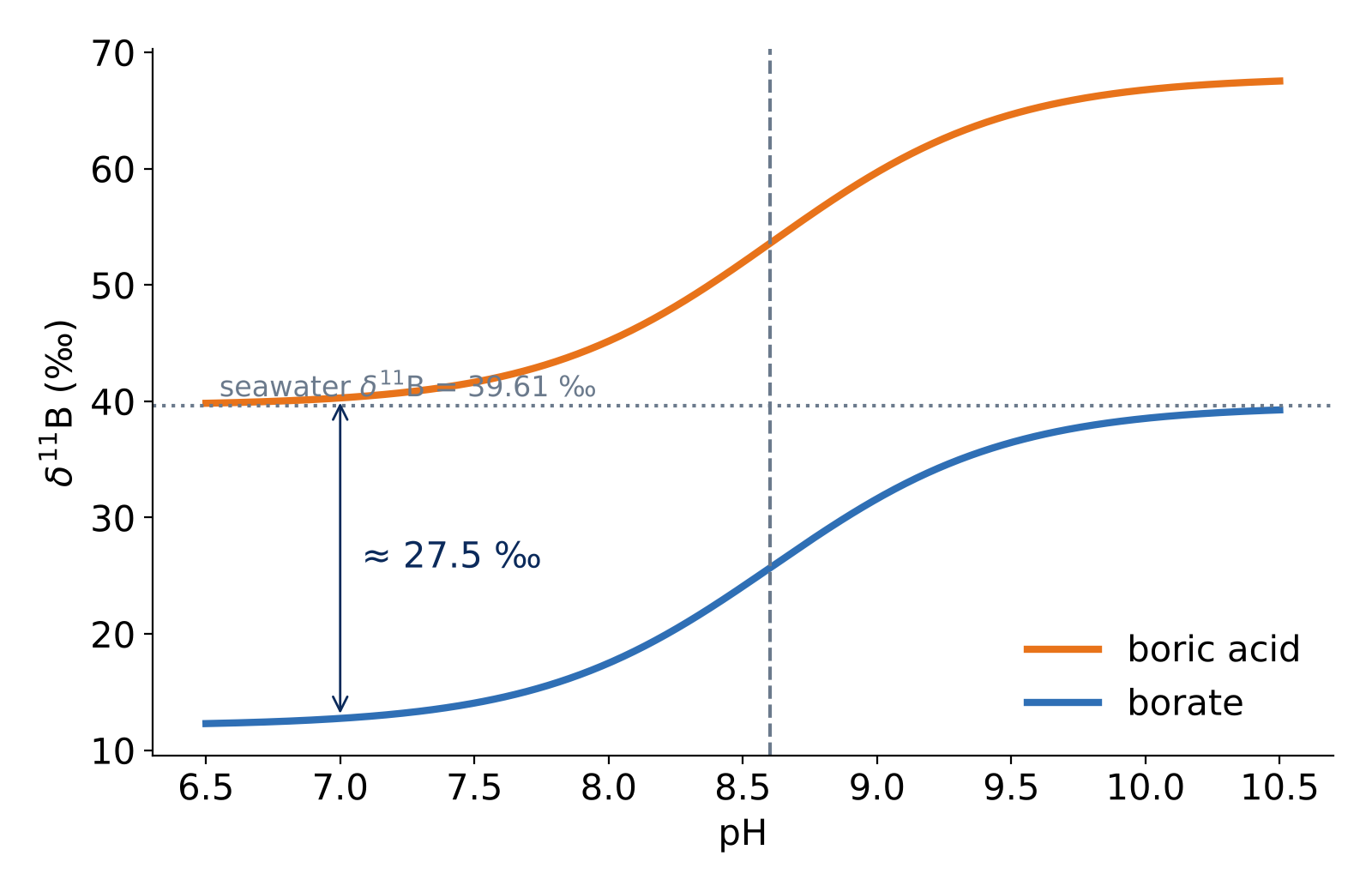
George: Boron has two stable isotopes, boron ten and boron eleven. The heavy one prefers boric acid. So the two forms carry different isotope compositions, separated by a fixed offset of about twenty-seven per mil. That value was measured in seawater by Klochko and colleagues. And the working assumption, going back to Hemming and Hanson in nineteen ninety-two, is that it is the borate that goes into the carbonate.
Hannah: So the shell records the borate. And the borate changes with pH.
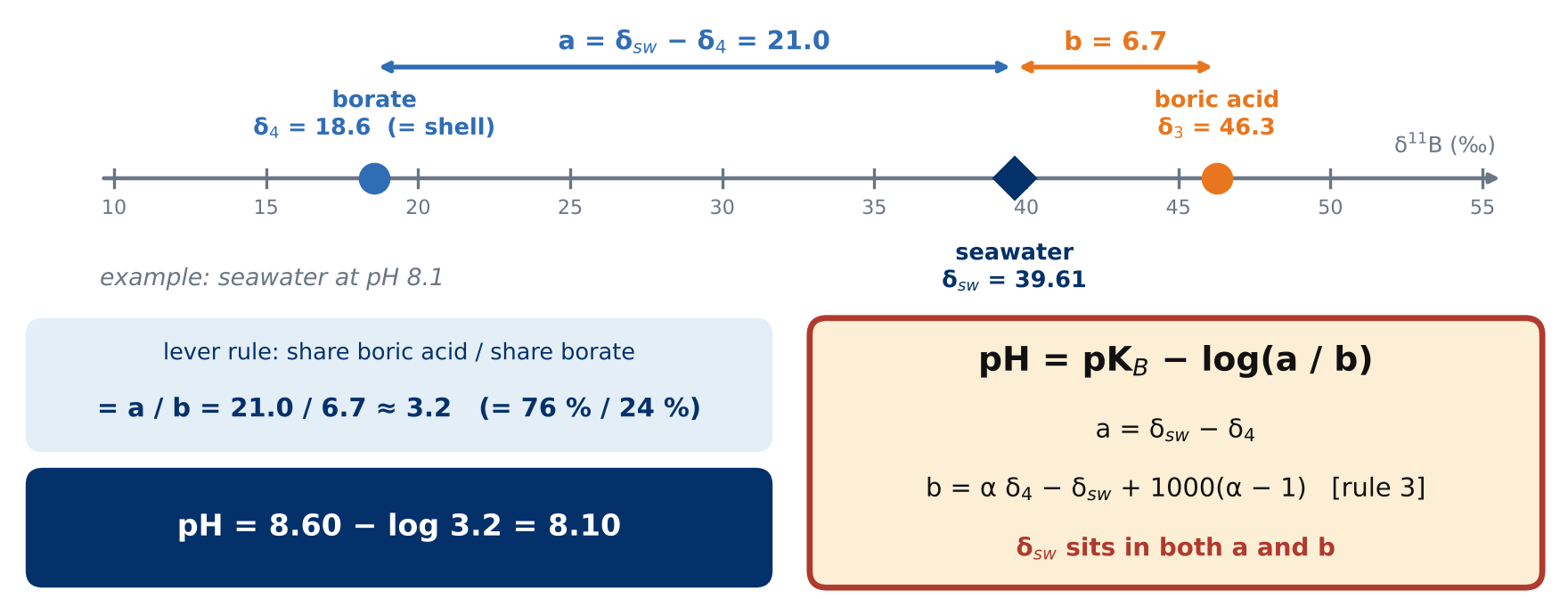
George: Exactly. And in the lecture we turn that into an equation, but there is a way to see it without any algebra. Picture a number line of boron isotope values. Borate sits low, boric acid sits about twenty-seven per mil higher, and seawater, which is the mixture of the two, sits somewhere in between. Like the balance point of a lever.
Hannah: And where exactly it sits depends on how much of each form there is.
George: Right. If seawater sits close to boric acid, most of the boron must be boric acid. So the two distances, from borate up to seawater and from seawater up to boric acid, give you the proportions. And the proportions give you the pH. That is the whole equation in one sentence.
Hannah: Let's try numbers. The lecture has an exercise.
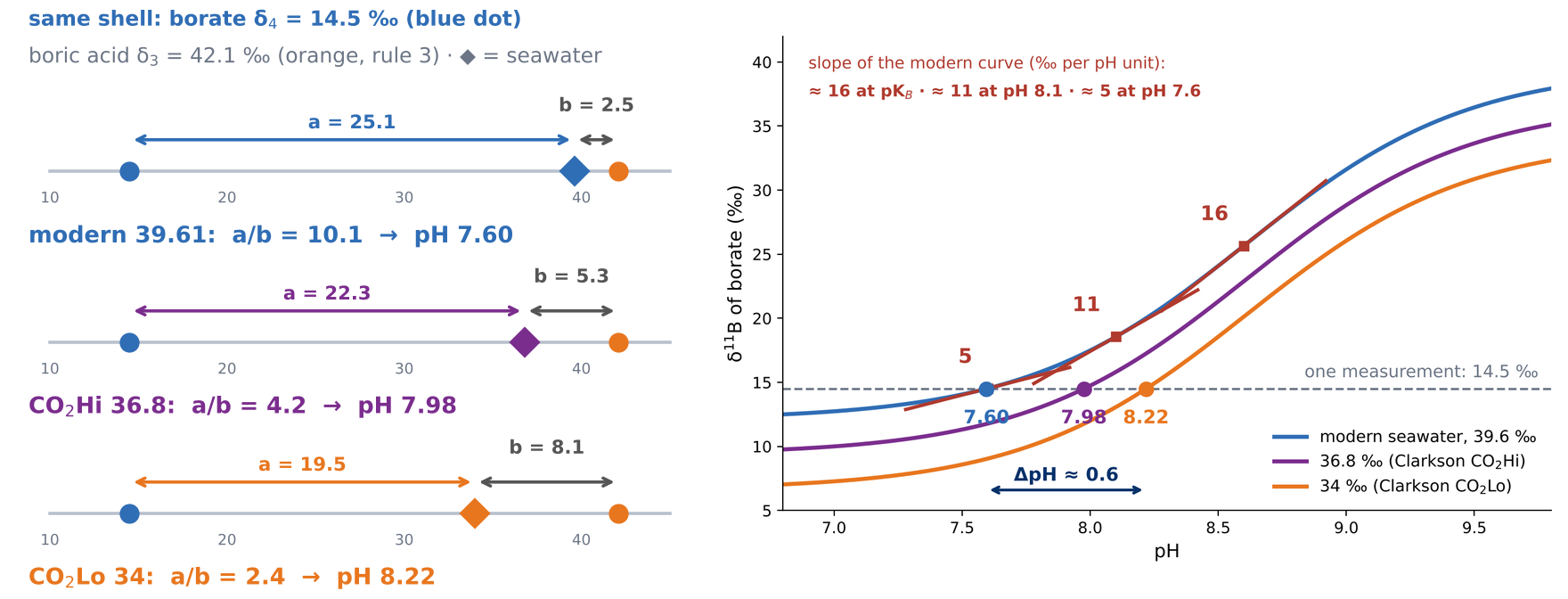
George: A shell with fourteen point five per mil. Modern seawater is thirty-nine point six. Boric acid then sits at about forty-two. Seawater is very close to boric acid, so almost all the boron is boric acid, and the pH comes out at seven point six.
Hannah: That is low. Today's ocean is eight point one.
George: And that unease is the right reaction. Because here is the catch. The equation needs one number that nobody can measure for the deep past: the boron isotope composition of seawater itself.
Hannah: What happens if I change it?
George: Keep the same shell and assume seawater at thirty-six point eight per mil. The balance point moves, and the pH becomes almost eight. Assume thirty-four, and you get eight point two. Same measurement, and the answer moves by more than half a pH unit.
Hannah: And half a pH unit is about the size of the signal we are looking for.
George: That is the central tension of the lecture. Those two values, by the way, are not invented. They are exactly the two seawater values used in one of the Permian studies we will meet later. There is one more property worth knowing. The proxy is most sensitive near pH eight point six, and it gets less sensitive as the water becomes more acidic. So an acidified ocean sits exactly where the instrument is weakest.
Hannah: You call these problems a ledger.
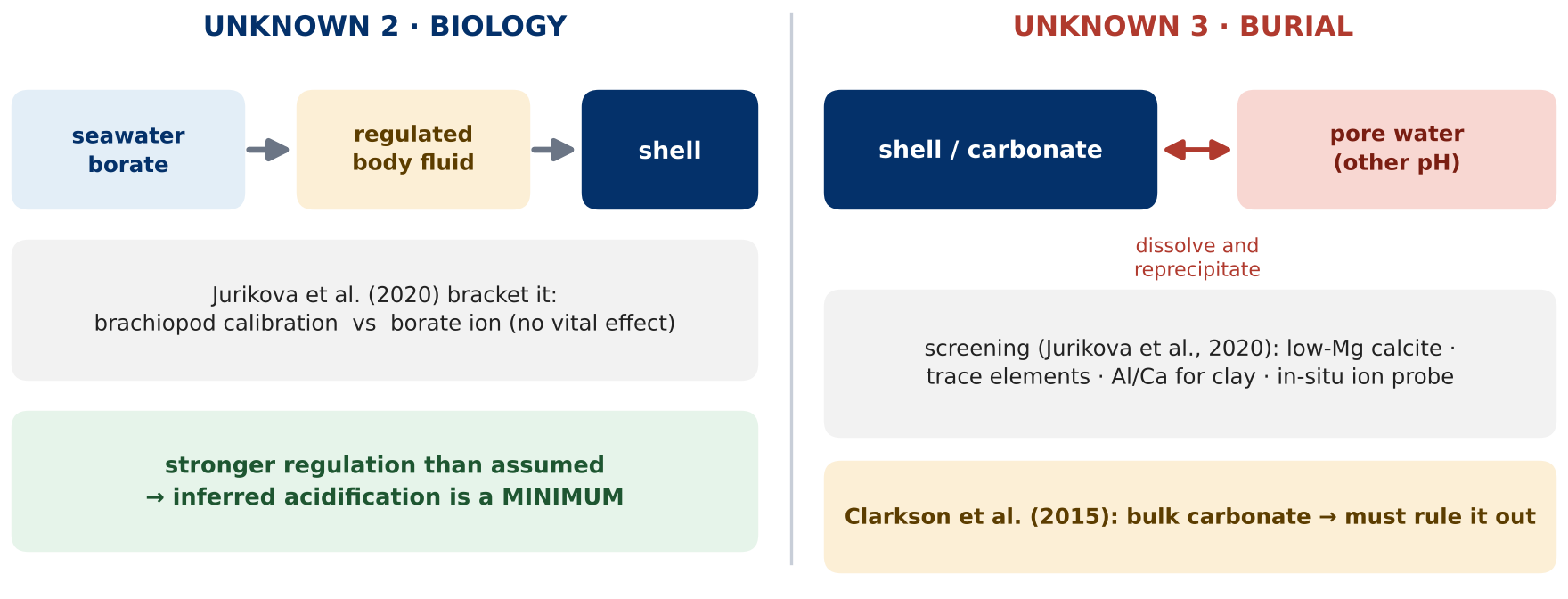
George: The ledger of unknowns. Three things that can move a boron pH record without the ocean's pH moving at all. The first is the seawater value we just discussed. The second is biology: organisms build their shells from a body fluid they control, so the shell does not simply record the sea outside. The third is burial: if the carbonate recrystallises, the new crystals take their boron from the pore water, which can have a very different pH.
Hannah: Is there any way out of the first problem?
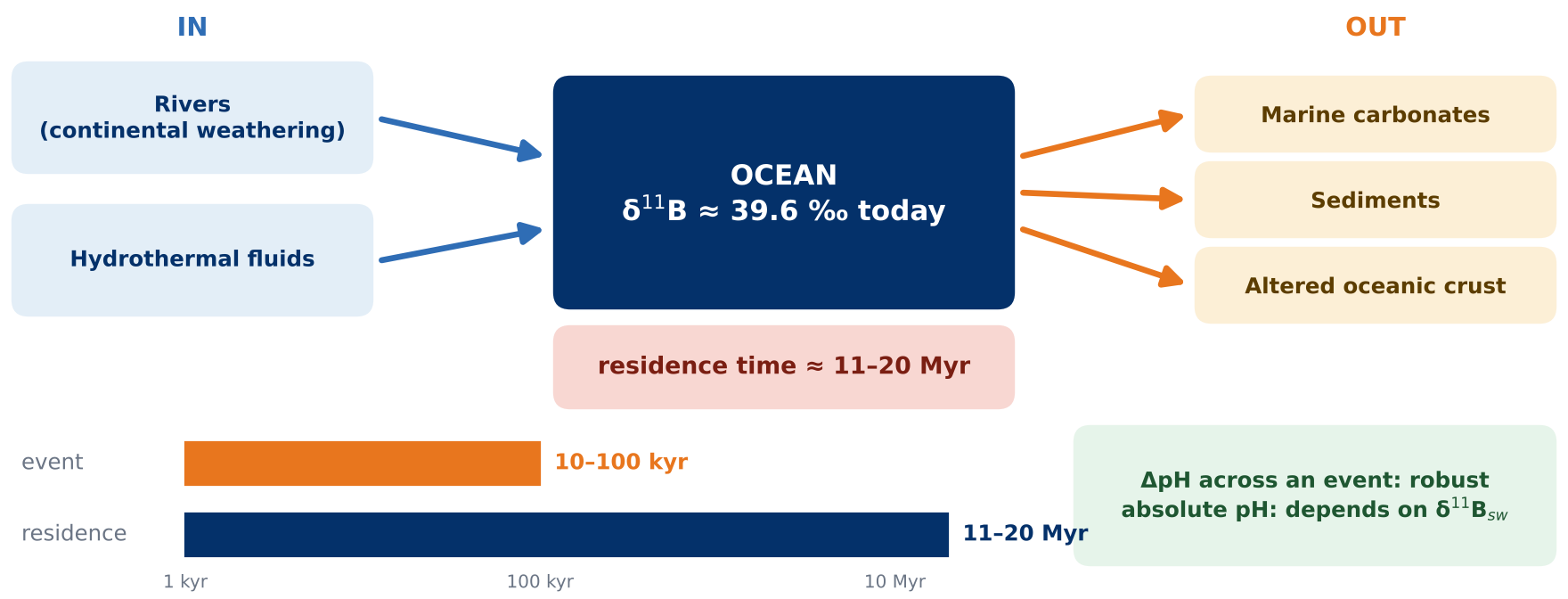
George: A partial one, and it comes from time. Boron stays in the ocean for more than ten million years. An extinction event lasts tens of thousands of years. So during the event, the seawater value could hardly change. That means the change in pH across an event is better constrained than the absolute level. Treat that as a guide, not a guarantee, as we will see.
Hannah: And the biology?
George: You need a calibration that translates the shell into seawater borate. A good study does not pick one calibration and hope. It brackets the problem with more than one. And there is an interesting asymmetry: if ancient brachiopods controlled their body fluid more strongly than assumed, the real acidification would be larger, not smaller.
Hannah: Let's go to the end of the Permian. What triggered it?
George: The leading explanation is the Siberian Traps, an enormous volcanic province in northern Asia. The key is not only the lava. Magma intruded as sills into sedimentary basins and baked them. Where it met coal, it released large amounts of isotopically light carbon, on top of the volcanic gas. Where it baked carbonates, it released carbon with a heavier composition.
Hannah: And the consequences?
George: In the lecture we follow three. First, warming. Joachimski and colleagues measured oxygen isotopes in conodonts from South China, small tooth-like fossils made of phosphate, which resists alteration better than carbonate. In the latest Permian, together with the negative carbon isotope shift and starting just before the main extinction phase, the oxygen isotope values of the conodont Hindeodus, interpreted as recording surface waters, fall by about two per mil. That is about eight degrees of warming, if you assume the seawater value.
Hannah: The same caveat as boron. A temperature from oxygen needs the water.
George: Exactly the same kind of caveat. Second, loss of oxygen. Brennecka and colleagues used uranium isotopes in carbonates from South China and found that anoxia expanded at, or slightly before, the extinction horizon. A warmer ocean holds less oxygen. And the third consequence is acidification, which is where boron comes in. The pattern also differed with latitude, from the tropics to the poles, but that is a story for the team that will present this extinction.
Hannah: Now the boron records. There are two studies.
George: Two careful studies of the same boundary that do not fully agree. That is the best training you can get. The first is Clarkson and colleagues in Science, twenty fifteen. They measured boron in marine carbonate rocks from a shallow platform in what is today the United Arab Emirates, open to the Neo-Tethys Ocean.
Hannah: And what did they find?
George: Through the first extinction pulse, the boron values stay stable. No sign of acidification. Then, near a second pulse in the earliest Triassic, they drop. The data imply a pH fall of up to about seven tenths of a unit, lasting something like ten thousand years. To produce it, their model needs a second, rapid release of about twenty-four thousand billion tonnes of carbon in about ten thousand years. That is more than all conventional fossil fuel reserves.
Hannah: One practical warning about their figure, from the lecture.
George: Yes. On their model figure, the age axis is in millions of years ago, so older ages are on the right, and time runs from right to left. If you read it the usual way, you read the story backwards.
Hannah: And the seawater value?
George: They ran two complete starting scenarios. One with low carbon dioxide and seawater at about thirty-four per mil, and one with high carbon dioxide and seawater at thirty-six point eight. And here even the size of the drop depends on the choice. The high scenario cannot reproduce a drop as large as the one they measured. That is part of why they favour the low one. So the ledger is at work right inside the paper.
Hannah: And the second study?
George: Jurikova and colleagues in Nature Geoscience, twenty twenty. Different archive: brachiopod shells, mostly from the Southern Alps of northern Italy, screened carefully for alteration. Their result is a drop of roughly half a pH unit already at the onset of the extinction, in the latest Permian. Their model needs much more carbon in total, about a hundred and five thousand billion tonnes, but that is a total from a model run of a million years, with the disturbance culminating about a hundred thousand years after the onset of the carbon isotope excursion.
Hannah: So one says the acidification came with the second pulse, and the other says at the onset. Who is right?
George: That is exactly what the assignment asks, and I will not give you the answer. But I will give you three questions. First, the archive. Bulk carbonate from a platform can recrystallise. Brachiopod calcite is more resistant, but brachiopods have their own biology. Second, the timing. Is the difference a real difference in the ocean, or a difference in what each section can resolve and how it is dated? Third, the ledger. Both depend on an assumed seawater value and on a carbon cycle model. What would one study need to have wrong for the other to be right?
Hannah: And the carbon numbers? Twenty-four thousand against a hundred and five thousand sounds like a big disagreement.
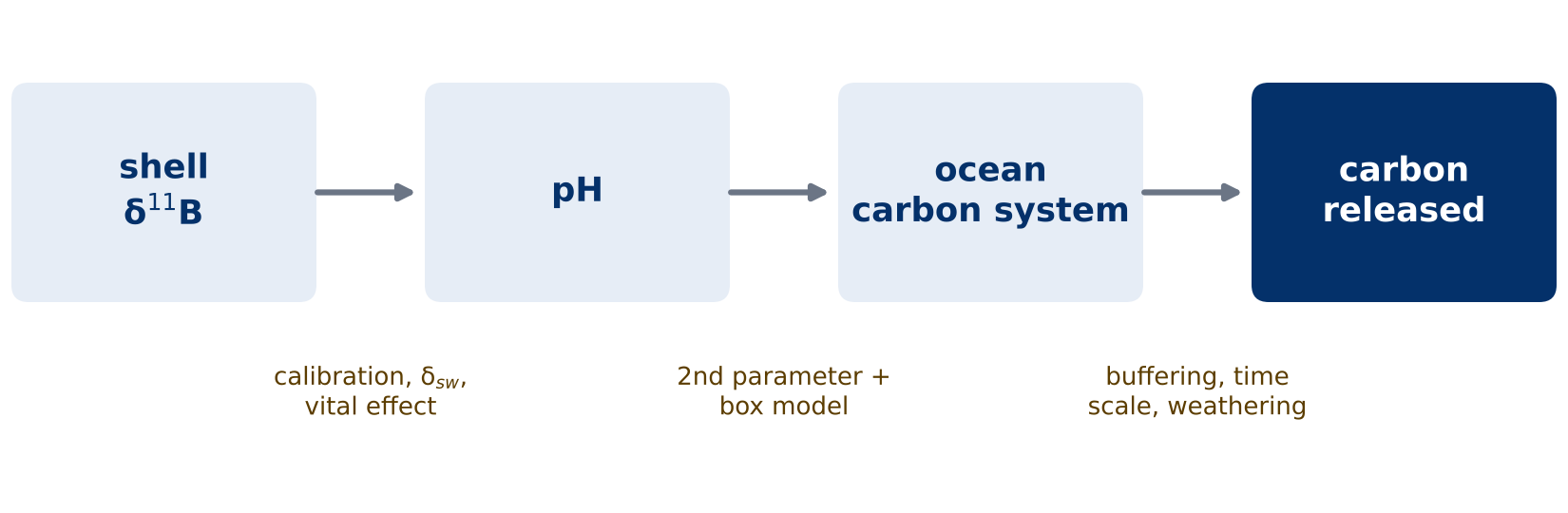
George: It sounds like one, but you cannot compare them directly. One is a pulse over about ten thousand years, the other a total from a million-year model run. And there is a deeper point. Boron gives you pH, not carbon. To go from pH to carbon you need a second parameter of the ocean's carbonate system and a model of how the ocean buffers the added carbon. Every step adds assumptions. So the pH is better constrained than the carbon.
Hannah: Let me try a summary. Carbon and oxygen isotopes tell us that carbon arrived and that the world warmed. Boron tells us what happened to the acidity of the ocean.
George: Correct.
Hannah: The shell records borate. Where seawater sits between borate and boric acid gives the proportions, and the proportions give the pH. But the seawater value is assumed, and it can move the answer by as much as the signal.
George: And the other two entries of the ledger, biology and burial, can do the same.
Hannah: And at the end of the Permian, two good studies agree that the ocean acidified, by something like half to seven tenths of a unit, but not on when, and not on how much carbon it took.
George: That is the lecture in a few lines. Read both papers, read their figures carefully, and ask what you would measure to decide between them. Next time we turn from acidity to oxygen, and to the anoxic events of the Palaeozoic and the Mesozoic.
Hannah: Thanks for listening, and see you in the next episode.
🎯 Learning objectives🎯 Lernziele
- Explain what δ¹³C and δ¹⁸O record during an extinction, and why they cannot give the pH of the oceanErklären, was δ¹³C und δ¹⁸O während eines Aussterbens aufzeichnen und warum sie den pH-Wert des Ozeans nicht liefern
- Describe boron speciation in seawater and why the δ¹¹B of borate depends on pHDie Bor-Speziation im Meerwasser beschreiben und erklären, warum δ¹¹B des Borats vom pH abhängt
- Derive the paleo-pH equation from three rules and calculate a pH from a shellDie Paläo-pH-Gleichung aus drei Regeln herleiten und aus einer Schale einen pH-Wert berechnen
- Name the three unknowns of a boron pH record: seawater δ¹¹B, vital effect, diagenesisDie drei Unbekannten einer Bor-pH-Datenreihe nennen: δ¹¹B des Meerwassers, Vitaleffekt, Diagenese
- Compare the two boron records of the end-Permian ocean and say what each would need to have wrong for the other to be rightDie beiden Bor-Datenreihen zum Ozean am Ende des Perm vergleichen und sagen, was bei der einen falsch sein müsste, damit die andere stimmt
Assignment 5:Übungsaufgabe 5: will be added to this page.wird auf dieser Seite ergänzt.
1. Carbon and oxygen first1. Zuerst Kohlenstoff und Sauerstoff
Every extinction study starts with carbon and oxygen isotopes. The end-Ordovician and the end-Permian crises have opposite signs: cooling and a positive δ¹³C excursion in the Ordovician, warming and a negative δ¹³C excursion at the end of the Permian, when a large amount of isotopically light carbon entered the ocean and atmosphere. Carbon and oxygen tell us that carbon arrived and that the world warmed. They do not tell us how the acidity of the ocean responded. That is the job of boron.Jede Aussterbe-Studie beginnt mit Kohlenstoff- und Sauerstoffisotopen. Die Krisen am Ende des Ordoviziums und des Perm haben entgegengesetzte Vorzeichen: Abkühlung und eine positive δ¹³C-Exkursion im Ordovizium, Erwärmung und eine negative δ¹³C-Exkursion am Ende des Perm, als viel isotopisch leichter Kohlenstoff in Ozean und Atmosphäre gelangte. Kohlenstoff und Sauerstoff zeigen, dass Kohlenstoff kam und die Welt sich erwärmte. Wie die Säure des Ozeans reagierte, zeigen sie nicht. Das ist die Aufgabe von Bor.
2. Two forms of boron, one switch2. Zwei Formen von Bor, ein Schalter
Dissolved boron exists as boric acid, B(OH)₃, and as the borate ion, B(OH)₄⁻. Their balance is set by pH. Half and half is reached at pKB ≈ 8.60 (25 °C, salinity 35). At today's pH of about 8.1, roughly a quarter of the boron is borate.Gelöstes Bor liegt als Borsäure, B(OH)₃, und als Borat-Ion, B(OH)₄⁻, vor. Ihr Verhältnis wird vom pH bestimmt. Halb und halb ist bei pKB ≈ 8,60 erreicht (25 °C, Salinität 35). Beim heutigen pH von etwa 8,1 ist rund ein Viertel des Bors Borat.
The heavy isotope ¹¹B prefers boric acid, so the two forms differ by about 27 ‰ (fractionation factor α = 1.0272, Klochko et al., 2006). The working assumption, going back to Hemming & Hanson (1992), is that borate is what enters the carbonate. Because the share of borate changes with pH, so does its δ¹¹B, and the shell records it.Das schwere Isotop ¹¹B bevorzugt die Borsäure, daher unterscheiden sich die beiden Formen um etwa 27 ‰ (Fraktionierungsfaktor α = 1,0272, Klochko et al., 2006). Die Arbeitsannahme, die auf Hemming & Hanson (1992) zurückgeht, ist, dass Borat in das Karbonat eingebaut wird. Weil sich der Boratanteil mit dem pH ändert, ändert sich auch sein δ¹¹B, und die Schale zeichnet es auf.
3. From shell to pH: the lever3. Von der Schale zum pH: der Hebel
Three rules give the equation. (1) The ratio of borate to boric acid is 10pH − pKB. (2) Seawater is the share-weighted mixture of the two species. (3) Boric acid sits a fixed offset above borate: δ₃ + 1000 = α (δ₄ + 1000). On a δ¹¹B number line, seawater lies between borate and boric acid like the balance point of a lever. With a = δsw − δ₄ and b = δ₃ − δsw, the share of boric acid divided by the share of borate is a / b, andDrei Regeln ergeben die Gleichung. (1) Das Verhältnis von Borat zu Borsäure ist 10pH − pKB. (2) Meerwasser ist die nach Anteilen gewichtete Mischung beider Spezies. (3) Borsäure liegt um einen festen Abstand über Borat: δ₃ + 1000 = α (δ₄ + 1000). Auf einer δ¹¹B-Zahlengeraden liegt Meerwasser zwischen Borat und Borsäure wie der Drehpunkt eines Hebels. Mit a = δsw − δ₄ und b = δ₃ − δsw ist der Anteil der Borsäure geteilt durch den Anteil des Borats gleich a / b, und
4. Same shell, three oceans4. Dieselbe Schale, drei Ozeane
A shell of 14.5 ‰ gives pH 7.60 if seawater was 39.61 ‰ (modern), 7.98 if it was 36.8 ‰ and 8.22 if it was 34 ‰. The measurement is identical; only the assumed seawater value changed, and it moves the pH by more than half a unit. The sensitivity of the proxy is about 16 ‰ per pH unit at pKB, about 11 at pH 8.1 and only about 5 at pH 7.6: an acidified ocean sits where the instrument is weakest.Eine Schale mit 14,5 ‰ ergibt pH 7,60, wenn das Meerwasser 39,61 ‰ hatte (heute), 7,98 bei 36,8 ‰ und 8,22 bei 34 ‰. Die Messung ist dieselbe; nur der angenommene Meerwasserwert ändert sich, und er verschiebt den pH um mehr als eine halbe Einheit. Die Empfindlichkeit des Proxys beträgt etwa 16 ‰ pro pH-Einheit bei pKB, etwa 11 bei pH 8,1 und nur etwa 5 bei pH 7,6: Ein versauerter Ozean liegt dort, wo das Instrument am schwächsten ist.
5. The ledger of unknowns5. Die Liste der Unbekannten
Seawater δ¹¹B. It is set by the balance of rivers and hydrothermal input against carbonates, sediments and altered oceanic crust. Boron stays in the ocean for roughly 11–20 million years (Jurikova et al., 2020), so seawater drifts over tens of millions of years but hardly changes during an event of tens of thousands of years. The change in pH across an event is therefore better constrained than the absolute level: a guide, not a guarantee.δ¹¹B des Meerwassers. Er ergibt sich aus dem Gleichgewicht von Flüssen und hydrothermalem Eintrag gegenüber Karbonaten, Sedimenten und alterierter ozeanischer Kruste. Bor bleibt etwa 11–20 Millionen Jahre im Ozean (Jurikova et al., 2020), daher driftet das Meerwasser über zig Millionen Jahre, ändert sich aber während eines Ereignisses von Zehntausenden von Jahren kaum. Die pH-Änderung über ein Ereignis ist daher besser bestimmt als der absolute Wert: eine Richtschnur, keine Garantie.
Biology and burial. Organisms build their shells from a body fluid they regulate (vital effect), so a calibration is needed; Jurikova et al. (2020) bracket it with two scenarios. After burial, carbonate can dissolve and reprecipitate with boron from pore water of a different pH (diagenesis); brachiopod calcite can be screened, bulk carbonate is more exposed.Biologie und Versenkung. Organismen bauen ihre Schalen aus einer Körperflüssigkeit, die sie regulieren (Vitaleffekt), daher ist eine Kalibrierung nötig; Jurikova et al. (2020) grenzen sie mit zwei Szenarien ein. Nach der Versenkung kann Karbonat gelöst und mit Bor aus Porenwasser anderen pH-Werts neu gefällt werden (Diagenese); Brachiopodenkalzit lässt sich prüfen, Gesamtgesteinskarbonat ist anfälliger.
6. The end-Permian ocean6. Der Ozean am Ende des Perm
About 252 million years ago, sills of the Siberian Traps intruded sedimentary basins; where they baked coal, they released isotopically light carbon. In South China, δ¹⁸O of the conodont Hindeodus falls by about 2 ‰ in the latest Permian, together with the negative δ¹³C shift and starting just before the main extinction phase: about 8 °C of warming, assuming a Permian seawater δ¹⁸O (Joachimski et al., 2012). Uranium isotopes show that anoxia expanded at, or slightly before, the extinction horizon (Brennecka et al., 2011). Boron adds the third stress: acidification.Vor etwa 252 Millionen Jahren drangen Lagergänge der Sibirischen Trapps in Sedimentbecken ein; wo sie Kohle erhitzten, setzten sie isotopisch leichten Kohlenstoff frei. In Südchina sinkt δ¹⁸O des Conodonten Hindeodus im jüngsten Perm um etwa 2 ‰, zusammen mit der negativen δ¹³C-Verschiebung und kurz vor Beginn der Hauptphase des Aussterbens: etwa 8 °C Erwärmung bei angenommenem δ¹⁸O des permischen Meerwassers (Joachimski et al., 2012). Uranisotope zeigen, dass sich Anoxie am oder kurz vor dem Aussterbehorizont ausbreitete (Brennecka et al., 2011). Bor fügt den dritten Stressfaktor hinzu: Versauerung.
Clarkson et al. (2015), Science. Bulk marine carbonate from Wadi Bih (Musandam, U.A.E.), a platform open to the Neo-Tethys. δ¹¹B is stable through the first extinction pulse and drops near the second, in the earliest Triassic: a pH fall of up to about 0.7 lasting about 10 kyr, which their model explains with about 24,000 Pg C released in about 10 kyr. Their two starting scenarios (seawater δ¹¹B ≈ 34 ‰ or 36.8 ‰) differ even in the size of the drop they can produce. Note: the age axis of their model figure (Fig. 2) has older ages to the right.Clarkson et al. (2015), Science. Marines Gesamtgesteinskarbonat aus dem Wadi Bih (Musandam, VAE), einer zur Neotethys offenen Plattform. δ¹¹B bleibt über den ersten Aussterbepuls stabil und fällt nahe dem zweiten in der frühesten Trias: ein pH-Abfall von bis zu etwa 0,7 für etwa 10 ka, den ihr Modell mit etwa 24.000 Pg C in etwa 10 ka erklärt. Ihre zwei Ausgangsszenarien (δ¹¹B des Meerwassers ≈ 34 ‰ oder 36,8 ‰) unterscheiden sich sogar in der Größe des Abfalls, den sie erzeugen können. Achtung: Auf der Altersachse ihrer Modellabbildung (Abb. 2) liegen ältere Alter rechts.
Jurikova et al. (2020), Nature Geoscience. Brachiopods, mainly from three sections in the Southern Alps, screened for diagenesis. A pH drop of roughly 0.5 at the onset of the extinction in the latest Permian. Their model needs about 105,600 Pg C in total over a 1-Myr model run, with the perturbation culminating about 100 kyr after the onset of the carbon isotope excursion.Jurikova et al. (2020), Nature Geoscience. Brachiopoden, überwiegend aus drei Profilen der Südalpen, auf Diagenese geprüft. Ein pH-Abfall von rund 0,5 zu Beginn des Aussterbens im jüngsten Perm. Ihr Modell benötigt insgesamt etwa 105.600 Pg C über einen Modelllauf von 1 Ma, mit dem Höhepunkt der Störung etwa 100 ka nach Beginn der Kohlenstoffisotopen-Exkursion.
Both records point to acidification of about 0.5 to 0.7 pH units linked to carbon release. They differ in timing and in the carbon required. Three questions: which archive is more robust, and what would you check? Is the timing difference a difference in the ocean or in what each section resolves and how it is dated? What would one study need to have wrong for the other to be right?Beide Datenreihen deuten auf eine Versauerung von etwa 0,5 bis 0,7 pH-Einheiten im Zusammenhang mit Kohlenstofffreisetzung. Sie unterscheiden sich im Zeitpunkt und in der benötigten Kohlenstoffmenge. Drei Fragen: Welches Archiv ist robuster, und was würden Sie prüfen? Ist der zeitliche Unterschied einer im Ozean oder einer in dem, was jedes Profil auflöst und wie es datiert ist? Was müsste an der einen Studie falsch sein, damit die andere stimmt?
7. pH is not carbon7. pH ist nicht Kohlenstoff
Boron gives pH. To get to the carbon released you need a second carbonate-system parameter and a model of how the ocean buffers the carbon. Each step adds assumptions, so 24,000 and 105,600 Pg C are not directly comparable: one is a 10-kyr pulse, the other a total from a 1-Myr model run.Bor liefert den pH. Um zur freigesetzten Kohlenstoffmenge zu kommen, braucht man einen zweiten Parameter des Karbonatsystems und ein Modell, wie der Ozean den Kohlenstoff puffert. Jeder Schritt bringt Annahmen mit sich, daher sind 24.000 und 105.600 Pg C nicht direkt vergleichbar: das eine ist ein Puls von 10 ka, das andere eine Summe aus einem Modelllauf von 1 Ma.
📚 References and further reading📚 Literatur und weiterführende Lektüre
- Brenchley, P.J. et al. (1994) Bathymetric and isotopic evidence for a short-lived Late Ordovician glaciation in a greenhouse period. Geology 22, 295–298.
- Brennecka, G.A. et al. (2011) Rapid expansion of oceanic anoxia immediately before the end-Permian mass extinction. PNAS 108, 17631–17634.
- Clarkson, M.O. et al. (2015) Ocean acidification and the Permo-Triassic mass extinction. Science 348, 229–232.
- Finnegan, S. et al. (2011) The magnitude and duration of Late Ordovician–Early Silurian glaciation. Science 331, 903–906.
- Hemming, N.G. & Hanson, G.N. (1992) Boron isotopic composition and concentration in modern marine carbonates. Geochimica et Cosmochimica Acta 56, 537–543.
- Joachimski, M.M. et al. (2012) Climate warming in the latest Permian and the Permian–Triassic mass extinction. Geology 40, 195–198.
- Jurikova, H. et al. (2020) Permian–Triassic mass extinction pulses driven by major marine carbon cycle perturbations. Nature Geoscience 13, 745–750.
- Klochko, K. et al. (2006) Experimental measurement of boron isotope fractionation in seawater. Earth and Planetary Science Letters 248, 276–285.