Read the transcriptTranskript lesen
Cold open
Hannah: Here's a question to get us started. The water in the bottle on your desk. Where did it fall as rain?
George: It sounds like a riddle, but the water itself can partly answer it. Rain that fell on the Atlantic coast, rain that fell high in the Alps, snow that fell on Greenland: each carries a slightly different mix of heavy and light atoms. A fingerprint.
Hannah: By the end of this episode, you'll know how to read that fingerprint, and why the same idea lets geologists measure the temperature of oceans that disappeared millions of years ago.
George: Welcome to the Sedimentary Geochemistry podcast. This is the companion to Module One, introduction to stable isotopes. I'm George.
Hannah: And I'm Hannah. This episode follows the first lecture. Listen to it on the train, while cooking, or before you tackle the exercises in the module. We'll keep the numbers light and the ideas clear. The exact values are all in the module, whenever you need them.
George: The plan is simple. First, the three warm-up calculations from the first week, because they matter more than they look. Then the fundamentals: what an isotope is, and why nature separates them. Then the language we use: delta, standards, alpha. And finally, water: how rain gets its isotopic fingerprint.
Why bother?
Hannah: Before anything else, let's answer the question many of you are probably asking. You signed up for a course about ancient oceans and mass extinctions. Why are we starting with subtraction and Greek letters?
George: Because every dramatic story in this course is written in this language. Later in the semester you'll look at the Permian–Triassic extinction and the Paleocene–Eocene Thermal Maximum. In both cases, the key evidence is a curve of carbon and oxygen isotopes through a stack of rocks.
Hannah: When a carbon isotope curve drops by several per mil at a boundary, that drop is usually read as a sign of a major disturbance of the carbon cycle, often a large release of isotopically light carbon into the oceans and the atmosphere. And part of this course is learning how to test that reading.
George: So think of today as learning the alphabet. Once you know it, those curves start to read like sentences.
Warm-up one: the size and sign of a change
Hannah: Let's start with the warm-ups. The first one: a carbon isotope value falls from a positive value to a negative one across a boundary. How big is the change, and in which direction?
George: The trick is to start with a definition, not with numbers. A change is always the final value minus the initial value. Final minus initial. Always in that order.
Hannah: Then put each value in brackets, with its sign. It looks fussy, but it's the habit that saves you. Minus a positive number becomes a minus, the two negatives add up, and you get a negative change of three and a half per mil.
George: And then the most important step: check that the answer makes sense. The value went down, so the change must be negative. Geologists would call this a negative carbon isotope excursion.
Hannah: If you got a positive answer, you reversed the order. If you got a much smaller number, you probably lost a sign along the way. Slips exactly like these cost students real points in last year's exam.
George: So this isn't about whether you can subtract. It's about whether you can subtract under exam pressure, with negative numbers, without slipping. Practice makes that automatic.
Warm-up two: mixing
Hannah: The second warm-up: you mix a smaller volume of isotopically light water with a larger volume of heavier water. What is the isotope value of the mixture?
George: The tempting answer is to average the two numbers. But that's only correct if the volumes are equal. Each water contributes in proportion to how much of it there is. So it's a weighted average.
Hannah: Multiply each value by its volume, add them up, and divide by the total volume. The answer lands at minus two point eight per mil.
George: And here's the habit we really want you to build. A mixture must always lie between its two ingredients, and closer to the one there's more of. If your answer falls outside that range, something has gone wrong. This one check catches an enormous number of errors.
Hannah: Keep this calculation in mind, because you'll meet it again and again. Mixing water masses in the ocean. Adding volcanic carbon to seawater during an extinction. They're all the same weighted average, just with bigger numbers.
Warm-up three: per mil
George: The third warm-up is the sneaky one. An isotope ratio changes very slightly, in the fourth decimal place. You're asked to express that change in per mil.
Hannah: Divide the new ratio by the old one. Subtract one, to keep only the change. Multiply by a thousand. And you get a nice, readable number: about plus nine per mil.
George: Notice what just happened. A change that was almost invisible as a raw number became a comfortable, readable value. That's exactly why isotope geochemists work in per mil.
Hannah: And here's the twist. Call the reference ratio "the standard". Call your answer "delta". And you've just used the delta notation. You did isotope geochemistry before anyone told you what it was called.
What is an isotope?
George: Let's build the foundations. An atom's nucleus contains protons and neutrons. The number of protons decides which element it is. Eight protons means oxygen. Always.
Hannah: But the number of neutrons can vary. Oxygen sixteen has eight protons and eight neutrons. Oxygen eighteen has eight protons and ten neutrons. Same element, different mass. Those are isotopes.
George: Because the electrons are the same, the chemistry is essentially the same. Oxygen eighteen still makes water, still makes carbonate, still does everything oxygen does. It's just a little heavier.
Hannah: And that tiny mass difference is the whole story of this course. A heavier atom vibrates a little more slowly, holds onto its bonds a little more tightly, and moves a little more sluggishly. Those small differences add up to measurable signals in rocks.
George: One more important word: stable. The isotopes we use don't decay. That's why a shell that grew two hundred and fifty million years ago can still carry the oxygen isotope signature of the sea it lived in.
Hannah: Provided nothing has changed it since. Keep that question mark in your head. Rocks get buried, heated and soaked in other fluids. Whether the original signal survived is the topic of a later lecture, on diagenesis.
Hydrogen and a Nobel Prize
George: Hydrogen is the extreme example. Ordinary hydrogen has just one proton. Deuterium has a proton and a neutron, so it's twice as heavy. Tritium has two neutrons, three times as heavy.
Hannah: Doubling the mass is a massive relative difference. No other element comes close. That's why hydrogen isotopes show the largest fractionations in nature.
George: Deuterium has a great backstory. It was discovered in the early nineteen-thirties by the American chemist Harold Urey and his colleagues. Urey received the Nobel Prize in chemistry for it in nineteen thirty-four.
Hannah: And Urey matters to this course for a second reason. In nineteen forty-seven he realised that the oxygen isotope composition of a carbonate shell should depend on the temperature of the water it grew in. That idea is the birth of isotope paleothermometry, the technique of reading past temperatures from shells.
George: His group in Chicago then turned that idea into a working method. And in nineteen fifty-five, one of his former colleagues, Cesare Emiliani, used it on tiny fossil shells from deep-sea cores and found that there had been many more glacial and interglacial cycles than geologists had thought. We'll come back to that story next week, because it has a twist.
Hannah: Tritium, by the way, is radioactive, with a half-life of about twelve years. Nuclear bomb tests in the nineteen fifties and sixties released a pulse of it into the water cycle, and hydrologists still use it to recognise young groundwater. But it's useless for deep time, so in this course we stick to deuterium.
Why light elements?
George: Here's a question worth thinking about. Uranium two thirty-eight has three more neutrons than uranium two thirty-five. Oxygen eighteen has only two more than oxygen sixteen. So which pair should fractionate more?
Hannah: The intuitive answer is uranium, since it has more extra neutrons. But it's the other way round. What matters is the relative mass difference, not the absolute one.
George: Two extra neutrons on an oxygen atom make it twelve and a half percent heavier. Three extra neutrons on a uranium atom make it barely more than one percent heavier.
Hannah: That's why the classic stable isotope systems are light elements: hydrogen, boron, carbon, oxygen and sulfur. Their relative mass differences are large enough to fractionate measurably at the temperatures of Earth's surface.
George: Heavy elements like strontium and neodymium mostly vary because of radioactive decay rather than fractionation. Later in the course we use them as tracers of where sediment and water came from.
Hannah: And uranium is the rebel. It does fractionate, despite its mass, through a different mechanism called the nuclear volume effect. That's the topic of the last lecture of the semester. So the chart in the module is actually a map of the whole course.
Rare means really rare
George: Another thing to appreciate is how rare the heavy isotopes are. Oxygen eighteen is about two atoms in every thousand oxygen atoms. Deuterium is one or two hydrogen atoms in every ten thousand.
Hannah: Here's an analogy, just to picture it. Imagine a stadium of ten thousand people, with one or two wearing red shirts. Isotope geochemistry is noticing that one stadium has slightly more red shirts than another.
George: And natural processes change those tiny fractions only in the third or fourth significant figure. So we need a notation that magnifies small differences. That's delta, and we'll get to it shortly.
Hannah: One more useful word: isotopologue. It means molecules that differ only in their isotopic composition. Ordinary water, water with oxygen eighteen, water with a deuterium atom. They're all water, just different isotopologues. You'll need that word in the clumped isotope lecture.
Why does nature separate isotopes?
George: Now the big question. If the chemistry is the same, why would nature ever separate isotopes?
Hannah: Because the physics isn't quite the same. Take water. Heavy water, made with deuterium, actually boils at a slightly higher temperature than normal water, freezes a few degrees above zero, and is about ten percent denser.
George: For our purposes, the key property is vapour pressure. Water containing oxygen eighteen is slightly less eager to evaporate. Its vapour pressure is just under one percent lower than that of ordinary water.
Hannah: And that tiny difference has a big consequence. Water vapour above the ocean is roughly ten per mil lighter in oxygen eighteen than the water it came from.
George: Remember that sentence. Vapour is about ten per mil lighter than the water it comes from. It's the engine behind the whole last part of this episode.
Hannah: There's a nice way to picture why. Atoms in a molecule are always vibrating, a bit like balls on springs. A heavier ball on the same spring vibrates more slowly and sits a little deeper in its energy well. So it takes slightly more energy to pull it free, whether that means breaking a chemical bond or escaping from liquid into vapour.
Two kinds of fractionation
George: Isotope separation in nature comes in two main flavours. Kinetic and equilibrium.
Hannah: Kinetic fractionation happens in fast, one-way, incomplete processes. Evaporation into dry air. Diffusion. Most biological reactions. Light molecules move or react faster, so the products end up light.
George: An analogy: imagine a crowd leaving a stadium through a narrow exit. The quicker people get out first. If you stop the flow halfway, the people outside are mostly the quick ones. That's an incomplete kinetic process.
Hannah: How much faster are light molecules? For carbon dioxide, the light version moves only about one percent faster than the version containing carbon thirteen. One percent sounds tiny, but it's enough to leave a clear signal.
George: The other kinetic mechanism is bond breaking. Bonds to heavy isotopes are slightly stronger, so reactions that break bonds prefer the light isotope. Photosynthesis prefers carbon twelve, which is why organic matter is isotopically light. Bacteria reducing sulfate prefer sulfur thirty-two, which is why pyrite in sediments can be very depleted.
Hannah: Equilibrium fractionation is different. Here isotopes swap back and forth between two substances, for example between carbon dioxide and water, until they settle into a stable distribution. The heavy isotope ends up where it forms the strongest bond.
George: Our analogy here is people choosing seats over a long evening. Everyone keeps moving, but over time the heavier people end up in the comfiest chairs. Not because they're faster, but because that's where they're most stable.
Hannah: And here's the crucial part. The size of the equilibrium fractionation depends on temperature. The warmer it is, the smaller the effect, because all molecules have so much energy that the small differences matter less.
George: That's what turns isotopes into thermometers. Measure the fractionation between a shell and the water it grew in, and you can work out the temperature. So the rule of thumb is: equilibrium effects give us thermometers, kinetic effects give us process tracers.
The delta notation
Hannah: Now the language. And the good news is that you've already used it in the warm-up.
George: An isotope ratio, called R, is always the heavy isotope divided by the light one. Delta compares the ratio of a sample with the ratio of a standard. You divide one by the other, subtract one, and multiply by a thousand. The result is in per mil.
Hannah: Why not just report the ratio? Because the instruments, gas mass spectrometers, are brilliant at comparing a sample with a reference gas, switching back and forth between them, but much less precise at measuring absolute ratios. So we report what the machine does best: comparisons.
George: Reading delta values is easy once you get used to it. A positive delta means the sample has more of the heavy isotope than the standard. We say it's enriched, or heavier. A negative delta means it's depleted, or lighter.
Hannah: And a common trap: when everything is negative, students mix up the direction. Minus five is heavier than minus ten. More positive means heavier. More negative means lighter. Draw that arrow in your notes.
George: And a negative delta doesn't mean a negative amount of anything. It just means less heavy isotope than in the standard.
Hannah: Which brings us to the golden rule of this course. A delta value means nothing without its standard. Always write it.
George: Against what? That's the question to ask every time you see a delta value.
Two standards and a fossil
Hannah: For oxygen, there are two standards. For water, we use V-SMOW, Vienna Standard Mean Ocean Water. For carbonates, we use V-P-D-B, and carbon isotopes are always reported against V-P-D-B as well.
George: And P-D-B has a great story. It stands for Pee Dee Belemnite. A belemnite is a fossil from an extinct squid-like animal. This one came from the Cretaceous Peedee Formation in South Carolina, and Urey's group used it as their reference material in the early nineteen-fifties.
Hannah: The problem is that a single fossil eventually runs out. The original was used up. So the International Atomic Energy Agency in Vienna coordinated replacement reference materials that tie back to the original scale. That's where the V for Vienna comes from.
George: Which means every carbon isotope value you'll ever read is ultimately measured against an extinct animal from South Carolina.
Hannah: The practical point is that the two scales are offset by about thirty per mil. Seawater sits at zero on the water scale, but at about minus thirty on the carbonate scale. And the conversion isn't just a shift, there's a small scale factor too. The exact equations are in the module, along with a converter you can play with.
George: And the warning that comes with it: never put a number from one scale and a number from the other into the same equation without converting first. That mistake cost students points last year.
Alpha and its shortcuts
Hannah: The last piece of notation is alpha, the fractionation factor. It's simply the isotope ratio in one substance divided by the ratio in another. For example, calcite and the water it grew in.
George: Alpha values are always very close to one. Something like one point zero two eight. That might look like almost nothing, but it's actually a big fractionation, about twenty-eight per mil.
Hannah: The worked example in the module uses calcite growing in seawater at twenty-five degrees, with the calibration of Kim and O'Neil from nineteen ninety-seven. If you follow it through, warm-water calcite ends up slightly negative on the carbonate scale, about minus two point four per mil.
George: And a confession worth making. Last year's material gave an alpha value for twenty-five degrees that was wrong. It was one point zero three one, which happens to be the scale factor between the two standards. It's a good example of how easily numbers from the two scales get mixed up. The module now has the corrected value.
Hannah: Because alpha values are awkward to say, we use shortcuts. Epsilon is alpha minus one, times a thousand. The simple difference between two delta values is called capital Delta. And calibrations are usually written as one thousand times the natural logarithm of alpha.
George: For small fractionations, all three are almost the same. For the large fractionations between minerals and water, the differences reach a few tenths of a per mil, which is about a degree of temperature. So for those, use the exact equations.
Hannah: One last sense of scale, which is worth remembering. For carbonate oxygen isotopes, a change of one per mil corresponds to roughly four to five degrees of temperature, if the water stays the same.
From the ocean to the continent
George: Now for the fun part. Let's follow some water on a journey.
Hannah: Start over the ocean. Seawater sits at about zero per mil. When it evaporates, the vapour is lighter, because the heavy molecules are a bit reluctant to leave. Remember: roughly ten per mil lighter, sometimes a bit more when the air is dry.
George: The air mass drifts towards land and cools, and the first rain forms. Rain condenses in equilibrium with the vapour, so the heavy isotopes condense preferentially. The first rain is heavier than the vapour it formed from.
Hannah: But think about what that means for the vapour left behind. It has just lost some of its heavy isotopes. So it gets lighter.
George: And the next rain forms from this lighter vapour, so it's lighter too. And the vapour left after that is lighter still. The further the air mass travels, and the more it rains, the lighter everything gets.
Hannah: There's a lovely story about this. The Danish physicist Willi Dansgaard, as he tells it in his memoir, wanted to know whether rain changes its isotopic composition during a single storm. So on a Saturday in June nineteen fifty-two, as a weather front approached Copenhagen, he put a beer bottle with a funnel in his garden and emptied it every hour or two while the front passed.
George: And he found that the isotopic composition of the rain changed systematically as the front passed over. He went on to map isotopes in rain around the world, and later became a pioneer of Greenland ice core research. All starting from beer bottles on a lawn.
Rayleigh distillation
Hannah: The process we just described has a name: Rayleigh distillation. It happens whenever a reservoir loses material bit by bit, each bit leaves with a constant fractionation relative to what remains, and is then gone for good.
George: The shape of the curve is the key insight. At first, as rain falls, the vapour changes slowly. But as the reservoir runs low, the values plunge. The last little bit of vapour is extremely depleted.
Hannah: An analogy we like: wringing out a wet towel. The first squeezes release water easily. The last drops take more and more effort. The end of the process is where things get extreme.
George: In the module there's an interactive chart where you can drag a slider and watch the vapour and the rain evolve as an air mass rains out. Try it. It makes the idea click.
Hannah: And Rayleigh distillation isn't just about rain. It's one of the most useful ideas in the course. When bacteria use up sulfate in a restricted basin, the remaining sulfate becomes heavier and heavier along the same kind of curve. You'll meet it again in the sulfur lecture.
The meteoric water line
George: Here's something remarkable. If you collect rain from all over the world and plot its deuterium value against its oxygen eighteen value, the points fall on a nearly straight line.
Hannah: It's called the global meteoric water line, described by Harmon Craig in nineteen sixty-one. The deuterium value is about eight times the oxygen value, plus ten.
George: Warm tropical rain sits at one end of the line, the upper right. Cold polar snow sits at the other end, the lower left. That's Rayleigh distillation again, written into a straight line.
Hannah: The intercept of about ten is the global average deuterium excess, and it carries information about the conditions where the water first evaporated.
George: And the line is also a detective tool. Water that has evaporated after it fell, in a lake for example, drifts below the line on a shallower slope. So if you find water plotting below the line, you can suspect evaporation.
Five effects, one cause
Hannah: Scientists describe five effects that control the isotopes of rain. Let's go through them quickly, and for each one, ask yourself the same question: how much vapour has already rained out, and how cold is it?
George: The temperature effect: colder places get lighter rain. At mid and high latitudes, roughly half to three quarters of a per mil per degree.
Hannah: The latitude effect: rain gets lighter towards the poles. The snow on the Greenland and Antarctic ice sheets is the most depleted water on Earth, because those air masses have travelled furthest and rained out most.
George: The continental effect: rain gets lighter as you move inland. Across Europe, from the Atlantic coast towards Russia, you can see the values steadily dropping as Atlantic air rains out.
Hannah: The altitude effect: rain gets lighter as you go up a mountain, because rising air cools and rains out. Typically a few tenths of a per mil per hundred metres. Geologists use this to estimate how high ancient mountain ranges were. It's called paleoaltimetry.
George: And the amount effect, which is the odd one out. In the tropics and in monsoon regions, the heaviest downpours give the lightest rain. In monsoon cities like New Delhi or Hong Kong, the wettest months have the most depleted rain, even though they are among the warmest months of the year. That's the opposite of what the temperature effect would predict.
Hannah: That's a classic trap. In tropical and monsoon records, oxygen isotopes mostly track rainfall, not temperature. Use a mid-latitude temperature rule there and you'll get nonsense.
George: Put all five together and you get a global map, like the one by Bowen and Wilkinson in the module. Highs in the tropics, lows at the poles, inland and up in the mountains. It's our modern baseline for interpreting ancient records.
Wrap-up
Hannah: Let's wrap up with five things to take away.
George: One. Isotopes of the same element differ only in mass, and mass is what separates them. Light elements fractionate most.
Hannah: Two. Kinetic fractionation is fast and one-way and gives us process tracers. Equilibrium fractionation depends on temperature and gives us thermometers.
George: Three. The notation: R, delta, alpha, epsilon. And always ask: against what? V-SMOW or V-P-D-B.
Hannah: Four. Evaporation makes light vapour, rain takes the heavy isotopes first, and so every later rain is lighter. That's Rayleigh distillation.
George: Five. That single process explains the temperature, latitude, continental, altitude and amount effects.
Hannah: Your homework is light. Copy the five key equations from the module onto one sheet of paper. That sheet will be on your desk for every assignment this semester. Then try the quiz at the end of the module.
George: And a question to think about before next week. The ice sheets store the lightest water on the planet. So when ice sheets grow during an ice age, what happens to the isotopic composition of the ocean left behind?
Hannah: Hold on to your answer. We'll find out next week.
George: Thanks for listening. See you in class.
🎯 Learning objectives🎯 Lernziele
- Calculate the size and sign of an isotopic change, a two-component mixture and a per mil value without sign errorsGröße und Vorzeichen einer Isotopenänderung, eine Zweikomponentenmischung und einen Promillewert ohne Vorzeichenfehler berechnen
- Explain what isotopes are and why light elements fractionate mostErklären, was Isotope sind und warum leichte Elemente am stärksten fraktionieren
- Distinguish kinetic from equilibrium fractionation and give examples of eachKinetische von Gleichgewichtsfraktionierung unterscheiden und Beispiele nennen
- Use δ, α, ε and 10³ ln α, and convert between the VSMOW and VPDB scalesδ, α, ε und 10³ ln α anwenden und zwischen VSMOW- und VPDB-Skala umrechnen
- Explain Rayleigh distillation and the five effects that control δ¹⁸O of precipitationDie Rayleigh-Destillation und die fünf Effekte erklären, die δ¹⁸O im Niederschlag steuern
Hinweis: In Formeln, Tabellen und Rechnern wird der Dezimalpunkt verwendet.
1. Warm-up: the three calculations, with solutions1. Aufwärmübungen: die drei Rechnungen mit Lösungen
These three calculations look simple. Last year, many exam points were lost to slips of exactly this kind rather than to geological misunderstandings. Try each one yourself first, then reveal the solution step by step.Diese drei Rechnungen sehen einfach aus. Im letzten Jahr gingen viele Klausurpunkte durch genau solche Fehler verloren, nicht durch geologische Missverständnisse. Rechnen Sie jede Aufgabe zuerst selbst, und decken Sie dann die Lösung Schritt für Schritt auf.
- Step 1Schritt 1 · A change is always final minus initialEine Änderung ist immer Endwert minus AnfangswertΔ = δ(final) − δ(initial)
- Step 2Schritt 2 · Insert the values with their signs, in bracketsWerte mit Vorzeichen in Klammern einsetzenΔ = (−1.1) − (+2.4)
- Step 3Schritt 3 · Subtracting a positive number: −(+2.4) = −2.4Minus vor einer positiven Zahl ergibt Minus: −(+2,4) = −2,4Δ = −1.1 − 2.4
- Step 4Schritt 4 · Add the two negative numbersDie beiden negativen Zahlen addierenΔ = −3.5 ‰
- Step 5Schritt 5 · Check: the value went down, so the change must be negative. Typical errors: +3.5 (order reversed), −1.3 (sign lost)Kontrolle: Der Wert sank, also muss die Änderung negativ sein. Typische Fehler: +3,5 (Reihenfolge vertauscht), −1,3 (Vorzeichen verloren)Δ = −3.5 ‰ < 0 ✓
- Step 1Schritt 1 · Each water counts by its volume: a weighted averageJedes Wasser zählt nach seinem Volumen: ein gewichtetes Mittelδ(mix) = (V₁·δ₁ + V₂·δ₂) / (V₁ + V₂)
- Step 2Schritt 2 · Multiply each value by its volumeJeden Wert mit seinem Volumen multiplizieren2 × (−10) = −20 3 × (+2) = +6
- Step 3Schritt 3 · Add the contributionsDie Beiträge addieren−20 + 6 = −14
- Step 4Schritt 4 · Divide by the total volume (5 L)Durch das Gesamtvolumen (5 L) teilenδ(mix) = −14 / 5 = −2.8 ‰
- Step 5Schritt 5 · Check: between −10 and +2, closer to +2 because there is more of it. The simple mean (−4) would be wrongKontrolle: zwischen −10 und +2, näher an +2, weil davon mehr vorhanden ist. Das einfache Mittel (−4) wäre falsch−10 < −2.8 < +2 ✓
- Step 1Schritt 1 · Compare with the reference: divideMit der Referenz vergleichen: dividieren0.0113 / 0.0112 = 1.00893
- Step 2Schritt 2 · Subtract 1 to keep only the change1 abziehen, damit nur die Änderung bleibt1.00893 − 1 = 0.00893
- Step 3Schritt 3 · Multiply by 1000 for per milFür Promille mit 1000 multiplizieren0.00893 × 1000 = +8.9 ‰
- Step 4Schritt 4 · Typical errors: 0.0001 (difference only), +0.89 (×100 gives percent)Typische Fehler: 0,0001 (nur Differenz), +0,89 (×100 ergibt Prozent)1 ‰ = 1/1000
- Step 5Schritt 5 · This is the δ notation: reference ratio = standard, result = δDas ist die δ-Notation: Referenzverhältnis = Standard, Ergebnis = δδ = (R_sample / R_standard − 1) × 1000
Why these three?Warum gerade diese drei?
A difference, a mass balance and a δ value: together they are most of the arithmetic of this course. Every mixing calculation later in the semester, from water masses to volcanic carbon added to the ocean, is warm-up 2 (mixing) with bigger numbers.Eine Differenz, eine Massenbilanz und ein δ-Wert: Zusammen sind das die meisten Rechnungen dieses Kurses. Jede spätere Mischungsrechnung, von Wassermassen bis zu vulkanischem Kohlenstoff im Ozean, ist Aufwärmaufgabe 2 (Mischung) mit größeren Zahlen.
2. What is an isotope?2. Was ist ein Isotop?
The mass number A is the number of protons plus neutrons (A = Z + N). Isotopes are atoms of the same element, with the same number of protons, but different numbers of neutrons. Oxygen-16 has 8 protons and 8 neutrons; oxygen-18 has 8 protons and 10 neutrons.Die Massenzahl A ist die Zahl der Protonen plus Neutronen (A = Z + N). Isotope sind Atome desselben Elements mit gleicher Protonenzahl, aber unterschiedlicher Neutronenzahl. Sauerstoff-16 hat 8 Protonen und 8 Neutronen, Sauerstoff-18 hat 8 Protonen und 10 Neutronen.
neutronNeutron
¹⁶O: 99.76 % of all oxygen
¹⁸O: 0.20 %¹⁶O: 99,76 % des Sauerstoffs
¹⁸O: 0,20 %
The electrons are the same, so the chemistry is the same to first order. What differs is the mass, and that changes vibration frequencies, bond strengths, diffusion and reaction rates: the origin of every isotope effect in this course. Stable means the nucleus does not decay, so a ratio fixed in a 250-million-year-old carbonate can still be measured today, provided nothing altered it since (that is the diagenesis lecture).Die Elektronen sind gleich, daher ist auch die Chemie in erster Näherung gleich. Was sich unterscheidet, ist die Masse, und sie verändert Schwingungsfrequenzen, Bindungsstärken, Diffusions- und Reaktionsraten: Das ist der Ursprung jedes Isotopeneffekts in diesem Kurs. Stabil heißt, dass der Kern nicht zerfällt. Ein Verhältnis, das in einem 250 Millionen Jahre alten Karbonat festgelegt wurde, lässt sich daher heute noch messen, sofern es seitdem nicht verändert wurde (das ist Thema der Diagenese-Vorlesung).
Hydrogen: the largest mass contrastWasserstoff: der größte Massenkontrast
Protium (¹H), deuterium (²H or D) and tritium (³H) have masses in the ratio 1 : 2 : 3. Doubling the mass from H to D is the largest relative mass difference of any stable isotope pair, which is why hydrogen isotopes show the largest fractionations in nature. Deuterium was discovered by Harold Urey and colleagues in 1931–32 (Nobel Prize in Chemistry, 1934). Tritium is radioactive (half-life 12.3 years) and is used to recognise young groundwater, not for deep time.Protium (¹H), Deuterium (²H oder D) und Tritium (³H) haben Massen im Verhältnis 1 : 2 : 3. Die Verdopplung der Masse von H zu D ist der größte relative Massenunterschied aller stabilen Isotopenpaare. Deshalb zeigen Wasserstoffisotope die größten Fraktionierungen in der Natur. Deuterium wurde 1931–32 von Harold Urey und Kollegen entdeckt (Nobelpreis für Chemie 1934). Tritium ist radioaktiv (Halbwertszeit 12,3 Jahre) und dient zur Erkennung junger Grundwässer, nicht für geologische Zeiträume.
Why light elements fractionate mostWarum leichte Elemente am stärksten fraktionieren
Mass-dependent isotope effects scale with the relative mass difference between isotopes, not the absolute one:Massenabhängige Isotopeneffekte skalieren mit dem relativen Massenunterschied der Isotope, nicht mit dem absoluten:
This chart is the map of the course. H, B, C, O and S (green) fractionate measurably at Earth-surface temperatures: lectures 2–6 and 10. Sr and Nd vary mainly through radioactive decay and are used as radiogenic tracers (lectures 7 and 9). Uranium is the exception: ²³⁸U/²³⁵U fractionates during reduction through a nuclear volume effect, not a mass effect (lecture 13).Dieses Diagramm ist die Landkarte des Kurses. H, B, C, O und S (grün) fraktionieren bei Temperaturen der Erdoberfläche messbar: Vorlesungen 2–6 und 10. Sr und Nd variieren vor allem durch radioaktiven Zerfall und dienen als radiogene Tracer (Vorlesungen 7 und 9). Uran ist die Ausnahme: ²³⁸U/²³⁵U fraktioniert bei der Reduktion durch einen Kernvolumeneffekt, nicht durch einen Masseneffekt (Vorlesung 13).
The rare isotope is really rareDas seltene Isotop ist wirklich selten
| ElementElement | IsotopeIsotop | Abundance (%)Häufigkeit (%) | ElementElement | IsotopeIsotop | Abundance (%)Häufigkeit (%) |
|---|---|---|---|---|---|
| H | ¹H | 99.985 | O | ¹⁶O | 99.759 |
| ²H (D) | 0.015 | ¹⁷O | 0.037 | ||
| C | ¹²C | 98.89 | ¹⁸O | 0.204 | |
| ¹³C | 1.11 | S | ³²S | 95.0 | |
| N | ¹⁴N | 99.63 | ³³S | 0.76 | |
| ¹⁵N | 0.37 | ³⁴S | 4.22 | ||
| ³⁶S | 0.014 |
Source: Sharp (2017), Principles of Stable Isotope Geochemistry.Quelle: Sharp (2017), Principles of Stable Isotope Geochemistry.
Natural processes change these small fractions only in the third or fourth significant figure. Isotope geochemistry is the business of measuring very small differences in very small ratios, which is why we need the δ notation (section 4).Natürliche Prozesse verändern diese kleinen Anteile nur in der dritten oder vierten signifikanten Stelle. Isotopengeochemie heißt, sehr kleine Unterschiede in sehr kleinen Verhältnissen zu messen. Deshalb brauchen wir die δ-Notation (Abschnitt 4).
IsotopologuesIsotopologe
Isotopologues are molecules that differ only in isotopic composition. Their abundances follow from multiplying the atom abundances: (0.99985)² × 0.99759 ≈ 0.9973, so 99.73 % of water is H₂¹⁶O. The heavy isotopologues that matter are H₂¹⁸O (≈ 0.20 %), H₂¹⁷O (≈ 0.04 %) and HD¹⁶O (≈ 0.03 %). Clumped-isotope analysis (lecture 5) measures the rare doubly substituted molecules of CO₂.Isotopologe sind Moleküle, die sich nur in ihrer Isotopenzusammensetzung unterscheiden. Ihre Häufigkeiten ergeben sich durch Multiplikation der Atomhäufigkeiten: (0,99985)² × 0,99759 ≈ 0,9973, also sind 99,73 % des Wassers H₂¹⁶O. Die wichtigen schweren Isotopologe sind H₂¹⁸O (≈ 0,20 %), H₂¹⁷O (≈ 0,04 %) und HD¹⁶O (≈ 0,03 %). Clumped-Isotope-Analysen (Vorlesung 5) erfassen die seltenen doppelt substituierten CO₂-Moleküle.
3. Why isotopes separate3. Warum sich Isotope trennen
Heavier water behaves differentlySchwereres Wasser verhält sich anders
| PropertyEigenschaft | H₂¹⁶O | D₂¹⁶O | H₂¹⁸O |
|---|---|---|---|
| Boiling point (°C)Siedepunkt (°C) | 100.00 | 101.42 | — |
| Freezing point (°C)Gefrierpunkt (°C) | 0.00 | 3.82 | — |
| Temperature of maximum density (°C)Temperatur der größten Dichte (°C) | 4.0 | 11.2 | — |
| Vapour pressure at 20 °C (kPa)Dampfdruck bei 20 °C (kPa) | 2.3379 | 2.0265 | 2.3161 |
From vapour pressure to fractionationVom Dampfdruck zur Fraktionierung
2.3379 / 2.3161 = 1.0094. H₂¹⁸O evaporates about 0.9 % less readily than H₂¹⁶O, and this ratio is close to the measured liquid–vapour fractionation factor at 20 °C (1.0098; Majoube, 1971). Remember: vapour is roughly 9–10 ‰ lighter in ¹⁸O than the water it evaporates from. Note: the boiling point of 101.42 °C belongs to D₂O, not to H₂¹⁸O.2,3379 / 2,3161 = 1,0094. Der Dampfdruck von H₂¹⁸O ist um etwa 0,9 % niedriger als der von H₂¹⁶O, und dieses Verhältnis liegt nahe am gemessenen Fraktionierungsfaktor Flüssigkeit–Dampf bei 20 °C (1,0098; Majoube, 1971). Merke: Dampf ist gegenüber dem Wasser, aus dem er verdunstet, um etwa 9–10 ‰ an ¹⁸O abgereichert. Hinweis: Der Siedepunkt von 101,42 °C gehört zu D₂O, nicht zu H₂¹⁸O.
Kinetic fractionationKinetische Fraktionierung
- Fast, incomplete, one-way processesSchnelle, unvollständige, nur in eine Richtung ablaufende Prozesse
- Light isotopologues move and react faster → products are lightLeichte Isotopologe bewegen sich und reagieren schneller → Produkte sind leicht
- Evaporation into dry air, diffusion, photosynthesis, bacterial sulfate reductionVerdunstung in trockene Luft, Diffusion, Photosynthese, bakterielle Sulfatreduktion
- → process tracers→ Prozess-Tracer
Equilibrium fractionationGleichgewichtsfraktionierung
- Reversible exchange between phases or speciesReversibler Austausch zwischen Phasen oder Spezies
- Heavy isotope goes where the bond is strongestDas schwere Isotop geht dorthin, wo die Bindung am stärksten ist
- Calcite–water, liquid–vapour, CO₂–waterCalcit–Wasser, Flüssigkeit–Dampf, CO₂–Wasser
- Depends on temperature → thermometersTemperaturabhängig → Thermometer
Kinetic effect 1: light molecules move fasterKinetischer Effekt 1: leichte Moleküle sind schneller
At the same temperature all molecules have the same mean kinetic energy, ½mv². For ¹²C¹⁶O₂ (mass 44) and ¹³C¹⁶O₂ (mass 45):Bei gleicher Temperatur haben alle Moleküle dieselbe mittlere kinetische Energie, ½mv². Für ¹²C¹⁶O₂ (Masse 44) und ¹³C¹⁶O₂ (Masse 45) gilt:
Kinetic effect 2: bonds to light isotopes break firstKinetischer Effekt 2: Bindungen leichter Isotope brechen zuerst
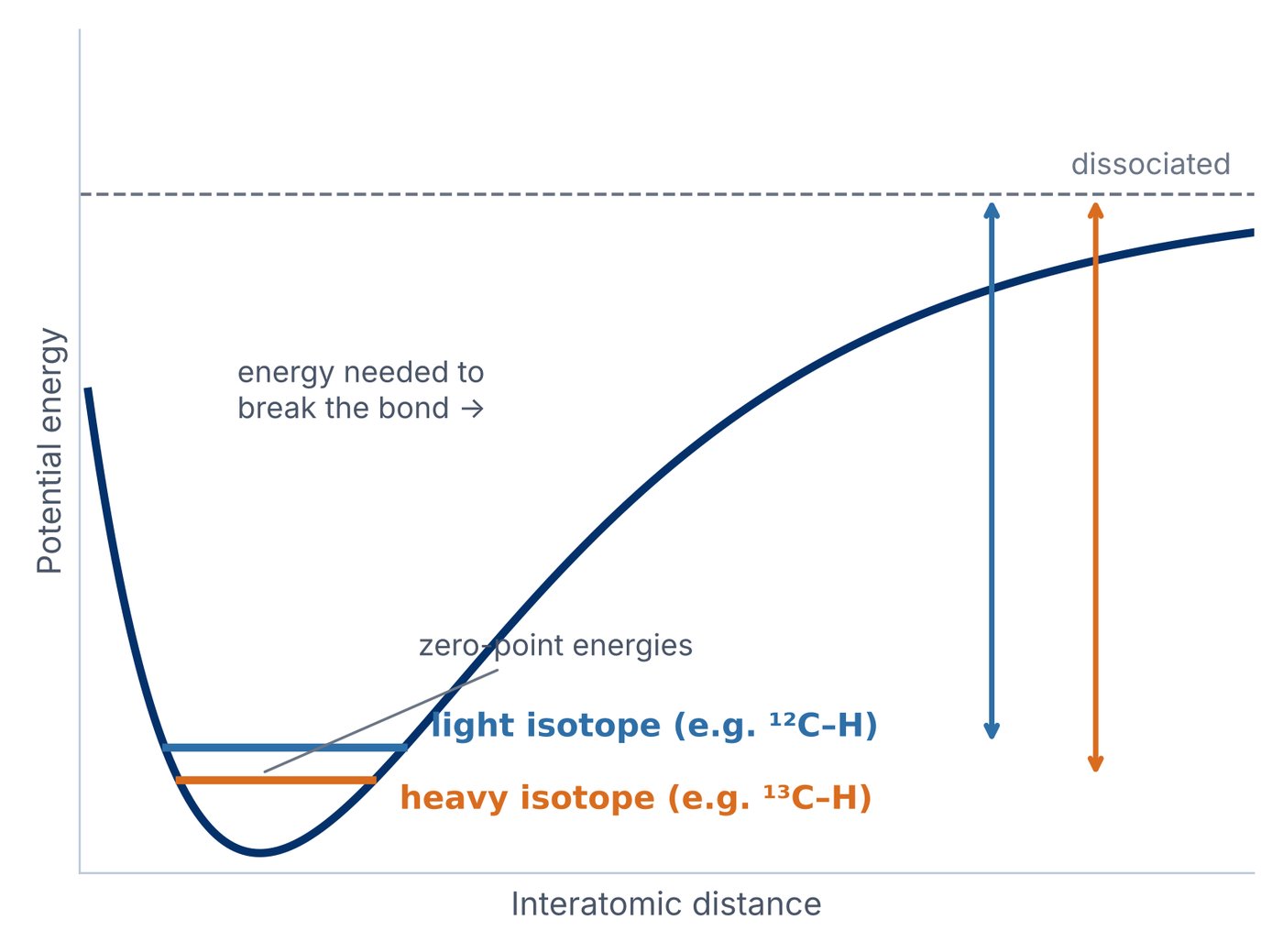
Think of atoms as balls on springs (an illustration, not a literal model): a heavier ball vibrates more slowly and sits deeper in its energy well. Reactions that break bonds and do not run to completion therefore make light products. Photosynthesis fixes ¹²CO₂ preferentially, so organic matter is isotopically light (lectures 2–3); bacterial sulfate reduction breaks ³²S–O bonds first, producing light sulfide and pyrite (lecture 10).Stellen Sie sich Atome als Kugeln an Federn vor (eine Veranschaulichung, kein wörtliches Modell): Eine schwerere Kugel schwingt langsamer und sitzt tiefer in ihrer Potenzialmulde. Reaktionen, die Bindungen brechen und nicht vollständig ablaufen, liefern daher leichte Produkte. Die Photosynthese fixiert bevorzugt ¹²CO₂, deshalb ist organische Substanz isotopisch leicht (Vorlesungen 2–3); die bakterielle Sulfatreduktion bricht zuerst ³²S–O-Bindungen und erzeugt leichtes Sulfid und Pyrit (Vorlesung 10).
Equilibrium: a reversible exchangeGleichgewicht: ein reversibler Austausch
- The heavy isotope concentrates in the species with the stronger bondDas schwere Isotop reichert sich in der Spezies mit der stärkeren Bindung an
- Fractionation decreases as temperature increases: the basis of every isotope thermometerDie Fraktionierung nimmt mit steigender Temperatur ab: die Grundlage jedes Isotopenthermometers
- Larger relative mass difference → larger effect (D:H = 2, ¹⁸O:¹⁶O = 1.125)Größerer relativer Massenunterschied → größerer Effekt (D:H = 2, ¹⁸O:¹⁶O = 1,125)
- Only the final state matters, not the pathwayNur der Endzustand zählt, nicht der Weg
Equilibrium is the reference, not a guaranteeGleichgewicht ist die Referenz, keine Garantie
Many organisms do not build their shells in isotopic equilibrium with seawater ("vital effects"; corals are the classic example). Equilibrium calibrations are an idealisation; real carbonates can deviate from them.Viele Organismen bauen ihre Schalen nicht im Isotopengleichgewicht mit dem Meerwasser ("Vitaleffekte"; Korallen sind das klassische Beispiel). Gleichgewichtskalibrierungen sind eine Idealisierung; reale Karbonate können davon abweichen.
4. The language: δ, standards, α and ε4. Die Sprache: δ, Standards, α und ε
Why not report the ratio itself? Gas-source mass spectrometers measure the sample and a reference gas alternately and are extremely precise at comparing the two, much less so at measuring absolute ratios. δ reports exactly what the instrument does best.Warum nicht das Verhältnis selbst angeben? Gasmassenspektrometer messen Probe und Referenzgas abwechselnd und sind beim Vergleichen der beiden äußerst präzise, beim Messen absoluter Verhältnisse viel weniger. δ gibt genau das an, was das Gerät am besten kann.
Reading the signDas Vorzeichen lesen
- δ > 0: enriched in the heavy isotope (heavier) than the standardδ > 0: gegenüber dem Standard an schwerem Isotop angereichert (schwerer)
- δ < 0: depleted (lighter)δ < 0: abgereichert (leichter)
- −5 ‰ is heavier than −10 ‰−5 ‰ ist schwerer als −10 ‰
- A negative δ is not a negative amount, just less than the standardEin negatives δ ist keine negative Menge, nur weniger als im Standard
The golden rule: against what?Die goldene Regel: bezogen worauf?
A δ value without its standard means nothing. Always write it: ‰ VSMOW, ‰ VPDB.Ein δ-Wert ohne Standard bedeutet nichts. Schreiben Sie ihn immer dazu: ‰ VSMOW, ‰ VPDB.
🧮 Try it: calculate δ🧮 Ausprobieren: δ berechnen
Two standards for oxygen: VSMOW and VPDBZwei Standards für Sauerstoff: VSMOW und VPDB
VSMOW (Vienna Standard Mean Ocean Water) is used for waters. VPDB (Vienna Pee Dee Belemnite) is used for carbonates; δ¹³C is always reported against VPDB. PDB was a belemnite from the Cretaceous Peedee Formation of South Carolina, used as reference by Harold Urey's group in Chicago in the early 1950s. When the original material ran out, replacement reference materials tied to the same scale were defined under the International Atomic Energy Agency in Vienna, hence the V.VSMOW (Vienna Standard Mean Ocean Water) wird für Wässer verwendet. VPDB (Vienna Pee Dee Belemnite) wird für Karbonate verwendet; δ¹³C wird immer gegen VPDB angegeben. PDB war ein Belemnit aus der kreidezeitlichen Peedee-Formation in South Carolina, den die Gruppe von Harold Urey in Chicago Anfang der 1950er Jahre als Referenz nutzte. Als das Originalmaterial aufgebraucht war, wurden unter der Internationalen Atomenergiebehörde in Wien Ersatz-Referenzmaterialien definiert, die an dieselbe Skala gebunden sind, daher das V.
δ¹⁸OVPDB = 0.97002 × δ¹⁸OVSMOW − 29.98
🔁 Scale converter🔁 Skalenumrechner
The fractionation factor αDer Fraktionierungsfaktor α
Example: calcite growing in equilibrium with water. Kim & O'Neil (1997) calibrated 10³ ln αcalcite–water = 18.03 (10³/T) − 32.42, with T in kelvin (experiments at 10–40 °C). At 25 °C this gives 10³ ln α = 28.05 and α = 1.0285. Calcite growing in seawater of 0 ‰ VSMOW is then +28.45 ‰ VSMOW, which is −2.38 ‰ VPDB.Beispiel: Calcit, der im Gleichgewicht mit Wasser wächst. Kim & O'Neil (1997) kalibrierten 10³ ln αCalcit–Wasser = 18,03 (10³/T) − 32,42 mit T in Kelvin (Experimente bei 10–40 °C). Bei 25 °C ergibt das 10³ ln α = 28,05 und α = 1,0285. Calcit, der in Meerwasser mit 0 ‰ VSMOW wächst, hat dann +28,45 ‰ VSMOW, also −2,38 ‰ VPDB.
🌡️ Calcite–water calculator (Kim & O'Neil, 1997)🌡️ Calcit–Wasser-Rechner (Kim & O'Neil, 1997)
Correction to last year's materialKorrektur gegenüber dem Material des Vorjahres
Earlier course material gave α(calcite–water) = 1.031 at 25 °C. That number is the VPDB–VSMOW scale factor (1.03091), not the fractionation factor. By Kim & O'Neil (1997), α = 1.031 corresponds to about 13 °C. A good example of how easily numbers from the two scales get confused.Früheres Kursmaterial gab α(Calcit–Wasser) = 1,031 bei 25 °C an. Diese Zahl ist der Skalenfaktor VPDB–VSMOW (1,03091), nicht der Fraktionierungsfaktor. Nach Kim & O'Neil (1997) entspricht α = 1,031 etwa 13 °C. Ein gutes Beispiel dafür, wie leicht Zahlen der beiden Skalen verwechselt werden.
ε, Δ and 10³ ln α: three shortcutsε, Δ und 10³ ln α: drei Abkürzungen
| QuantityGröße | DefinitionDefinition | Calcite–water, 25 °CCalcit–Wasser, 25 °C |
|---|---|---|
| Enrichment factorAnreicherungsfaktor ε | (α − 1) × 1000 | 28.45 ‰ |
| Simple differenceEinfache Differenz Δ | δA − δB | 28.45 ‰ |
| Calibration formKalibrierungsform | 10³ ln α | 28.05 ‰ |
For small fractionations and δ values close to 0 ‰, Δ ≈ ε ≈ 10³ ln α. ε and 10³ ln α agree within ≈ 0.05 ‰ below about 10 ‰ and differ by 0.2–0.4 ‰ at 20–30 ‰, about a degree in carbonate thermometry. Δ departs further from ε the further δB is from 0 ‰, because Δ ≈ ε (1 + δB/1000): with ε = 10 ‰ and δB = −30 ‰, Δ = 9.7 ‰. For mineral–water fractionations, use the exact equations, and convert a calibration with α = exp(10³ ln α / 1000) before combining it with δ values.Für kleine Fraktionierungen und δ-Werte nahe 0 ‰ gilt Δ ≈ ε ≈ 10³ ln α. ε und 10³ ln α stimmen unter etwa 10 ‰ auf ≈ 0,05 ‰ überein und unterscheiden sich bei 20–30 ‰ um 0,2–0,4 ‰, in der Karbonat-Thermometrie etwa ein Grad. Δ weicht umso stärker von ε ab, je weiter δB von 0 ‰ entfernt ist, denn Δ ≈ ε (1 + δB/1000): Mit ε = 10 ‰ und δB = −30 ‰ ist Δ = 9,7 ‰. Verwenden Sie für Mineral–Wasser-Fraktionierungen die exakten Gleichungen, und rechnen Sie eine Kalibrierung mit α = exp(10³ ln α / 1000) um, bevor Sie sie mit δ-Werten kombinieren.
A sense of scaleEin Gefühl für die Größenordnung
For carbonate δ¹⁸O, 1 ‰ corresponds to roughly 4–5 °C if the water composition stays the same (calcite becomes about 0.2 ‰ lighter per degree of warming). Good laboratories measure carbonate δ¹⁸O and δ¹³C to better than about 0.1 ‰.Für Karbonat-δ¹⁸O entspricht 1 ‰ etwa 4–5 °C, sofern die Wasserzusammensetzung gleich bleibt (Calcit wird pro Grad Erwärmung etwa 0,2 ‰ leichter). Gute Labore messen Karbonat-δ¹⁸O und δ¹³C mit einer Präzision von besser als etwa ±0,1 ‰.
📋 Five equations to know by heart📋 Fünf Gleichungen zum Auswendiglernen
- RatioVerhältnis: R = heavy / lightschwer / leicht
- δ: δ = (Rsample / Rstandard − 1) × 1000
- ScalesSkalen: δ¹⁸OVSMOW = 1.03091 × δ¹⁸OVPDB + 30.91
- α: αA–B = (1000 + δA) / (1000 + δB)
- ShortcutsAbkürzungen: ε = (α − 1) × 1000 ≈ 10³ ln α ≈ δA − δB (small fractionations, δ near 0 ‰kleine Fraktionierungen, δ nahe 0 ‰)
Copy these onto one sheet: you will use it in every assignment.Schreiben Sie diese auf ein Blatt: Sie werden es in jeder Übung brauchen. 📄 Or download the one-page key-equations sheet (PDF, English)📄 Oder laden Sie das einseitige Formelblatt herunter (PDF, Englisch)
5. Oxygen and hydrogen isotopes in precipitation5. Sauerstoff- und Wasserstoffisotope im Niederschlag
From the ocean to the continentVom Ozean zum Kontinent
Vapour leaving the ocean (0 ‰) is depleted, here −12 ‰: more than the ≈ 10 ‰ equilibrium effect, because evaporation into unsaturated air adds a kinetic component. The first rain condenses in equilibrium with the vapour and is about 10 ‰ heavier than it. Because rain removes heavy isotopes, the remaining vapour becomes lighter, and so does every later rain.Dampf, der den Ozean (0 ‰) verlässt, ist abgereichert, hier −12 ‰: mehr als der Gleichgewichtseffekt von ≈ 10 ‰, weil die Verdunstung in ungesättigte Luft eine kinetische Komponente hinzufügt. Der erste Regen kondensiert im Gleichgewicht mit dem Dampf und ist etwa 10 ‰ schwerer als dieser. Weil der Regen schwere Isotope entfernt, wird der verbleibende Dampf leichter, und mit ihm jeder spätere Regen.
Numbers calculated with a constant α = 1.0098 (20 °C; Majoube, 1971), initial vapour −12 ‰; δ²H placed on the meteoric water line (δ²H = 8 δ¹⁸O + 10).Zahlen berechnet mit konstantem α = 1,0098 (20 °C; Majoube, 1971), Anfangsdampf −12 ‰; δ²H auf der meteorischen Wasserlinie (δ²H = 8 δ¹⁸O + 10).
Rayleigh distillationRayleigh-Destillation
δrain = α (δvapour + 1000) − 1000
📉 Interactive: rain out an air mass📉 Interaktiv: eine Luftmasse abregnen lassen
Constant temperature during rain-out, initial vapour −12 ‰, α from Majoube (1971). In nature the air also cools as it rains out, so real curves steepen further.Konstante Temperatur während des Abregnens, Anfangsdampf −12 ‰, α nach Majoube (1971). In der Natur kühlt die Luft beim Abregnen zusätzlich ab, daher werden reale Kurven noch steiler.
Dansgaard's beer bottlesDansgaards Bierflaschen
On a Saturday in June 1952 the Danish physicist Willi Dansgaard, as he tells it in his memoir, put a beer bottle with a funnel in his garden in Copenhagen and emptied it every hour or two while a single, well-developed weather front passed. The isotopic composition of the rain changed systematically during the passage of the front. He later mapped isotopes in precipitation worldwide (Dansgaard, 1964) and became a pioneer of Greenland ice-core research.An einem Samstag im Juni 1952 stellte der dänische Physiker Willi Dansgaard, wie er in seinen Memoiren erzählt, eine Bierflasche mit Trichter in seinen Garten in Kopenhagen und leerte sie alle ein bis zwei Stunden, während eine einzelne, gut ausgebildete Wetterfront durchzog. Die Isotopenzusammensetzung des Regens änderte sich während des Frontdurchgangs systematisch. Später kartierte er die Isotope im Niederschlag weltweit (Dansgaard, 1964) und wurde ein Pionier der grönländischen Eiskernforschung.
Rayleigh distillation is not only about rain. Whenever a reservoir is used up and the removed fraction differs isotopically from what remains, the residue follows a Rayleigh-type curve: an evaporating lake becomes heavier; sulfate consumed by bacteria in a restricted basin becomes heavier (lecture 10).Rayleigh-Destillation betrifft nicht nur Regen. Immer wenn ein Reservoir aufgebraucht wird und der entfernte Anteil sich isotopisch vom Rest unterscheidet, folgt der Rest einer Rayleigh-Kurve: Ein verdunstender See wird schwerer; Sulfat, das in einem Becken mit eingeschränkter Zirkulation von Bakterien verbraucht wird, wird schwerer (Vorlesung 10).
The global meteoric water lineDie globale meteorische Wasserlinie
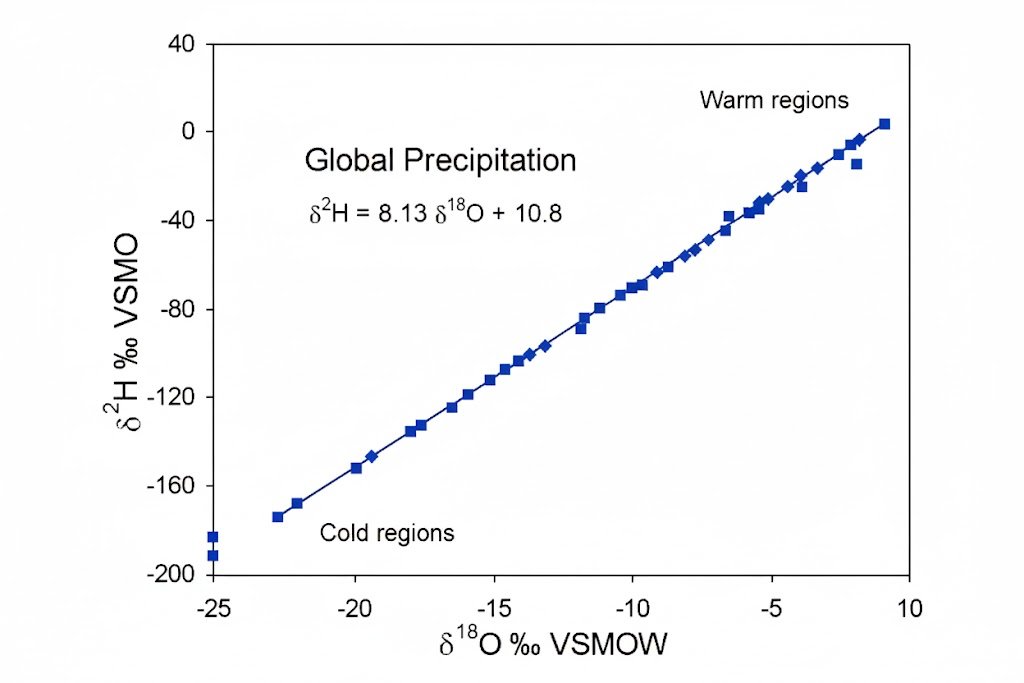
d = δ²H − 8 δ¹⁸O
The slope of about 8 reflects the ratio of the equilibrium fractionations of H and O during condensation. Warm, low-latitude rain plots at the upper right, cold high-latitude snow at the lower left. Water that has evaporated after it fell, for example in a lake, plots below the line on a shallower slope: a useful diagnostic.Die Steigung von etwa 8 spiegelt das Verhältnis der Gleichgewichtsfraktionierungen von H und O bei der Kondensation wider. Warmer Regen niedriger Breiten liegt oben rechts, kalter Schnee hoher Breiten unten links. Wasser, das nach dem Niederschlag teilweise verdunstet ist, zum Beispiel in einem See, liegt unterhalb der Linie auf einer Geraden mit flacherer Steigung: ein nützliches Diagnosemerkmal.
Five effects, one causeFünf Effekte, eine Ursache
For each effect ask: how much vapour has already rained out, and how cold is it?Fragen Sie bei jedem Effekt: Wie viel Dampf ist bereits abgeregnet, und wie kalt ist es?
ContinentalKontinentaleffekt
Lighter with distance inland, as the air mass rains out along its path.Leichter mit zunehmender Entfernung ins Inland, weil die Luftmasse entlang ihres Wegs abregnet.
TemperatureTemperatureffekt
Colder → lighter; about 0.5–0.7 ‰ per °C at mid–high latitudes.Kälter → leichter; etwa 0,5–0,7 ‰ pro °C in mittleren bis hohen Breiten.
AltitudeHöheneffekt
Higher → lighter; typically −0.15 to −0.5 ‰ per 100 m, global mean ≈ −2.8 ‰ per km.Höher → leichter; typisch −0,15 bis −0,5 ‰ pro 100 m, globales Mittel ≈ −2,8 ‰ pro km.
AmountMengeneffekt
In monsoon regions the wettest months give the lightest rain, although they are warm.In Monsungebieten liefern die regenreichsten Monate den leichtesten Regen, obwohl sie warm sind.
LatitudeBreiteneffekt
Lighter towards the poles; about −25 to −60 ‰ on the polar ice sheets.Leichter zu den Polen hin; etwa −25 bis −60 ‰ auf den polaren Eisschilden.
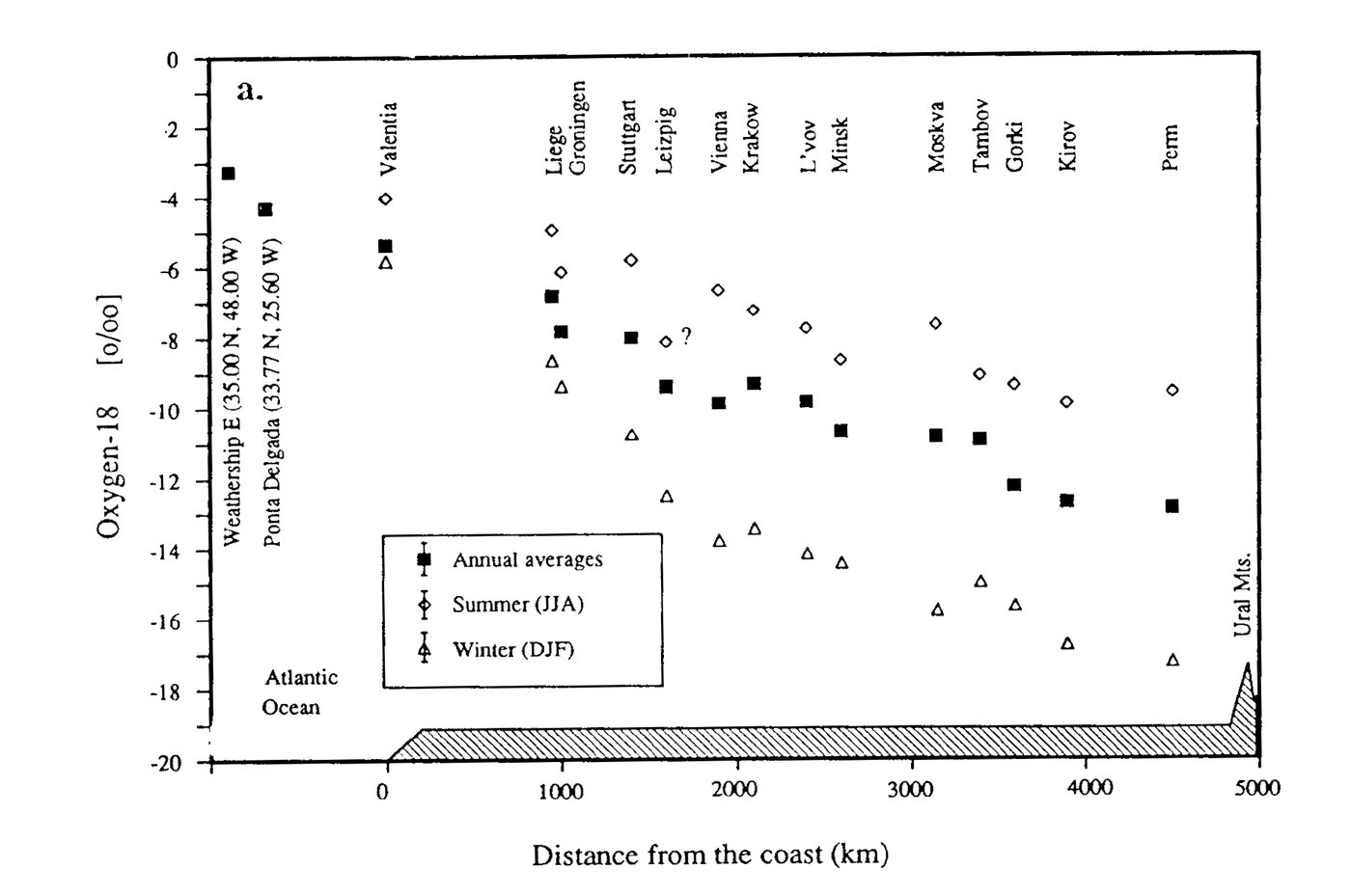
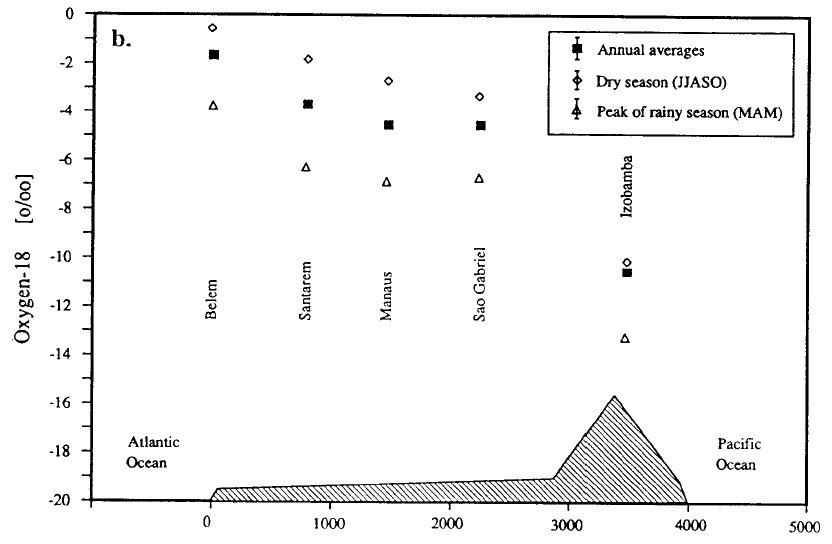
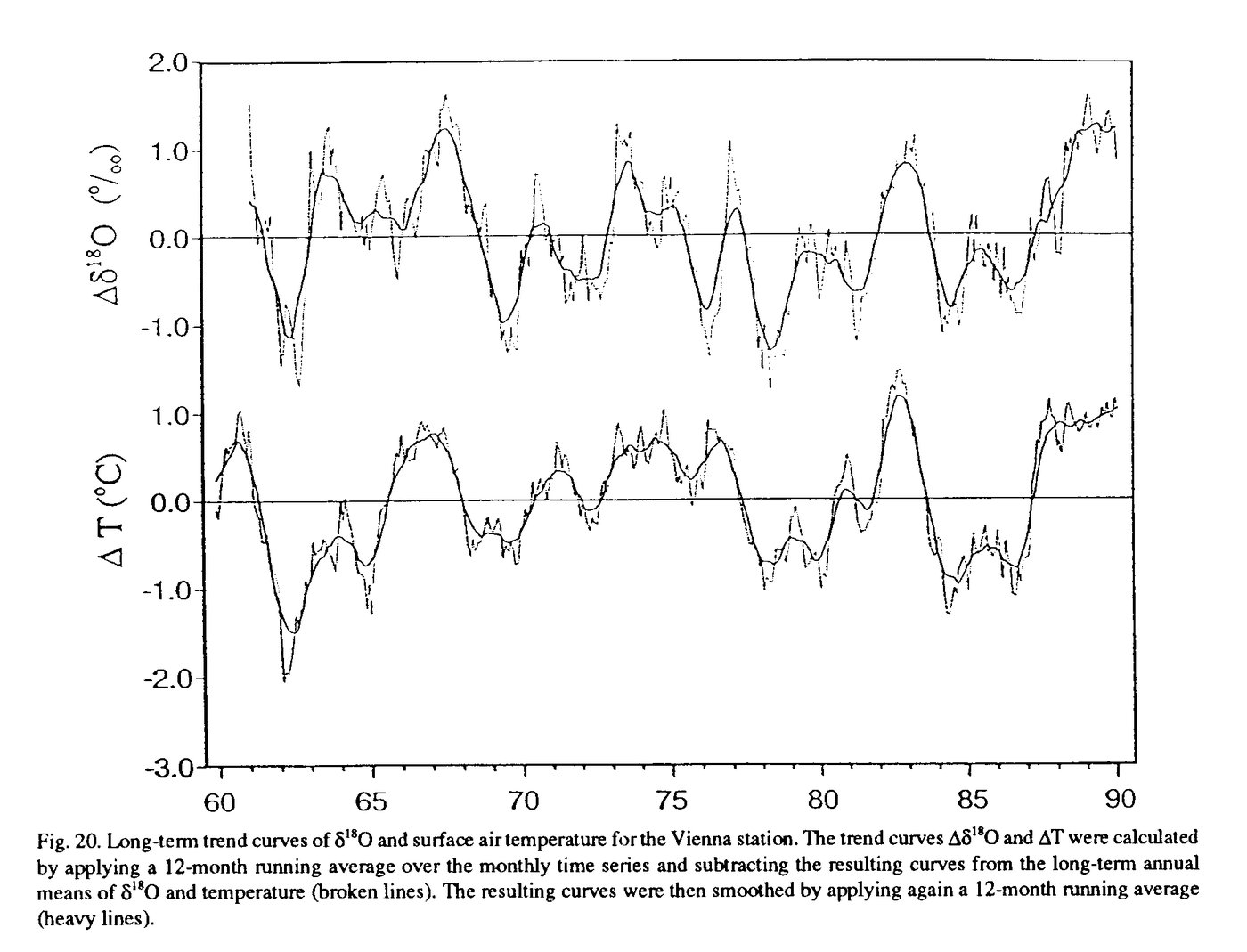
Rain integrates the history of its air mass, not just the local temperature on the day it falls. δ¹⁸O in ice cores or speleothems is therefore a climate proxy, not a simple thermometer.Regen integriert die Geschichte seiner Luftmasse, nicht nur die lokale Temperatur am Tag des Niederschlags. δ¹⁸O in Eiskernen oder Speläothemen ist daher ein Klimaproxy, kein einfaches Thermometer.
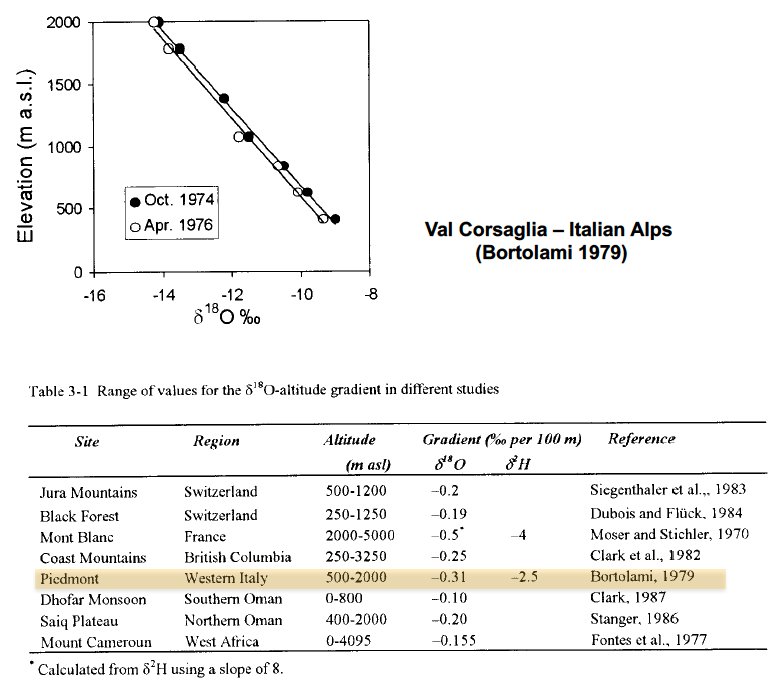
The altitude effect is the basis of stable-isotope paleoaltimetry: if the δ¹⁸O of ancient precipitation can be reconstructed, the elevation of an ancient mountain range can be estimated.Der Höheneffekt ist die Grundlage der Paläoaltimetrie mit stabilen Isotopen: Lässt sich das δ¹⁸O vorzeitlichen Niederschlags rekonstruieren, kann man die Höhe eines ehemaligen Gebirges abschätzen.
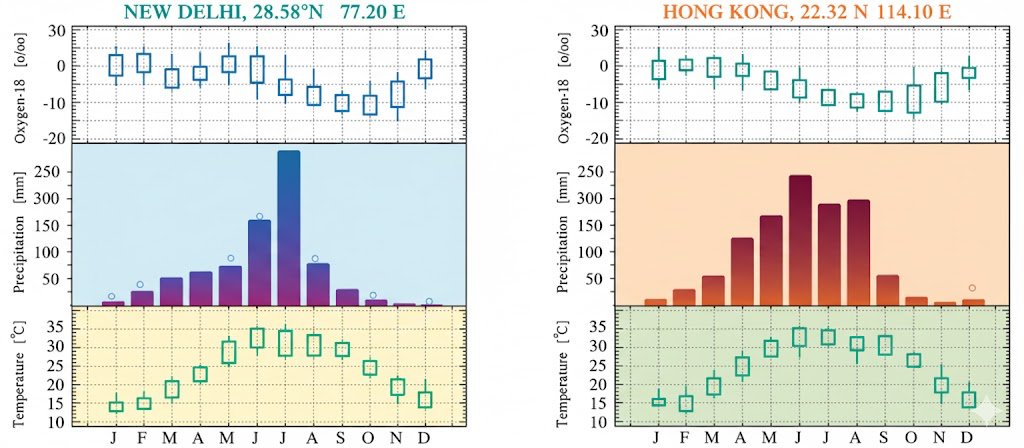
A classic interpretation errorEin klassischer Interpretationsfehler
In tropical and monsoon archives δ¹⁸O tracks rainfall amount more than temperature. Applying a mid-latitude temperature relationship there gives nonsense.In tropischen und Monsun-Archiven folgt δ¹⁸O eher der Niederschlagsmenge als der Temperatur. Wendet man dort eine Temperaturbeziehung mittlerer Breiten an, kommt Unsinn heraus.
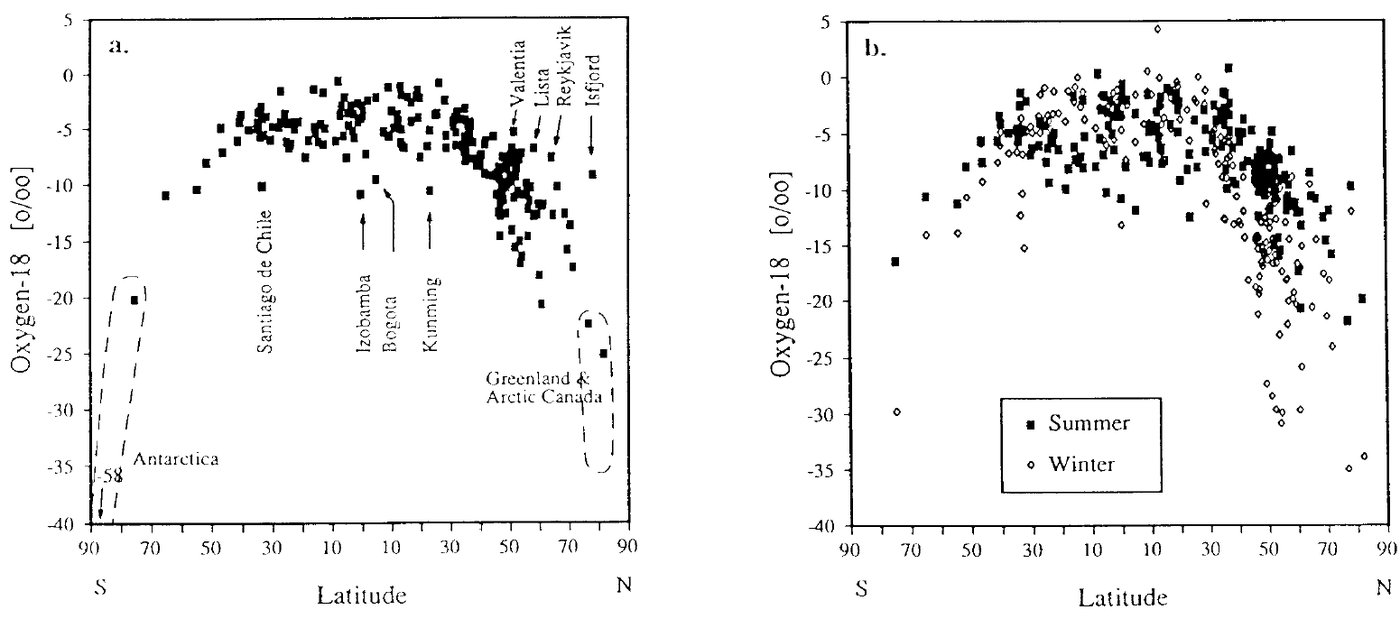
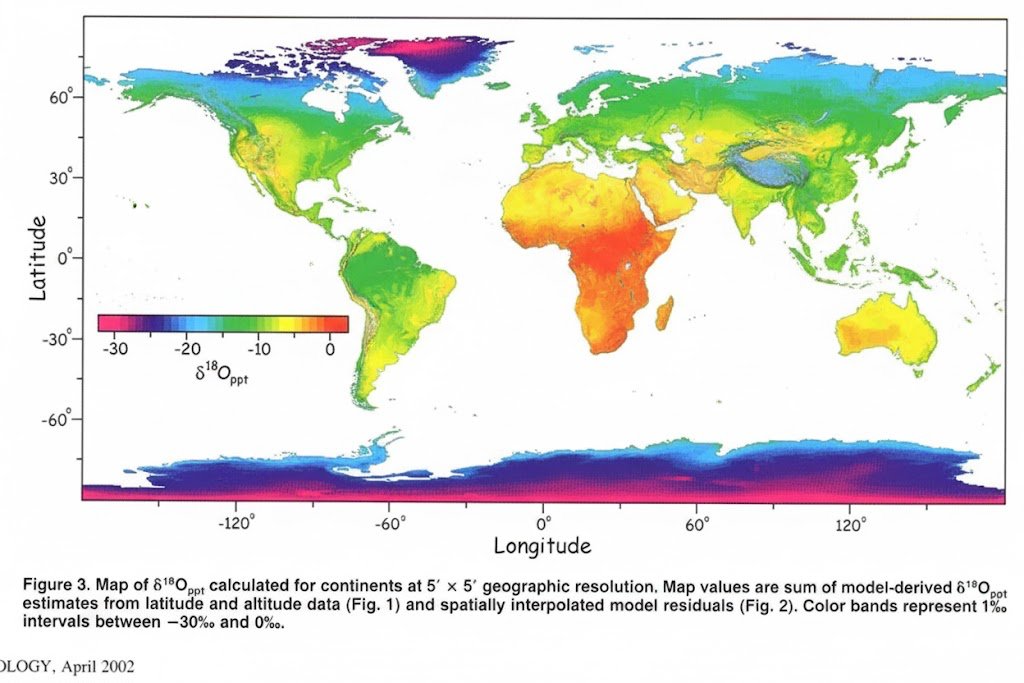
This map is the modern baseline. Before interpreting an unusual δ¹⁸O in an ancient carbonate as temperature, ask which of the five effects could explain it.Diese Karte ist die heutige Ausgangsbasis. Bevor Sie ein ungewöhnliches δ¹⁸O in einem alten Karbonat als Temperatur deuten, fragen Sie, welcher der fünf Effekte es erklären könnte.
📌 Take-home points📌 Das Wichtigste
- Isotopes differ only in mass, and mass is what fractionates them; light elements fractionate most.Isotope unterscheiden sich nur in der Masse, und die Masse bewirkt ihre Fraktionierung; leichte Elemente fraktionieren am stärksten.
- Kinetic fractionation (fast, one-way) gives process tracers; equilibrium fractionation (temperature-dependent) gives thermometers.Kinetische Fraktionierung (schnell, nur in eine Richtung) liefert Prozess-Tracer; Gleichgewichtsfraktionierung (temperaturabhängig) liefert Thermometer.
- R, δ, α, ε, and always the standard: ‰ VSMOW or ‰ VPDB.R, δ, α, ε, und immer der Standard: ‰ VSMOW oder ‰ VPDB.
- Rayleigh distillation: vapour becomes lighter as rain falls out, and every later rain is lighter.Rayleigh-Destillation: Der Dampf wird beim Abregnen leichter, und jeder spätere Regen ist leichter.
- Temperature, latitude, continental, altitude and amount effects: five effects, one cause.Temperatur-, Breiten-, Kontinental-, Höhen- und Mengeneffekt: fünf Effekte, eine Ursache.
Assignment 1:Übungsaufgabe 1: open the assignment on this lectureÜbungsaufgabe zu dieser Vorlesung öffnen · closedabgeschlossen
Question for next week:Frage für nächste Woche: ice sheets store the lightest water on Earth. When they grow, what happens to the δ¹⁸O of the ocean left behind?Eisschilde speichern das leichteste Wasser der Erde. Was passiert mit dem δ¹⁸O des verbleibenden Ozeans, wenn sie wachsen?
🧠 Test your understanding🧠 Testen Sie Ihr Verständnis
📚 References and further reading📚 Literatur und weiterführende Lektüre
- Bortolami, G.C., Ricci, B., Susella, G.F. & Zuppi, G.M. (1979) Isotope hydrology of the Val Corsaglia, Maritime Alps, Piedmont, Italy. In: Isotope Hydrology 1978, IAEA, Vienna, 327–350.
- Bowen, G.J. & Wilkinson, B. (2002) Spatial distribution of δ¹⁸O in meteoric precipitation. Geology 30, 315–318.
- Clark, I.D. & Fritz, P. (1997) Environmental Isotopes in Hydrogeology. CRC Press / Lewis Publishers.
- Coplen, T.B., Kendall, C. & Hopple, J. (1983) Comparison of stable isotope reference samples. Nature 302, 236–238.
- Craig, H. (1961) Isotopic variations in meteoric waters. Science 133, 1702–1703.
- Dansgaard, W. (1964) Stable isotopes in precipitation. Tellus 16, 436–468.
- Kim, S.-T. & O'Neil, J.R. (1997) Equilibrium and nonequilibrium oxygen isotope effects in synthetic carbonates. Geochimica et Cosmochimica Acta 61, 3461–3475.
- Majoube, M. (1971) Fractionnement en oxygène 18 et en deutérium entre l'eau et sa vapeur. Journal de Chimie Physique 68, 1423–1436.
- Poage, M.A. & Chamberlain, C.P. (2001) Empirical relationships between elevation and the stable isotope composition of precipitation and surface waters. American Journal of Science 301, 1–15.
- Rozanski, K., Araguás-Araguás, L. & Gonfiantini, R. (1993) Isotopic patterns in modern global precipitation. In: Climate Change in Continental Isotopic Records, Geophysical Monograph 78, AGU, 1–36.
- Sharp, Z. (2017) Principles of Stable Isotope Geochemistry, 2nd edition. Open access, University of New Mexico.
- Urey, H.C. (1947) The thermodynamic properties of isotopic substances. Journal of the Chemical Society, 562–581.