Read the transcriptTranskript lesen
Hannah: Welcome back to the Sedimentary Geochemistry podcast. This is the companion episode to Lecture 3, carbonate diagenesis. I'm Hannah.
George: And I'm George. Last week we treated a shell as a faithful recorder. Its oxygen told us about temperature and water, its carbon told us about the carbon cycle. Today we ask the uncomfortable question behind all of that.
Hannah: Which is?
George: Is the signal we measure today still the signal the shell recorded when it grew? Or has something rewritten it since?
Hannah: And that something is diagenesis.
George: Exactly. Diagenesis is everything that happens to a sediment after it is deposited and before it becomes a metamorphic rock. For carbonates, the key point is simple. A buried shell is not sealed in a box. Water keeps moving through the pores of the rock. And that water can dissolve the original mineral and grow new mineral in its place.
Hannah: And the new mineral takes its chemistry from the new water.
George: That's the whole problem in one sentence. So the lecture is built around three questions you should ask about any fluid. What is the water? How much of it passed through the rock? And at what temperature did the new carbonate grow?
Hannah: Let's start with a debate, because the lecture did too. Two well-known geochemists, Lynton Land and Ján Veizer, looked at the same material, old brachiopod shells, and came to opposite conclusions.
George: Right. Old shells tend to have low oxygen isotope values. Land read that as alteration: over hundreds of millions of years, the shells exchanged oxygen with later fluids. Veizer argued that carefully selected shells are well preserved, so the low values are real. Then either the oceans were much warmer, or seawater itself had a different oxygen composition.
Hannah: And who was right?
George: That's not the question for today. Both readings are physically possible. What decides between them is a question about process: did these particular shells ever meet enough fluid, of the right kind, to change them? If you understand the processes, you can judge a dataset yourself, instead of simply trusting a famous name.
Hannah: So let's get to the processes. The first one is mineralogy.
George: Yes. Carbonates come in three main forms: aragonite, high-magnesium calcite, and low-magnesium calcite. The first two are unstable at the Earth's surface. They are a bit more soluble than low-magnesium calcite. So a pore water can be undersaturated with respect to aragonite and, at the same time, supersaturated with respect to low-magnesium calcite.
Hannah: Which means it dissolves one and grows the other.
George: Crystal by crystal, on a very small scale. Corals, many molluscs, green algae, early marine cements, most platform mud: all of that is made of the unstable minerals, and most of it will eventually be replaced by low-magnesium calcite.
Hannah: Whereas a brachiopod, which builds its shell from low-magnesium calcite to begin with...
George: Has no chemical reason to change. That's why long-term temperature records rely on stable skeletons, such as brachiopods, belemnites and foraminifera, or on the phosphate of conodonts, and not on bulk limestone.
Hannah: Now here is the part I find really elegant. When that new calcite grows, oxygen and carbon behave completely differently. Why?
George: This is the most important idea of the lecture, and it's just a mass balance. Think of the rock as a store of oxygen and carbon. Every kilogram of water that flows through offers its own oxygen and carbon in exchange.
Hannah: And water is H two O.
George: Exactly. Almost all of the mass of water is oxygen. So one kilogram of water brings as much oxygen as one kilogram of rock contains, in fact almost twice as much. But dissolved carbon in water is just a trace, thousands of times less than in the rock.
Hannah: So for oxygen, water and rock are partners of similar size. For carbon, the rock wins easily.
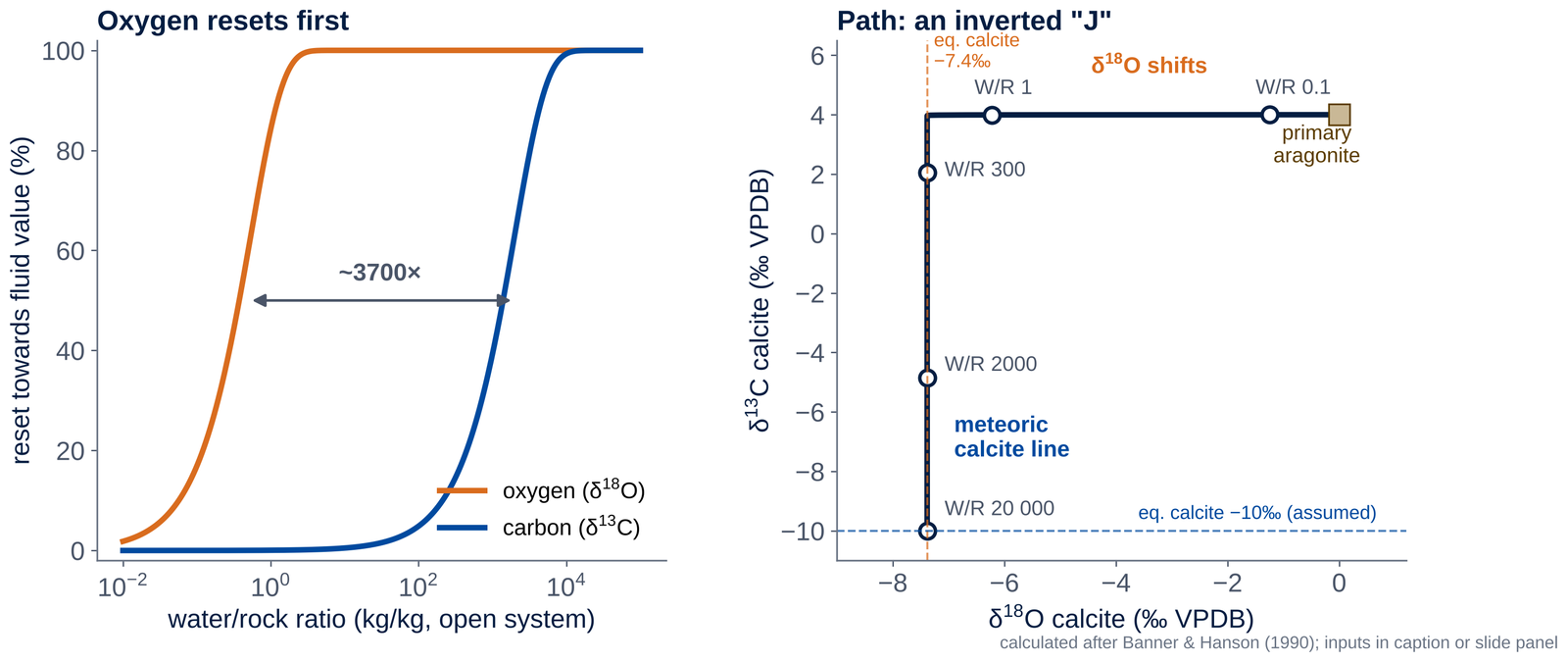
George: That's a nice way to say it. The consequence is dramatic. In the model we used in class, the open-system water-rock model of Banner and Hanson, oxygen is mostly reset after about one kilogram of water has passed per kilogram of rock. Carbon needs hundreds to thousands of kilograms.
Hannah: Three orders of magnitude.
George: Yes. And on a cross-plot of carbon against oxygen, that gives a very characteristic path. The sample first moves sideways: oxygen gets lighter, carbon stays where it was. Only with much more water does the path turn and fall. People call it an inverted J.
Hannah: So a rock can have a completely reset oxygen value and still carry its original carbon value.
George: And that is why carbon-isotope stratigraphy often works in rocks where oxygen thermometry is hopeless. But notice the asymmetry. A primary-looking carbon value tells you nothing about oxygen. If carbon has been reset, oxygen has certainly been reset too. Its value only changes, of course, if the new water is different.
Hannah: Is there a way to break that rule?
George: Give the water more carbon. If the fluid is rich in carbon dioxide, for example from decaying organic matter, carbon resets at much lower water-to-rock ratios. Keep that in mind. It comes back in the burial setting, and in the assignment.
Hannah: Let's go through the settings. The lecture used a carbonate island as the map.
George: Right. Picture a low island. Rain falls on the surface and passes through the soil, where it picks up carbon dioxide from roots and decaying organic matter. That makes it slightly acidic, which is why it can dissolve limestone. Just below the surface is the vadose zone, where pores hold both air and water. Below the water table, every pore is full of fresh water: that's the freshwater lens. Underneath it is a brackish mixing zone, and all around the rock is soaked in seawater. And deeper down, burial: the rock gets hotter, and the pore water slowly changes by reacting with the rock.
Hannah: Three settings, three waters.
George: And before you measure any isotope, the rock already tells you which setting a cement grew in, from its shape.
Hannah: Because a crystal can only grow where there is water.
George: Exactly. If a pore was completely full of water, the cement grows evenly around every grain, a rim of equal thickness. That's typical of the marine setting. If the pore held both air and water, water hangs as drops under the grains and as little bridges where grains touch, so the cement grows only there. Pendant and meniscus cements: that's the vadose zone. And coarse crystals that grow bigger towards the middle of a pore point to the freshwater lens or to burial.
Hannah: The lecture had a rule for this. Look before you drill.
George: Always. Decide in thin section which grain or which cement generation you are sampling. Otherwise your powder is a mixture of different waters and different times, and the number you get means nothing.
Hannah: So, the marine setting first. That one sounds harmless.
George: For isotopes, it's the gentlest. The water is seawater, at sea-floor temperature, which is more or less what the organisms grew in. So even a lot of water doesn't move the values far. What matters is not only how much water, but how different that water is.
Hannah: But marine cements are still important.
George: Very. They fill the rock with aragonite and high-magnesium calcite, which are unstable. They become the fuel for later alteration. And there's one subtlety that is not alteration at all: aragonite takes up more carbon thirteen than calcite from the same water.
Hannah: About one point seven per mil, if I remember the lecture.
George: That's the one number worth remembering today. The consequence: if a limestone changes its aragonite content up a section, its bulk carbon value can drift, even with no new carbon coming in. That can look like a global carbon-cycle excursion when it isn't one. Compare like with like.
Hannah: Now the meteoric setting, where the big changes happen.
George: Whenever a platform is exposed, for example when sea level falls during a glaciation, rain enters the rock. Let's follow the carbon first. Near the surface, the water is loaded with soil carbon dioxide, which is isotopically light. So calcite growing there is light. Deeper down, the soil supply fades, and more and more of the carbon comes from the limestone that is dissolving. So the carbon value climbs back towards marine values.
Hannah: And oxygen?
George: Hardly changes with depth. It's the same rainwater everywhere, at the same temperature. Only right at the top can evaporation make the water a bit heavier.
Hannah: So you get a big spread in carbon at almost constant oxygen.
George: And on a cross-plot that's a near-vertical line. It's called the meteoric calcite line, a concept from Lohmann's work. All the calcites share the oxygen value of the local rain, but each one took a different mix of soil carbon and rock carbon. One end is rock-buffered, close to marine. The other end is water-buffered, recording soil-derived carbon.
Hannah: So if I see a vertical array at low oxygen values, I should think meteoric diagenesis.
George: Immediately. And don't read the carbon spread as a change in the global carbon cycle. There's even a bonus. Because the line sits at the oxygen value of local rain, the line itself can be a climate archive for the exposure surface.
Hannah: There was a beautiful example of this in a single crystal.
George: Meyers and Lohmann, 1985. A crinoid fragment with a calcite overgrowth that grew in zones, like tree rings. The oldest zone sits near marine values. The next one is intermediate. The third is light in both oxygen and carbon.
Hannah: Why that sequence?
George: Because the rock's ability to buffer the water gets used up. When fresh water first entered, plenty of unstable aragonite and high-magnesium calcite was still dissolving and feeding marine carbon and oxygen into the pore water. The rock controlled the water. As those minerals ran out, the buffer weakened. Once they were gone, the cement simply recorded the meteoric water itself.
Hannah: So the water-to-rock ratio is also a clock.
George: Exactly. Inside one crystal you see the model's path, recorded in time instead of calculated.
Hannah: Before we go deeper, the break question from the lecture. Before land plants existed, would meteoric alteration shift carbon values more or less than today?
George: Less. Without plants, soils produce very little light carbon dioxide. Rainwater then carries mainly atmospheric carbon dioxide, so its dissolved carbon is much closer to the rock. Meteoric alteration can then be almost invisible in carbon, while oxygen is still reset.
Hannah: Which is worrying for Precambrian records.
George: It means you can't use the carbon values alone to rule alteration in or out. Now, burial.
Hannah: Deeper, hotter.
George: Deeper, hotter, and the pore water becomes saltier and changes its composition by reacting with the rock. Burial cements are coarse and clear, and they are the last generation to fill the pores. Burial waters are usually low in oxygen, so they carry dissolved iron, and burial cements often contain iron. That matters for cathodoluminescence, which we'll get to.
Hannah: And the isotopes?
George: Each younger burial cement tends to have a lower oxygen value. The reason is temperature. The oxygen isotope difference between calcite and water gets smaller as the water gets hotter. So calcite growing from hot water is lighter. Carbon, meanwhile, hardly moves, because the pore water still carries little carbon compared with the rock.
Hannah: The same asymmetry again.
George: The same rule. Which brings us to a mistake that students make every year. One measured oxygen value does not give you one temperature.
Hannah: Because there are two unknowns.
George: Right. The calcite value depends on the temperature and on the oxygen value of the water. A lighter water at low temperature and a heavier water at high temperature can produce exactly the same calcite. In the lecture, one burial cement gave a burial depth that differed by about a factor of two, depending only on which water we assumed.
Hannah: So which water should we assume?
George: Not seawater, usually. Deep formation waters tend to be heavier than seawater, because hot water exchanges oxygen with the minerals around it. So if you assume seawater, you will generally underestimate the temperature.
Hannah: You said burial carbon hardly moves. But the lecture had a slide where carbon moves a lot.
George: In rocks rich in organic matter. Below the sea floor, microbes break down organic matter and use one oxidant after another. First oxygen, then nitrate, manganese and iron oxides, then sulfate. When those are used up, methane is produced.
Hannah: And each step does something different to carbon.
George: Respiration and sulfate reduction turn light organic carbon into carbon dioxide, so the pore water gets very light, and cements and concretions growing there are strongly depleted in carbon thirteen. Methane production works the other way. The microbes that make methane prefer the light carbon, so the methane is very light, and the carbon dioxide left behind becomes heavy.
Hannah: So in organic-rich rocks, diagenetic carbonate can be pushed far from marine values in either direction.
George: And a carbon anomaly in such a unit is not automatically a global event. The extreme lightness of methane carbon is also why methane is a candidate source for the Paleocene-Eocene Thermal Maximum, which we'll meet in Lecture 10.
Hannah: One more mineral: dolomite.
George: Dolomite is special because it isn't just recrystallised calcite. It contains magnesium, and the rock doesn't have much. So the magnesium has to be brought in by water, and that takes a lot of water. Dolomitisation is a high water-to-rock process. Its oxygen records the dolomitising water and temperature. Its carbon is often inherited from the precursor.
Hannah: Oxygen reset, carbon inherited.
George: Once more. And there's a mineral effect on top. From the same water at the same temperature, dolomite is heavier in oxygen than calcite, by about three per mil at room temperature. So a heavier dolomite next to a calcite is not automatically evidence of evaporated water.
Hannah: Let's get practical. Part three of the lecture: is my sample altered?
George: The first tool is cathodoluminescence. You fire electrons at the sample, and some trace elements make calcite glow. Manganese makes it glow orange. Iron does the opposite: it dims the glow.
Hannah: And why does that reveal alteration?
George: Follow the redox chemistry. In oxygen-rich seawater, manganese and iron form insoluble oxides, so there is almost none dissolved. A living brachiopod takes up very little, and its shell stays dark. Many diagenetic waters are low in oxygen. There, manganese and iron dissolve and enter the new calcite. So altered calcite tends to glow.
Hannah: Tends to.
George: Tends to. A dark shell is not proof. If the altered calcite contains a lot of iron, the iron can hide the manganese glow. Cathodoluminescence is a first check, not a proof.
Hannah: The second tool is trace elements.
George: Same logic as the isotopes: new calcite takes its composition from the new water. During meteoric alteration, strontium and sodium go down, and manganese and iron go up. Fossil shells close to the range of modern brachiopods, high in strontium, low in manganese and iron, are candidates for preserved material.
Hannah: With the caveat that there are no universal cut-off values.
George: Exactly. Thresholds depend on the species and the setting. And a shell can pass the trace-element test and still have altered oxygen, because different signals reset at different water-to-rock ratios. That's the model again.
Hannah: So the advice is to combine tests.
George: Yes. The lecture had a workflow. Is the material a stable low-magnesium calcite skeleton? Is the original shell fabric preserved under the electron microscope? Do the trace elements and the luminescence look like something that never met a reducing fluid? And, where available, does the strontium isotope ratio match seawater of that age? Each test checks a different way alteration can happen. Any failure sends the sample out, or into the diagenetic pile.
Hannah: And then there's the shortcut that many papers use.
George: The correlation test. If carbon and oxygen correlate, the samples are declared altered; if they don't, they are declared fine. Think back to the inverted J. Alteration first moves oxygen at constant carbon. That path does not produce a neat straight line. And other processes can create correlations without meteoric alteration. A correlation is a reason to look closer, not a test.
Hannah: The case study at the end changed how I think about global signals.
George: Swart and Kennedy, 2012. For old rocks we don't have a deep-sea record, so carbon curves come from platform carbonates. Large shifts have been read as global carbon-cycle events, with one main argument: the same pattern appears in many basins, and local alteration can't happen everywhere at the same time.
Hannah: But it can.
George: It can, if the driver is global. Swart and Kennedy studied young platform cores from the Bahamas and from the Pacific, where we know the true ocean record from deep-sea fossils. Sea level is global. When it falls, every platform is exposed at the same time, rain enters every platform at the same time, and meteoric alteration happens everywhere at once. The platform records looked alike, half a world apart, and they were reproducible. But they did not record the ocean.
Hannah: So "the same signal everywhere" is not proof of a marine origin.
George: Right. And the implication is that some very old carbon anomalies may be diagenetic. Note what is not claimed: the curves can still be used to correlate sections. What's questioned is whether they record the global carbon cycle.
Hannah: And one of the last slides pointed ahead to Lecture 5.
George: To clumped isotopes. Every diagenetic oxygen value we discussed today needed two things, a temperature and the composition of the water, and we only measure one number. Clumped isotopes measure how often carbon thirteen and oxygen eighteen sit together in the same carbonate ion. That depends on temperature, not on the water. Once you know the temperature, you can work out the water.
Hannah: With a catch.
George: With a catch that fits today's topic. At high burial temperatures, the clumped signal can itself be reset. The same question as in the whole lecture: has the signal been reset?
Hannah: Let's wrap up. If students remember only a few things from this episode, what should they be?
George: Five things. One: oxygen resets first, because water is mostly oxygen and carries little carbon. Two: mineralogy decides what survives; low-magnesium calcite skeletons are the archive. Three: each setting has its fingerprint, set by its water and its temperature. Marine stays close to seawater, meteoric gives constant oxygen with variable carbon, burial gives lighter oxygen with inherited carbon. Four: organic matter pushes carbon both ways. And five: screen with several independent tools, and never use a correlation as a test.
Hannah: And for the assignment this week?
George: Assignment 3 asks you to use exactly these tools. You'll run the water-rock model yourself, work out when a burial cement closed the pores of a reservoir, and screen a set of brachiopod shells before trusting their temperatures. The deadline is Monday at noon. Show your working, and for every number ask yourself: what water, how much, at what temperature?
Hannah: Thanks for listening. See you in class.
George: See you next week.
🎯 Learning objectives🎯 Lernziele
- Explain what diagenesis does to a carbonate and name its three controls: the water, how much of it, and the temperatureErklären, was die Diagenese mit einem Karbonat macht, und ihre drei Steuergrößen nennen: das Wasser, seine Menge und die Temperatur
- Explain with a mass balance why δ¹⁸O is reset at much lower water/rock ratios than δ¹³C, and use the open-system modelMit einer Massenbilanz erklären, warum δ¹⁸O bei viel kleineren Wasser/Gesteins-Verhältnissen zurückgesetzt wird als δ¹³C, und das Modell des offenen Systems anwenden
- Recognise the fingerprints of marine, meteoric and burial diagenesis, including the meteoric calcite lineDie Fingerabdrücke mariner, meteorischer und Versenkungsdiagenese erkennen, einschließlich der meteorischen Calcitlinie
- Calculate a burial temperature from a cement and explain why the assumed water controls the answerAus einem Zement eine Versenkungstemperatur berechnen und erklären, warum das angenommene Wasser das Ergebnis bestimmt
- Screen samples with fabric, cathodoluminescence and trace elements, and know the limits of each testProben mit Gefüge, Kathodolumineszenz und Spurenelementen prüfen und die Grenzen jedes Tests kennen
Hinweis: In Formeln, Tabellen und Rechnern wird der Dezimalpunkt verwendet.
Assignment 3:Übungsaufgabe 3: open the assignment on this moduleÜbungsaufgabe zu diesem Modul öffnen · deadline Monday 16 November 2026, 12:00Abgabe Montag, 16. November 2026, 12:00 Uhr
1. The rules of alteration1. Die Regeln der Alteration
Two readings of the same shellsZwei Lesarten derselben Schalen
Old brachiopod shells tend to have low δ¹⁸O. Lynton Land read this as alteration: over hundreds of millions of years the shells exchanged oxygen with later fluids. Ján Veizer argued that carefully selected shells are well preserved, so the low values are real: either the oceans were warmer, or seawater itself had a different δ¹⁸O. Both readings are physically possible. What decides between them is a question about process, and that question runs through this module: did the shell ever meet enough fluid, of the right kind, to change it?Alte Brachiopodenschalen haben meist ein niedriges δ¹⁸O. Lynton Land deutete dies als Veränderung: Über Hunderte Millionen Jahre tauschten die Schalen Sauerstoff mit späteren Fluiden aus. Ján Veizer argumentierte, dass sorgfältig ausgewählte Schalen gut erhalten sind und die niedrigen Werte daher echt sind: Entweder waren die Ozeane wärmer, oder das Meerwasser selbst hatte ein anderes δ¹⁸O. Beide Lesarten sind physikalisch möglich. Entscheidend ist eine Frage nach dem Prozess, die sich durch dieses Modul zieht: Ist die Schale jemals mit genug Fluid der richtigen Art in Kontakt gekommen, um sie zu verändern?
Diagenesis is everything that happens to a sediment after deposition and before metamorphism. A buried shell is not sealed in a box: water keeps moving through the pores. For the chemistry of carbonates, three things matter most. It replaces unstable minerals, it fills pores with cement, and it can form new minerals such as dolomite. In each case new carbonate grows from the pore water, and the new carbonate takes its chemistry from that water.Diagenese ist alles, was mit einem Sediment nach der Ablagerung und vor der Metamorphose geschieht. Eine eingebettete Schale liegt nicht in einer verschlossenen Kiste: Wasser bewegt sich weiter durch die Poren. Für die Chemie der Karbonate sind drei Vorgänge am wichtigsten. Sie ersetzt instabile Minerale, sie füllt Poren mit Zement, und sie kann neue Minerale wie Dolomit bilden. In jedem Fall wächst neues Karbonat aus dem Porenwasser, und das neue Karbonat übernimmt seine Chemie von diesem Wasser.
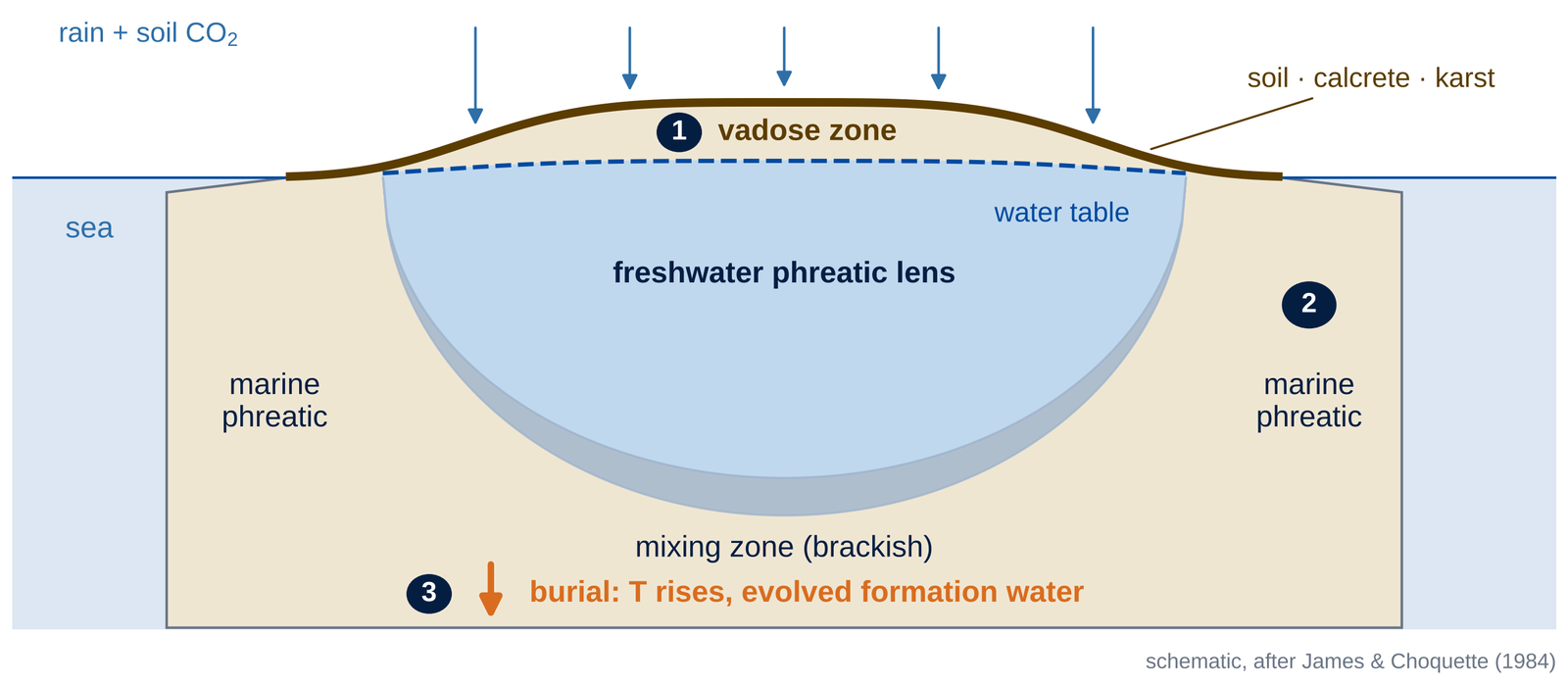
Follow the water. Rain passes through the soil, picks up CO₂ and becomes slightly acidic, which is why it can dissolve limestone. In the vadose zone the pores hold both air and water. Below the water table every pore is full of fresh water: the freshwater lens. Where fresh water meets seawater there is a brackish mixing zone, and all around the rock is soaked in seawater. Deeper down, in burial, the rock gets hotter and the pore water slowly changes by reacting with the rock.Folgen Sie dem Wasser. Regen sickert durch den Boden, nimmt CO₂ auf und wird leicht sauer; deshalb kann er Kalkstein lösen. In der vadosen Zone enthalten die Poren Luft und Wasser. Unter dem Grundwasserspiegel ist jede Pore mit Süßwasser gefüllt: die Süßwasserlinse. Wo Süßwasser auf Meerwasser trifft, liegt eine brackische Mischungszone, und ringsum ist das Gestein mit Meerwasser getränkt. In größerer Tiefe, bei der Versenkung, wird das Gestein wärmer, und das Porenwasser verändert sich langsam durch Reaktion mit dem Gestein.
The three controlsDie drei Steuergrößen
For every setting, ask the same three questions. What is the water? (its δ¹⁸O, its carbon content and the δ¹³C of that carbon) How much of it passed through? (the water/rock ratio) At what temperature did the new carbonate grow? If you can answer these, you can predict what alteration does to a signal.Stellen Sie für jedes Milieu dieselben drei Fragen. Welches Wasser? (sein δ¹⁸O, sein Kohlenstoffgehalt und das δ¹³C dieses Kohlenstoffs) Wie viel davon ist durchgeflossen? (das Wasser/Gesteins-Verhältnis) Bei welcher Temperatur ist das neue Karbonat gewachsen? Wer diese Fragen beantworten kann, kann vorhersagen, was die Veränderung mit einem Signal macht.
Mineralogy decides what survivesDie Mineralogie entscheidet, was überdauert
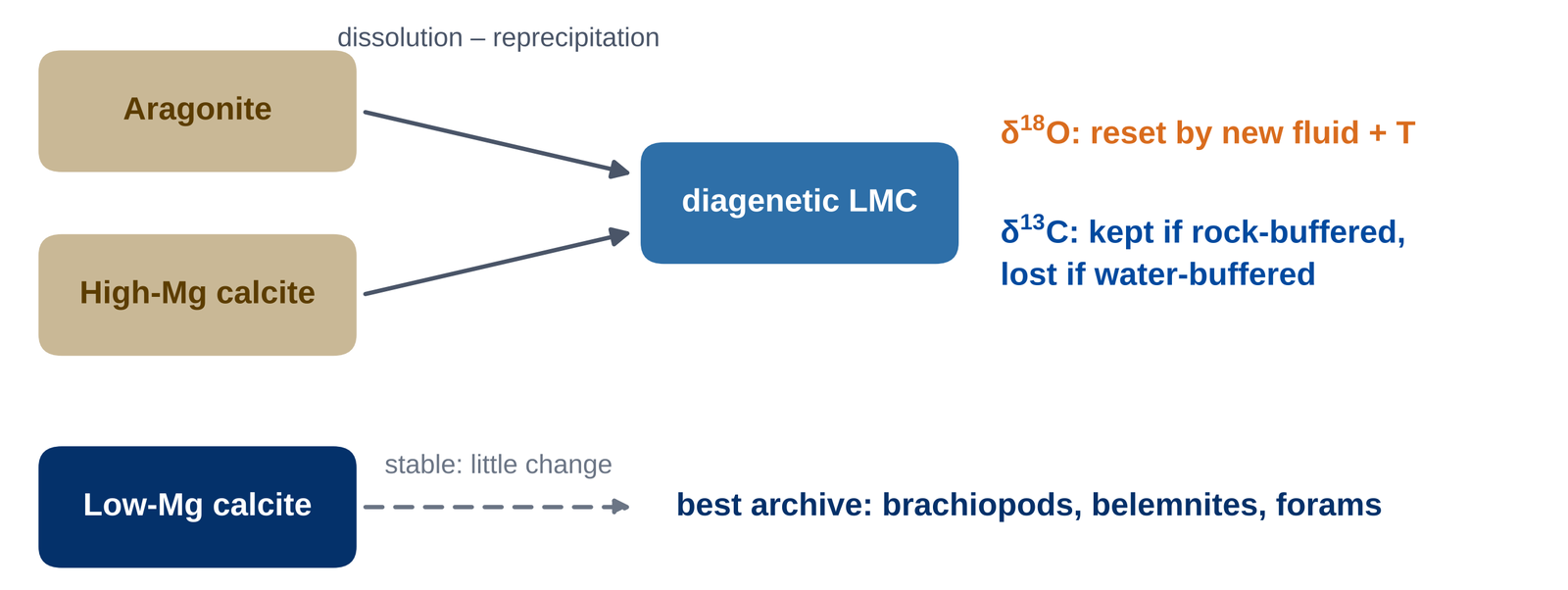
Aragonite and high-magnesium calcite are unstable at the Earth's surface: they are more soluble than low-magnesium calcite. A pore water can therefore dissolve them and, at the same time, precipitate low-magnesium calcite, crystal by crystal. Corals, many molluscs, green algae, early marine cements and most platform mud are made of the unstable minerals. Low-magnesium calcite is the stable form, so a brachiopod or belemnite built of it has much less reason to change, although it can still recrystallise, especially during deep burial. That is why long-term temperature records rely on such stable skeletons, foraminifera, or the phosphate of conodonts, and not on bulk limestone.Aragonit und Hoch-Magnesium-Calcit sind an der Erdoberfläche instabil: Sie sind löslicher als Niedrig-Magnesium-Calcit. Ein Porenwasser kann sie daher lösen und gleichzeitig Niedrig-Magnesium-Calcit ausfällen, Kristall für Kristall. Korallen, viele Mollusken, Grünalgen, frühe marine Zemente und der größte Teil des Plattformschlamms bestehen aus den instabilen Mineralen. Niedrig-Magnesium-Calcit ist die stabile Form; ein Brachiopode oder Belemnit aus diesem Mineral hat daher viel weniger Grund, sich zu verändern, kann aber dennoch rekristallisieren, besonders bei tiefer Versenkung. Deshalb beruhen langfristige Temperaturreihen auf solchen stabilen Skeletten, auf Foraminiferen oder auf dem Phosphat von Conodonten, und nicht auf Gesamtgestein.
When the new calcite grows, it takes its oxygen from the water, at the temperature of the water: once enough water has passed through (a water/rock ratio of about 1 or more), the original δ¹⁸O is lost. Carbon is different. If most of the carbon comes from the dissolving old carbonate, the new calcite inherits the old δ¹³C. Only if a lot of water brings carbon from outside is δ¹³C reset as well. Why should the two elements behave so differently in the same water? Section 2.Wenn der neue Calcit wächst, bezieht er seinen Sauerstoff aus dem Wasser, bei der Temperatur des Wassers: Sobald genug Wasser hindurchgeflossen ist (ein Wasser/Gesteins-Verhältnis von etwa 1 oder mehr), geht das ursprüngliche δ¹⁸O verloren. Beim Kohlenstoff ist es anders. Stammt der meiste Kohlenstoff aus dem sich lösenden alten Karbonat, erbt der neue Calcit das alte δ¹³C. Nur wenn viel Wasser Kohlenstoff von außen heranbringt, wird auch δ¹³C zurückgesetzt. Warum verhalten sich die beiden Elemente im selben Wasser so unterschiedlich? Abschnitt 2.
2. Why oxygen resets long before carbon2. Warum Sauerstoff lange vor Kohlenstoff zurückgesetzt wird
This is the central idea of the module, and it is a mass balance. Think of the rock as a store of oxygen and carbon. Every kilogram of water that flows through offers its own oxygen and carbon in exchange. Water is H₂O, so almost all of its mass is oxygen: one kilogram of water carries almost twice as much oxygen as one kilogram of calcite (89 % versus 48 % by mass). But water carries only a trace of dissolved carbon, thousands of times less than the rock. So the rock's oxygen is quickly replaced, while its carbon is barely touched.Das ist der Kerngedanke dieses Moduls, und es ist eine Massenbilanz. Stellen Sie sich das Gestein als Speicher für Sauerstoff und Kohlenstoff vor. Jedes Kilogramm Wasser, das hindurchfließt, bietet seinen eigenen Sauerstoff und Kohlenstoff zum Austausch an. Wasser ist H₂O, fast seine ganze Masse ist also Sauerstoff: Ein Kilogramm Wasser enthält fast doppelt so viel Sauerstoff wie ein Kilogramm Calcit (89 % gegenüber 48 % der Masse). Gelöster Kohlenstoff ist im Wasser dagegen nur in Spuren vorhanden, tausendfach weniger als im Gestein. Daher wird der Sauerstoff des Gesteins schnell ersetzt, sein Kohlenstoff kaum berührt.
δrock = δeq + (δ0 − δeq) · exp(−N · Cw / Cr)
N = cumulative water/rock mass ratio · Cw, Cr = concentration of O or C in water and rock · δ0 = primary value · δeq = calcite in equilibrium with the waterN = kumulatives Wasser/Gesteins-Massenverhältnis · Cw, Cr = Konzentration von O oder C in Wasser und Gestein · δ0 = Primärwert · δeq = Calcit im Gleichgewicht mit dem Wasser
- Step 1Schritt 1 · Oxygen and carbon in calcite (CaCO₃, 100.09 g/mol)Sauerstoff und Kohlenstoff im Calcit (CaCO₃, 100.09 g/mol)O: 48.0/100.09 = 48 % · C: 12.0/100.09 = 12 %
- Step 2Schritt 2 · Oxygen and carbon in the waterSauerstoff und Kohlenstoff im WasserO: 16.0/18.0 = 89 % · C: 5 mmol × 12 g/mol = 60 mg/kg = 0.006 %
- Step 3Schritt 3 · Water/rock concentration ratio for each elementKonzentrationsverhältnis Wasser/Gestein für jedes ElementO: 89/48 ≈ 1.85 · C: 0.006/12 ≈ 0.0005
- Step 4Schritt 4 · CompareVergleichen1.85 / 0.0005 ≈ 3700
- Step 5Schritt 5 · MeaningBedeutung~1 kg water per kg rock resets most of the O; C needs thousands~1 kg Wasser pro kg Gestein setzt den Großteil des O zurück; C braucht Tausende
🧪 Interactive: flush a limestone with meteoric water🧪 Interaktiv: einen Kalkstein mit meteorischem Wasser durchspülen
Primary aragonite: δ¹⁸O 0 ‰, δ¹³C +4 ‰ VPDB; equilibrium calcite: δ¹⁸O −7.38 ‰, δ¹³C −10 ‰ VPDB (as in the figure). Cr: O 480 000, C 120 000 ppm; Cw(O) 888 000 ppm. Try ten times more DIC, as in a fluid from organic-rich rocks.Primärer Aragonit: δ¹⁸O 0 ‰, δ¹³C +4 ‰ VPDB; Gleichgewichtscalcit: δ¹⁸O −7,38 ‰, δ¹³C −10 ‰ VPDB (wie in der Abbildung). Cr: O 480 000, C 120 000 ppm; Cw(O) 888 000 ppm. Probieren Sie zehnmal mehr DIC, wie in einem Fluid aus organikreichen Gesteinen.
Two consequencesZwei Folgerungen
A sample can have a fully reset δ¹⁸O and still keep its original δ¹³C. That is why carbon-isotope stratigraphy often works where oxygen thermometry fails. The reverse is not true: if δ¹³C has been reset, δ¹⁸O has been reset too (its value only moves if the water differs from the original). And if the water carries much more carbon, for example CO₂ from decaying organic matter, carbon resets at much lower water/rock ratios.Eine Probe kann ein vollständig zurückgesetztes δ¹⁸O haben und dennoch ihr ursprüngliches δ¹³C behalten. Deshalb funktioniert die Kohlenstoffisotopen-Stratigraphie oft dort, wo die Sauerstoff-Thermometrie versagt. Umgekehrt gilt das nicht: Ist δ¹³C zurückgesetzt, so ist auch δ¹⁸O zurückgesetzt (sein Wert ändert sich nur, wenn das Wasser vom ursprünglichen abweicht). Und wenn das Wasser viel mehr Kohlenstoff enthält, etwa CO₂ aus dem Abbau organischer Substanz, wird Kohlenstoff bei viel kleineren Wasser/Gesteins-Verhältnissen zurückgesetzt.
3. Three settings, three fingerprints3. Drei Milieus, drei Fingerabdrücke
Cements show where the water wasZemente zeigen, wo das Wasser war
A crystal can only grow where there is water, so the shape of a cement records how water filled the pore. In a pore full of water, crystals grow evenly on every grain: a rim of equal thickness, the isopachous fringe, typical of the marine setting. In a pore with air and water, water hangs as drops under grains and as bridges where grains touch, and cement grows only there: pendant and meniscus cements of the vadose zone. Crystals that grow slowly from few nuclei become larger towards the pore centre: drusy or equant mosaics of the freshwater lens and of burial. Rule: look before you drill. Decide in thin section which grain or cement generation you sample, otherwise the powder mixes different waters and times.Ein Kristall kann nur dort wachsen, wo Wasser ist; die Form eines Zements zeigt daher, wie das Wasser die Pore füllte. In einer wassergefüllten Pore wachsen die Kristalle gleichmäßig auf jedem Korn: ein Saum gleicher Dicke, der isopache Saum, typisch für das marine Milieu. In einer Pore mit Luft und Wasser hängt das Wasser als Tropfen unter den Körnern und als Brücke an den Kornkontakten, und nur dort wächst Zement: Hänge- und Meniskuszemente der vadosen Zone. Kristalle, die langsam aus wenigen Keimen wachsen, werden zur Porenmitte hin größer: drusige oder blockige Mosaike der Süßwasserlinse und der Versenkung. Regel: erst schauen, dann bohren. Legen Sie im Dünnschliff fest, welches Korn oder welche Zementgeneration Sie beproben; sonst mischt das Pulver verschiedene Wässer und Zeiten.
Marine: a lot of water, little changeMarin: viel Wasser, wenig Veränderung
When the diagenetic fluid is seawater at sea-floor temperature, the cement grows under almost the same conditions as the organisms around it. In δ¹⁸O, modern reef cements (Gonzalez & Lohmann, 1985) plot close to the values expected for equilibrium with local seawater. A lot of water does not move them far, because the water is nearly the same as the original. What matters is not only how much water, but how different it is. The importance of marine diagenesis is indirect: it fills the rock with aragonite and high-Mg calcite cements, which become the raw material for later alteration.Ist das diagenetische Fluid Meerwasser mit Meeresbodentemperatur, wächst der Zement unter fast denselben Bedingungen wie die Organismen um ihn herum. Im δ¹⁸O liegen moderne Riffzemente (Gonzalez & Lohmann, 1985) nahe an den Werten, die für ein Gleichgewicht mit dem örtlichen Meerwasser zu erwarten sind. Viel Wasser verschiebt sie nicht weit, weil das Wasser dem ursprünglichen fast gleicht. Es zählt nicht nur, wie viel Wasser, sondern wie verschieden es ist. Die Bedeutung der marinen Diagenese ist indirekt: Sie füllt das Gestein mit Aragonit- und Hoch-Mg-Calcit-Zementen, dem Rohstoff späterer Veränderung.
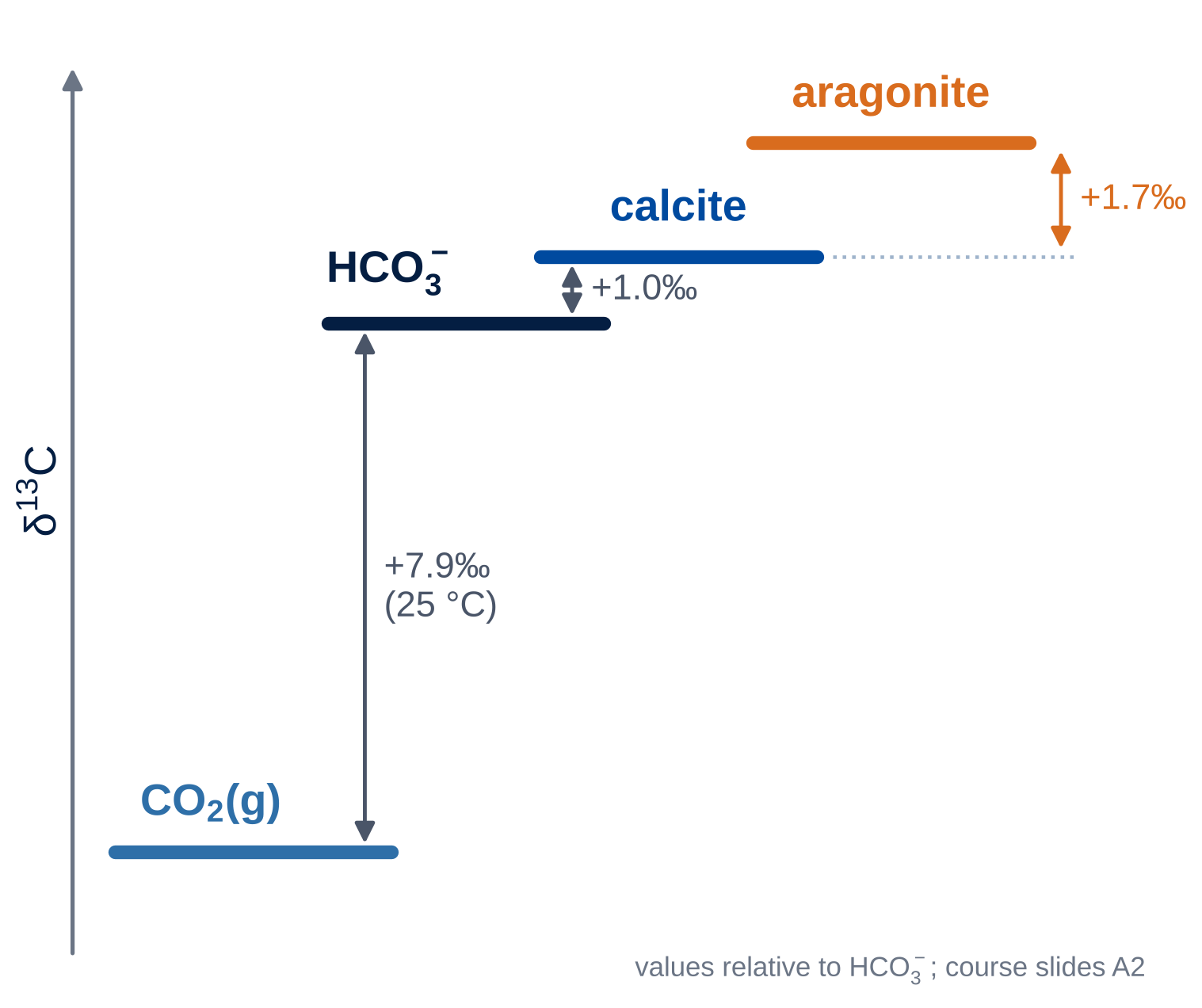
Even without any alteration, the mineral matters. Aragonite takes up more ¹³C than calcite from the same bicarbonate, about 1.7 ‰ more. So if the proportion of aragonite in a sediment changes up a section, bulk δ¹³C changes too, and it can look like an excursion of the global carbon cycle when it is not. During diagenesis, the offset only appears if the new calcite takes part of its carbon from the pore water; if no carbon at all is exchanged, the calcite simply inherits the carbon of the aragonite. Compare like with like: an aragonitic bivalve and a calcitic brachiopod from the same bed are not expected to have the same δ¹³C.Auch ohne jede Veränderung spielt das Mineral eine Rolle. Aragonit nimmt aus demselben Hydrogencarbonat mehr ¹³C auf als Calcit, etwa 1,7 ‰ mehr. Ändert sich also der Aragonitanteil eines Sediments im Profil, ändert sich auch das Gesamt-δ¹³C, und das kann wie eine Exkursion des globalen Kohlenstoffkreislaufs aussehen, obwohl es keine ist. Bei der Diagenese tritt der Abstand nur auf, wenn der neue Calcit einen Teil seines Kohlenstoffs aus dem Porenwasser bezieht; wird gar kein Kohlenstoff ausgetauscht, erbt der Calcit einfach den Kohlenstoff des Aragonits. Vergleichen Sie Gleiches mit Gleichem: Bei einer aragonitischen Muschel und einem calcitischen Brachiopoden aus derselben Schicht ist kein gleiches δ¹³C zu erwarten.
Meteoric: one water, many carbon mixturesMeteorisch: ein Wasser, viele Kohlenstoffmischungen
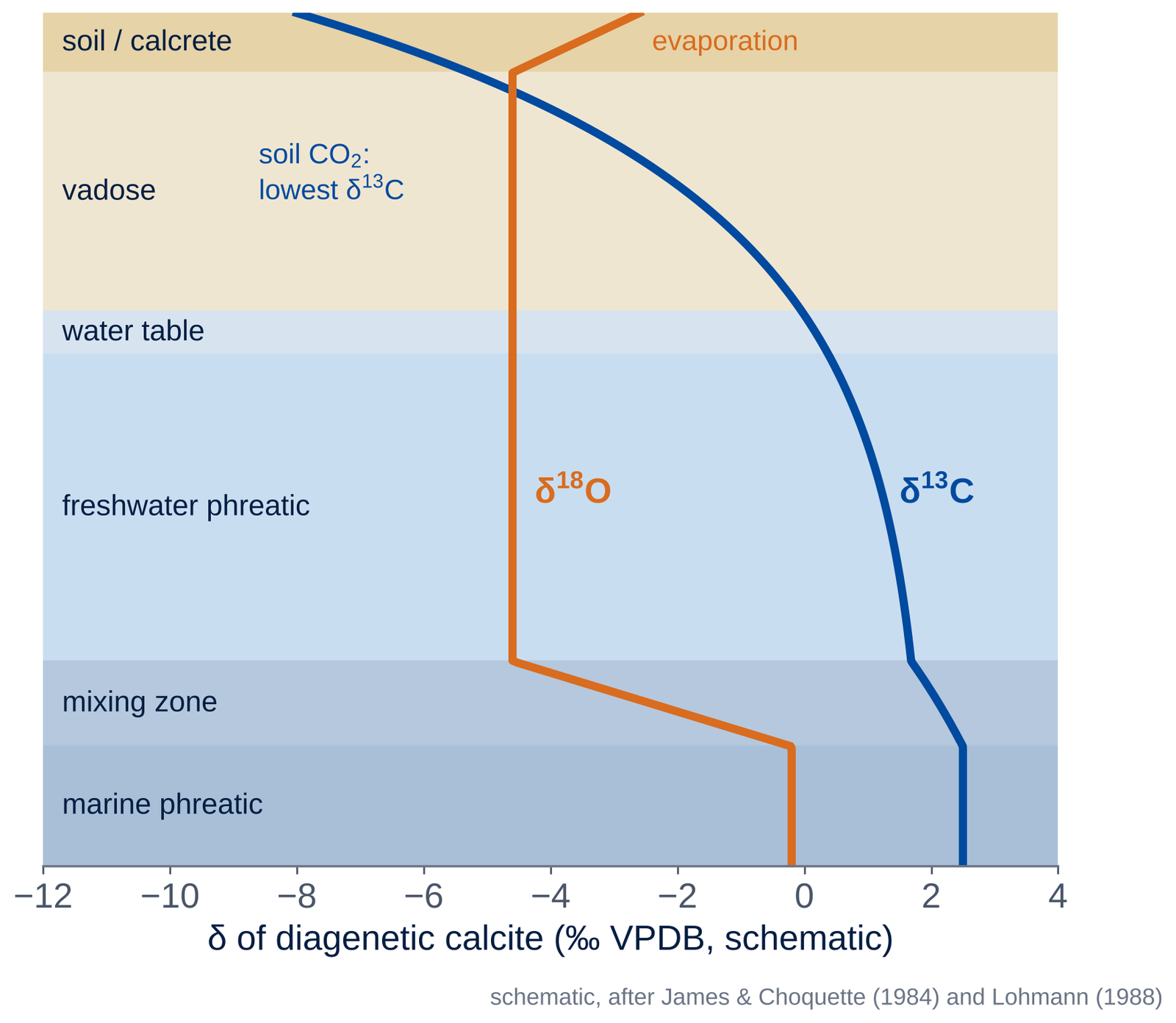
When a platform is exposed, for example during a glacial sea-level fall, rain enters the rock. Carbon changes with depth because its source changes: near the surface the water carries light CO₂ from soil respiration, so calcite is light; deeper down, more and more carbon comes from the dissolving limestone, and δ¹³C climbs back towards marine values. Oxygen hardly changes with depth: the water is the same rain everywhere, at the same temperature. Only at the very top can evaporation make it a little heavier. The result is a large spread in δ¹³C at almost constant δ¹⁸O.Wird eine Plattform freigelegt, etwa bei einer glazialen Meeresspiegelabsenkung, dringt Regen ins Gestein. Kohlenstoff ändert sich mit der Tiefe, weil sich seine Quelle ändert: Nahe der Oberfläche führt das Wasser leichtes CO₂ aus der Bodenatmung, der Calcit ist daher leicht; tiefer stammt immer mehr Kohlenstoff aus dem sich lösenden Kalkstein, und δ¹³C steigt wieder zu marinen Werten an. Sauerstoff ändert sich mit der Tiefe kaum: Das Wasser ist überall derselbe Regen bei derselben Temperatur. Nur ganz oben kann Verdunstung es etwas schwerer machen. Das Ergebnis ist eine große Spannweite im δ¹³C bei fast konstantem δ¹⁸O.
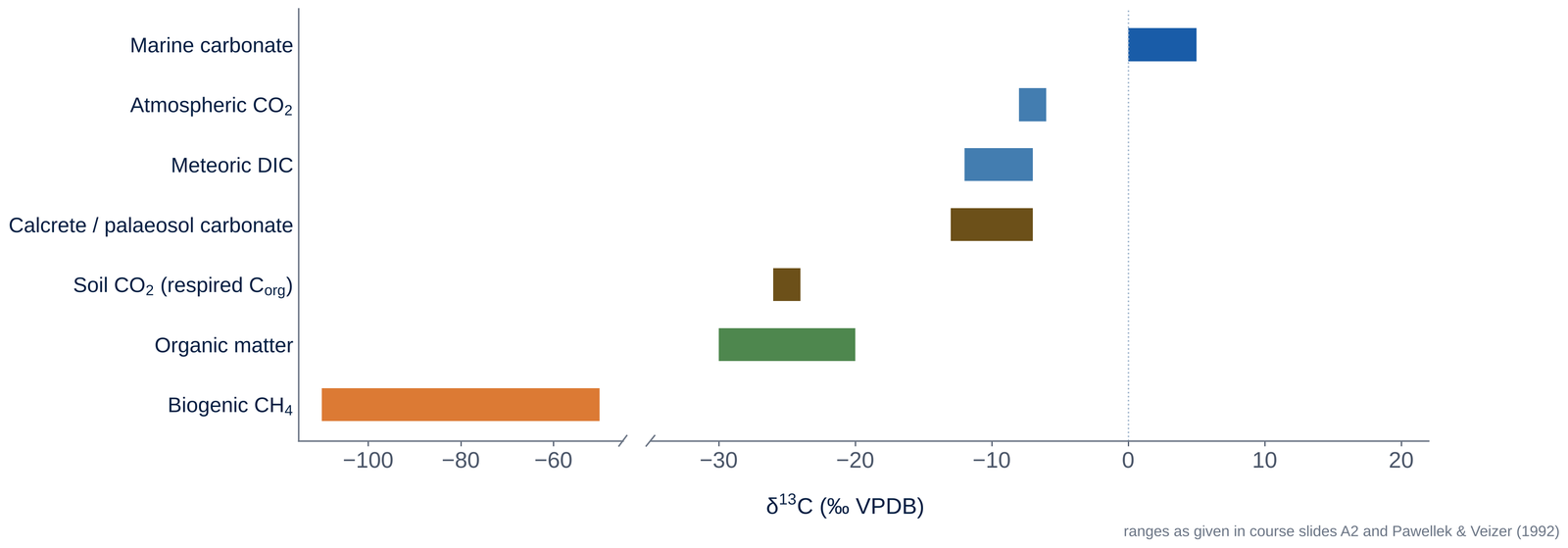
Rainwater with dissolved CO₂ dissolves limestone (CaCO₃ + CO₂ + H₂O → Ca²⁺ + 2 HCO₃⁻): one carbon comes from the CO₂, one from the rock. Meteoric DIC therefore lies between soil gas and rock. Under a vegetated soil, meteoric cements become clearly lighter than marine ones; on a bare surface with only atmospheric CO₂ they can have similar δ¹³C, and carbon then does not show the alteration although oxygen has been reset. Before land plants, soils produced little respired CO₂, so meteoric alteration shifted δ¹³C less.Regenwasser mit gelöstem CO₂ löst Kalkstein (CaCO₃ + CO₂ + H₂O → Ca²⁺ + 2 HCO₃⁻): Ein Kohlenstoff stammt aus dem CO₂, einer aus dem Gestein. Meteorisches DIC liegt daher zwischen Bodengas und Gestein. Unter einem bewachsenen Boden werden meteorische Zemente deutlich leichter als marine; auf einer kahlen Oberfläche mit nur atmosphärischem CO₂ können sie ein ähnliches δ¹³C haben, und der Kohlenstoff zeigt die Veränderung dann nicht, obwohl der Sauerstoff zurückgesetzt ist. Vor den Landpflanzen erzeugten Böden wenig veratmetes CO₂, daher verschob meteorische Veränderung das δ¹³C weniger.
The meteoric calcite lineDie meteorische Calcitlinie
Calcites from one meteoric system plot as a near-vertical array on a δ¹³C–δ¹⁸O cross-plot (Lohmann, 1988): the same δ¹⁸O, because they share one rainwater and one temperature, but different δ¹³C, because each took a different mix of rock carbon and soil carbon. One end is rock-buffered (near marine), the other water-buffered (recording soil-derived carbon). A vertical array at low δ¹⁸O points to meteoric diagenesis; do not read its carbon spread as a change in the global carbon cycle. A zoned cement can show the same evolution in time: Meyers & Lohmann (1985) found successive zones moving from near-marine to light values as the unstable grains that buffered the water were used up.Calcite eines meteorischen Systems liegen im δ¹³C–δ¹⁸O-Diagramm auf einer nahezu senkrechten Anordnung (Lohmann, 1988): dasselbe δ¹⁸O, weil sie ein Regenwasser und eine Temperatur teilen, aber verschiedenes δ¹³C, weil jeder eine andere Mischung aus Gesteins- und Bodenkohlenstoff aufnahm. Ein Ende ist gesteinsgepuffert (nahe marin), das andere wassergepuffert (zeichnet Bodenkohlenstoff auf). Eine senkrechte Anordnung bei niedrigem δ¹⁸O deutet auf meteorische Diagenese; lesen Sie ihre Kohlenstoffspanne nicht als Änderung des globalen Kohlenstoffkreislaufs. Ein zonierter Zement kann dieselbe Entwicklung zeitlich zeigen: Meyers & Lohmann (1985) fanden aufeinanderfolgende Zonen, die sich von nahezu marinen zu leichten Werten bewegten, als die instabilen Körner, die das Wasser pufferten, aufgebraucht waren.
4. Burial, organic matter and dolomite4. Versenkung, organisches Material und Dolomit
As sediment is buried it gets hotter, and the pore water becomes saltier and changes its composition by reacting with the rock. Burial cements are coarse, clear and the last to fill the pores. Burial water is usually low in oxygen and carries dissolved iron, so burial cements often contain iron. Successive cement generations tend to have lower δ¹⁸O, because the oxygen isotope difference between calcite and water shrinks as temperature rises. δ¹³C hardly moves: the pore water still carries little carbon compared with the rock.Bei der Versenkung wird das Sediment wärmer, und das Porenwasser wird salziger und verändert seine Zusammensetzung durch Reaktion mit dem Gestein. Versenkungszemente sind grobkristallin, klar und füllen die Poren zuletzt. Versenkungswasser ist meist sauerstoffarm und führt gelöstes Eisen, daher enthalten Versenkungszemente oft Eisen. Aufeinanderfolgende Zementgenerationen haben meist ein niedrigeres δ¹⁸O, weil der Sauerstoffisotopenunterschied zwischen Calcit und Wasser mit steigender Temperatur kleiner wird. δ¹³C ändert sich kaum: Das Porenwasser enthält im Vergleich zum Gestein weiterhin wenig Kohlenstoff.
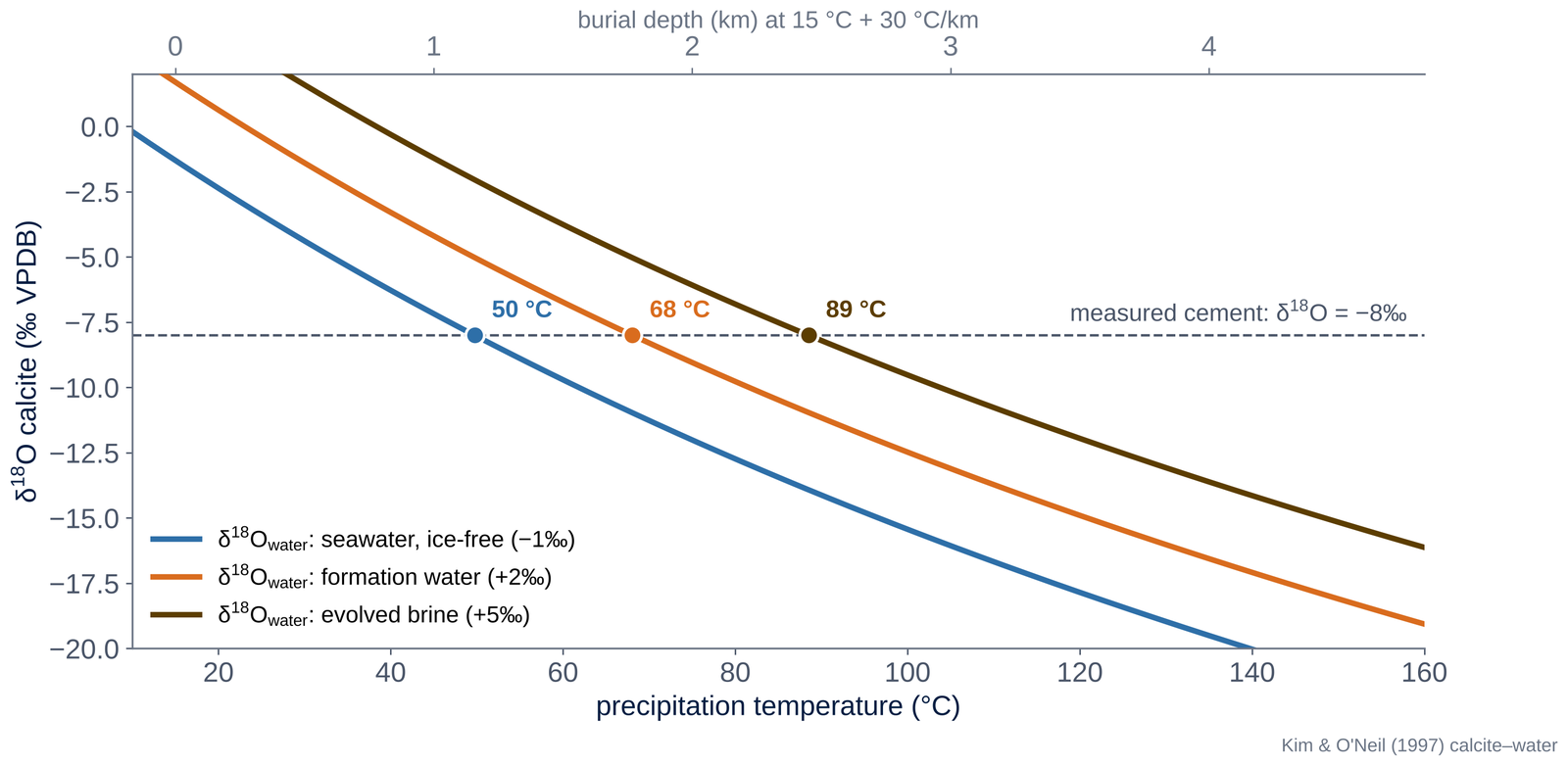
One δ¹⁸O, two unknownsEin δ¹⁸O, zwei Unbekannte
A calcite δ¹⁸O fixes a combination of temperature and water δ¹⁸O, not a temperature. Lighter water at low temperature and heavier water at high temperature give the same calcite. Deep, hot, saline formation waters are commonly heavier than seawater, because they exchange oxygen with ¹⁸O-rich minerals at high temperature; shallow formation waters can be lighter if they contain meteoric water. Assuming seawater for a deep cement therefore usually underestimates its temperature. An independent thermometer, such as clumped isotopes (Δ₄₇) or fluid inclusions, removes the ambiguity.Ein Calcit-δ¹⁸O legt eine Kombination aus Temperatur und Wasser-δ¹⁸O fest, keine Temperatur. Leichteres Wasser bei niedriger Temperatur und schwereres Wasser bei hoher Temperatur ergeben denselben Calcit. Tiefe, heiße, salzhaltige Formationswässer sind meist schwerer als Meerwasser, weil sie bei hoher Temperatur Sauerstoff mit ¹⁸O-reichen Mineralen austauschen; flache Formationswässer können leichter sein, wenn sie meteorisches Wasser enthalten. Wer für einen tiefen Zement Meerwasser annimmt, unterschätzt daher meist dessen Temperatur. Ein unabhängiges Thermometer, etwa Clumped-Isotope (Δ₄₇) oder Flüssigkeitseinschlüsse, beseitigt die Mehrdeutigkeit.
🌡️ Interactive: how hot was the cement?🌡️ Interaktiv: Wie heiß war der Zement?
Kim & O'Neil (1997): 1000 ln α = 18.03 × 10³/T − 32.42 (a later recalculation with a revised acid fractionation factor gives −32.17 and temperatures about 1.5 °C higher); VSMOW = 1.03092 × VPDB + 30.92 (Brand et al., 2014); surface temperature 15 °C.Kim & O'Neil (1997): 1000 ln α = 18,03 × 10³/T − 32,42 (eine spätere Neuberechnung mit korrigiertem Säurefraktionierungsfaktor ergibt −32,17 und etwa 1,5 °C höhere Temperaturen); VSMOW = 1,03092 × VPDB + 30,92 (Brand et al., 2014); Oberflächentemperatur 15 °C.
Organic matter pushes carbon both waysOrganisches Material verschiebt den Kohlenstoff in beide Richtungen
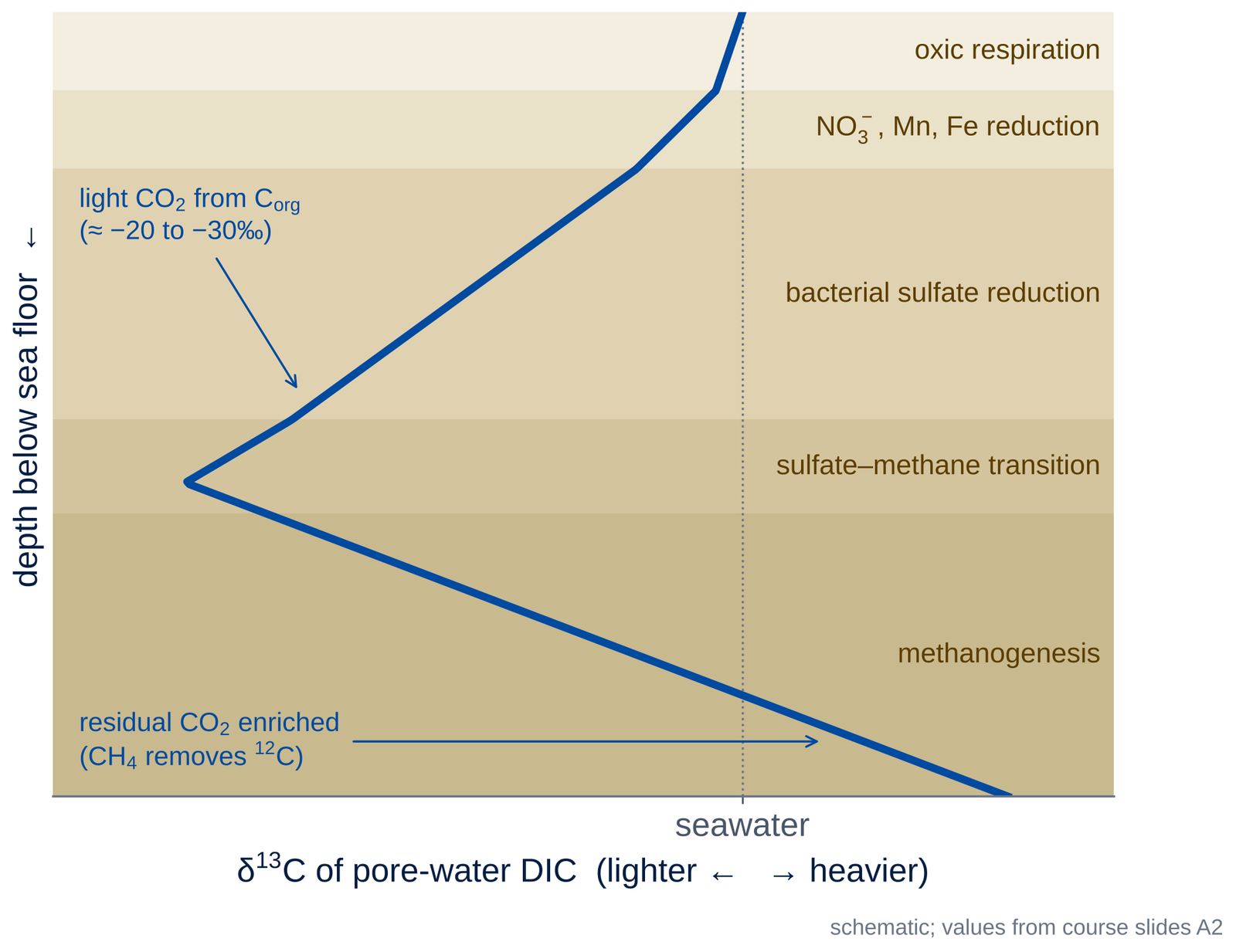
Below the sea floor, microbes oxidise organic matter with the most efficient oxidant available, then switch to the next one: oxygen, nitrate, manganese and iron oxides, sulfate, and finally, when sulfate is used up, methane production. Respiration and sulfate reduction turn light organic carbon into CO₂ with little isotope change, so the pore water becomes light and cements and concretions growing there are strongly depleted in ¹³C. Where sulfate and methane meet, microbes oxidise methane with sulfate and release its very light carbon, so pore-water δ¹³C is lowest there. In the methanogenic zone below, the microbes put the light carbon into methane, so the remaining CO₂ becomes heavy and carbonates growing there can be unusually heavy. In organic-rich rocks, a δ¹³C anomaly is therefore not automatically a global event.Unter dem Meeresboden oxidieren Mikroben organisches Material mit dem effizientesten verfügbaren Oxidationsmittel und wechseln dann zum nächsten: Sauerstoff, Nitrat, Mangan- und Eisenoxide, Sulfat und schließlich, wenn das Sulfat verbraucht ist, die Methanbildung. Atmung und Sulfatreduktion wandeln leichten organischen Kohlenstoff fast ohne Isotopenänderung in CO₂ um; das Porenwasser wird leicht, und dort wachsende Zemente und Konkretionen sind stark an ¹³C verarmt. Wo Sulfat und Methan aufeinandertreffen, oxidieren Mikroben Methan mit Sulfat und setzen dessen sehr leichten Kohlenstoff frei; dort ist das δ¹³C des Porenwassers am niedrigsten. In der methanogenen Zone darunter bauen die Mikroben den leichten Kohlenstoff in Methan ein; das verbleibende CO₂ wird schwer, und dort wachsende Karbonate können ungewöhnlich schwer sein. In organikreichen Gesteinen ist eine δ¹³C-Anomalie daher nicht automatisch ein globales Ereignis.
Dolomite records the dolomitising waterDolomit zeichnet das dolomitisierende Wasser auf
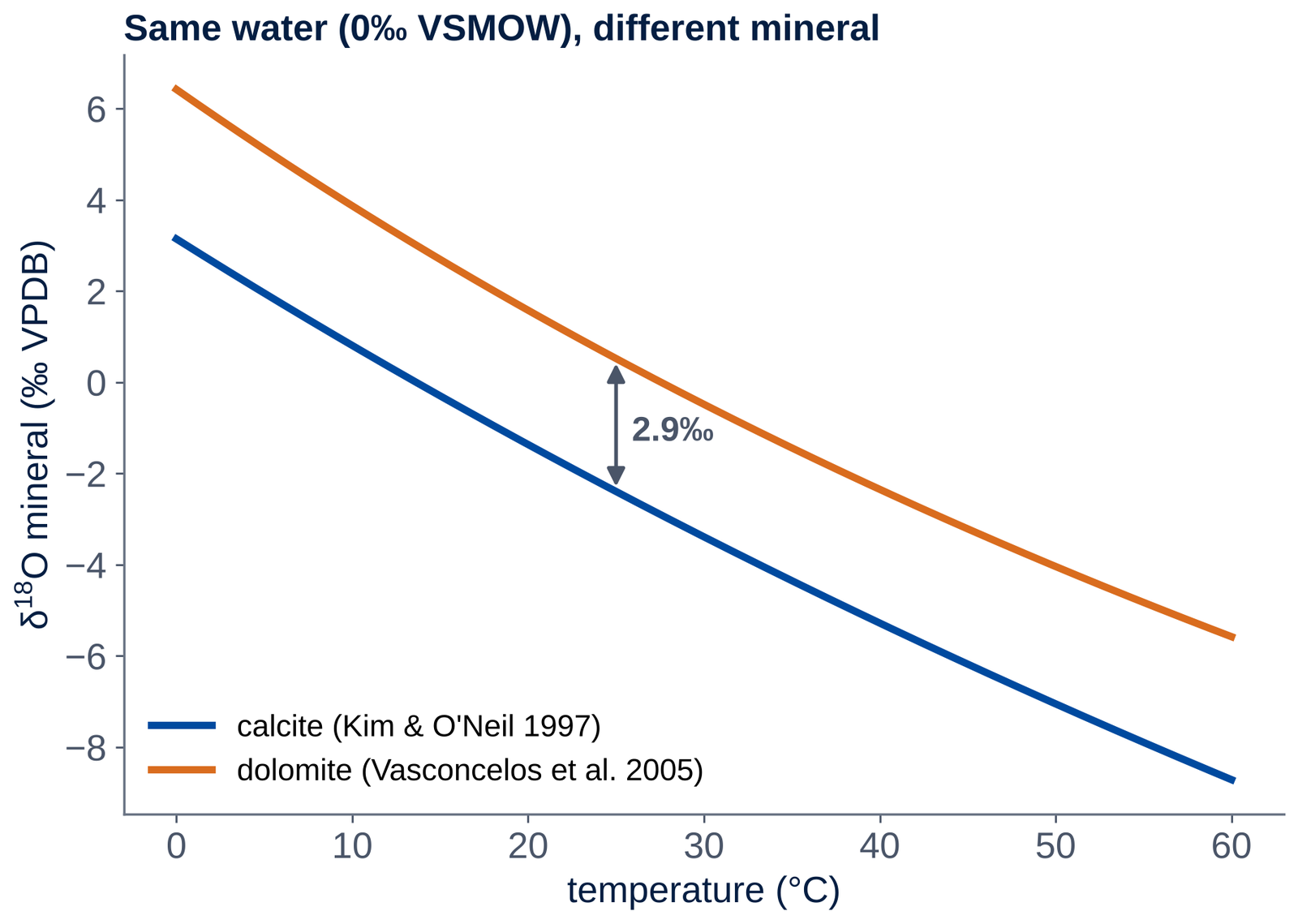
Dolomite contains magnesium that the limestone lacks, so the magnesium must be brought in by water, and that takes a lot of water. Dolomitisation is therefore a high water/rock process: dolomite δ¹⁸O records the dolomitising water and its temperature, while its carbon is often inherited from the precursor. Oxygen reset, carbon inherited: the same asymmetry again. On top, dolomite from the same water at the same temperature is heavier in δ¹⁸O than calcite, by about 3 ‰ at 25 °C with this calibration (others give up to about 4 ‰). A dolomite heavier than the calcite next to it is not automatically evidence of evaporated water. Low-temperature dolomite calibrations are still debated.Dolomit enthält Magnesium, das dem Kalkstein fehlt; das Magnesium muss also mit dem Wasser herangeführt werden, und dafür braucht es viel Wasser. Dolomitisierung ist daher ein Prozess mit hohem Wasser/Gesteins-Verhältnis: Das δ¹⁸O des Dolomits zeichnet das dolomitisierende Wasser und dessen Temperatur auf, während sein Kohlenstoff oft vom Vorläufer geerbt wird. Sauerstoff zurückgesetzt, Kohlenstoff geerbt: wieder dieselbe Asymmetrie. Hinzu kommt: Dolomit aus demselben Wasser bei derselben Temperatur ist im δ¹⁸O schwerer als Calcit, bei 25 °C mit dieser Kalibrierung um etwa 3 ‰ (andere ergeben bis etwa 4 ‰). Ein Dolomit, der schwerer ist als der Calcit daneben, belegt also nicht automatisch verdunstetes Wasser. Kalibrierungen für Dolomit bei niedriger Temperatur sind weiterhin umstritten.
5. Is my sample altered?5. Ist meine Probe alteriert?
Cathodoluminescence: a redox storyKathodolumineszenz: eine Redoxgeschichte
Under an electron beam, Mn²⁺ in calcite makes it luminesce orange, while Fe²⁺ quenches the luminescence. In oxygen-rich seawater, manganese and iron form insoluble oxides, so a living brachiopod takes up very little and its shell stays dark under cathodoluminescence (CL). Many diagenetic waters are low in oxygen: manganese and iron dissolve and enter the new calcite, so altered calcite tends to glow. But a dark shell is not proof of preservation: if altered calcite contains a lot of iron, the iron can hide the manganese glow. CL is a first check, not a proof.Unter einem Elektronenstrahl lässt Mn²⁺ den Calcit orange lumineszieren, während Fe²⁺ die Lumineszenz löscht. In sauerstoffreichem Meerwasser bilden Mangan und Eisen unlösliche Oxide; ein lebender Brachiopode nimmt daher sehr wenig auf, und seine Schale bleibt unter der Kathodolumineszenz (KL) dunkel. Viele diagenetische Wässer sind sauerstoffarm: Mangan und Eisen gehen in Lösung und werden in den neuen Calcit eingebaut, daher leuchtet alterierter Calcit meist. Eine dunkle Schale beweist aber keine Erhaltung: Enthält alterierter Calcit viel Eisen, kann das Eisen das Leuchten des Mangans verdecken. KL ist eine erste Prüfung, kein Beweis.
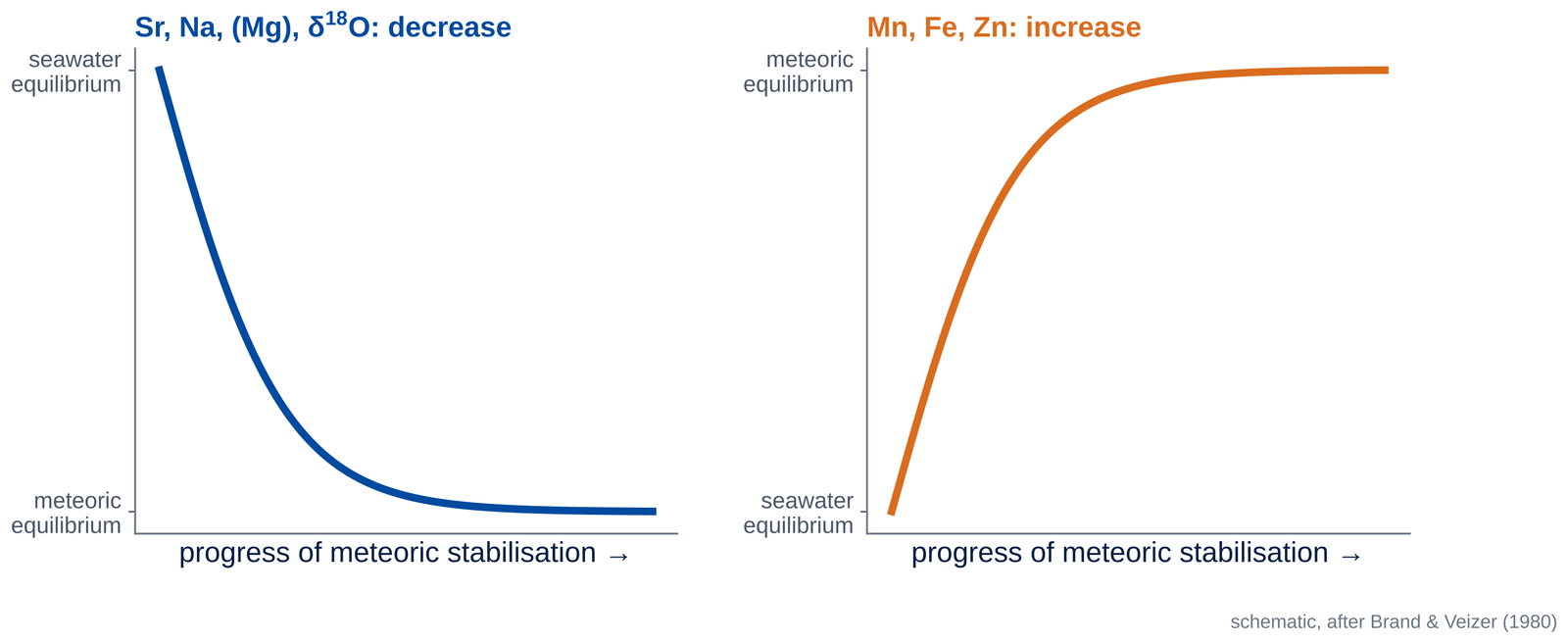
Trace elements follow the same logic as isotopes. During meteoric alteration strontium and sodium decrease, because meteoric water is poor in them and calcite takes up less strontium than aragonite; manganese, iron and zinc increase, because low-oxygen waters carry them dissolved. Fossils close to the range of modern shells, high in Sr and low in Mn and Fe, are candidates for preserved material. There are no universal cut-off values: thresholds depend on the taxon and the setting. And because different signals reset at different water/rock ratios, a shell can pass the trace-element test and still have altered δ¹⁸O.Spurenelemente folgen derselben Logik wie die Isotope. Bei meteorischer Alteration nehmen Strontium und Natrium ab, weil meteorisches Wasser arm daran ist und Calcit weniger Strontium aufnimmt als Aragonit; Mangan, Eisen und Zink nehmen zu, weil sauerstoffarme Wässer sie gelöst führen. Fossilien nahe dem Bereich moderner Schalen, reich an Sr und arm an Mn und Fe, kommen als erhaltenes Material in Frage. Universelle Grenzwerte gibt es nicht: Schwellen hängen vom Taxon und vom Milieu ab. Und weil verschiedene Signale bei verschiedenen Wasser/Gesteins-Verhältnissen zurückgesetzt werden, kann eine Schale den Spurenelementtest bestehen und dennoch ein verändertes δ¹⁸O haben.
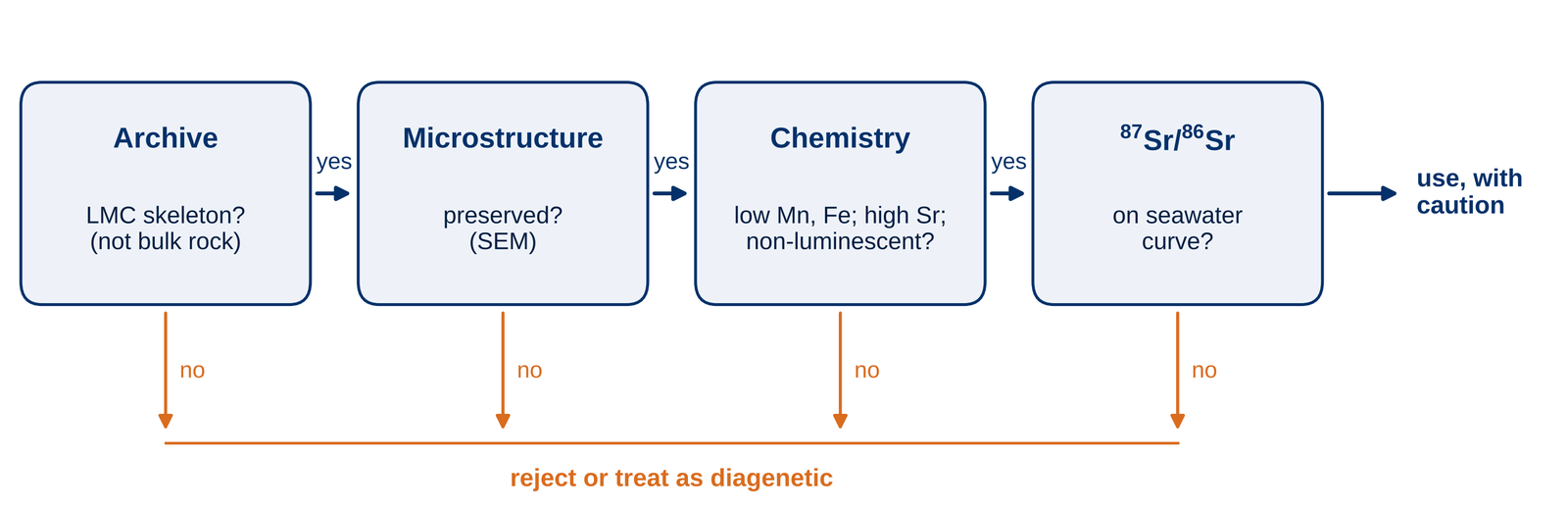
The last step compares the ⁸⁷Sr/⁸⁶Sr of the shell with the seawater curve for its age: a shell that exchanged strontium with a later fluid usually moves off the curve. Strontium isotopes are covered in a later lecture.Der letzte Schritt vergleicht das ⁸⁷Sr/⁸⁶Sr der Schale mit der Meerwasserkurve ihres Alters: Eine Schale, die Strontium mit einem späteren Fluid ausgetauscht hat, weicht meist von der Kurve ab. Strontiumisotope werden in einer späteren Vorlesung behandelt.
A correlation is not a testEine Korrelation ist kein Test
Many papers argue: δ¹³C and δ¹⁸O correlate, so the samples are altered; they do not, so the samples are fine. But alteration follows a curved path, the inverted J of section 2: oxygen changes first at nearly constant carbon. Such a path need not produce a straight-line correlation, and other processes can produce correlations without meteoric alteration. A correlation is a reason to look closer, not a test.Viele Arbeiten argumentieren: δ¹³C und δ¹⁸O korrelieren, also sind die Proben verändert; sie korrelieren nicht, also sind sie in Ordnung. Die Veränderung folgt aber einem gekrümmten Pfad, dem umgekehrten J aus Abschnitt 2: Sauerstoff ändert sich zuerst bei nahezu konstantem Kohlenstoff. Ein solcher Pfad muss keine lineare Korrelation erzeugen, und andere Prozesse können Korrelationen ohne meteorische Veränderung erzeugen. Eine Korrelation ist ein Grund, genauer hinzusehen, kein Test.
Case study: when alteration looks globalFallbeispiel: wenn Veränderung global aussieht
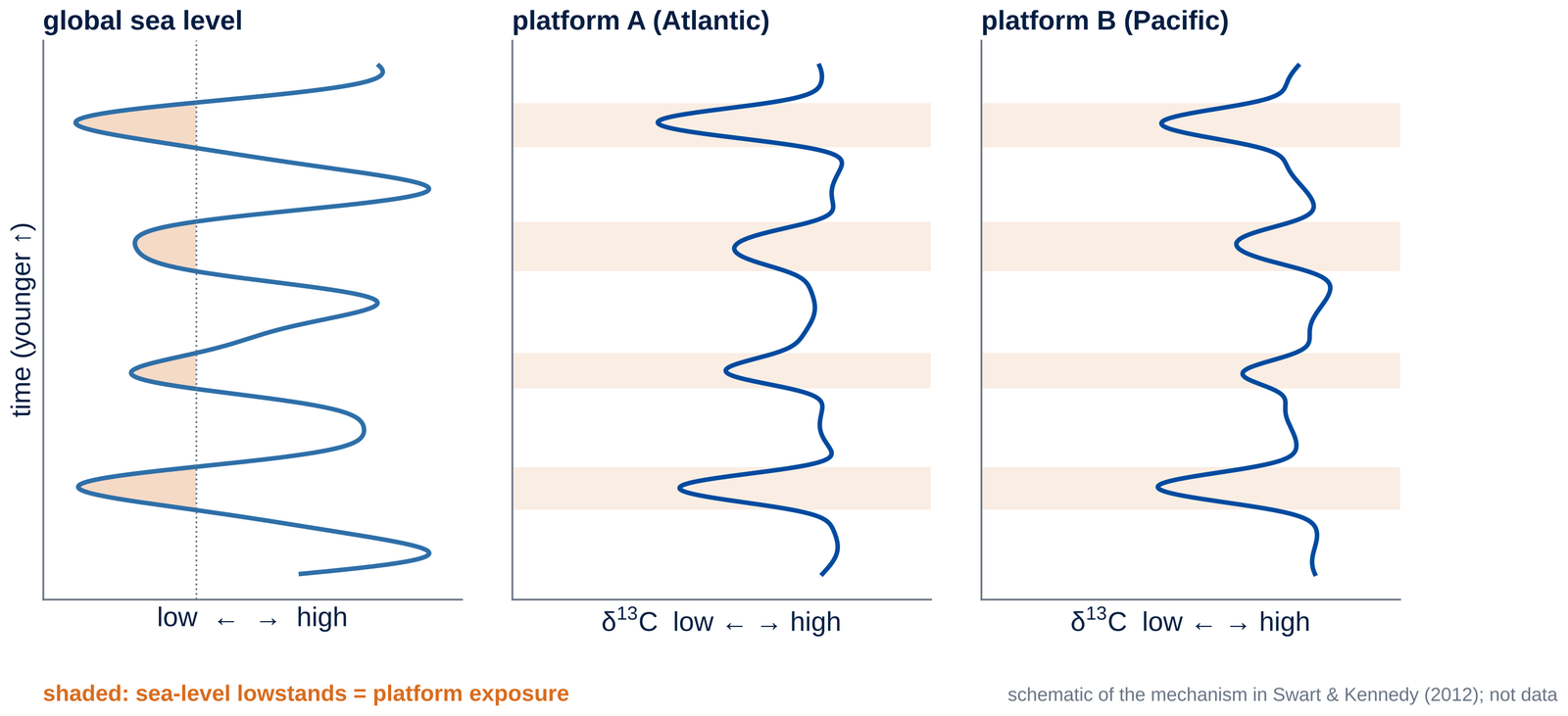
For old rocks there is no deep-sea record, so carbon-isotope curves come from platform carbonates. Large shifts have been read as global carbon-cycle events, mainly because the same pattern appears in many basins. Swart & Kennedy (2012) studied young platform cores from the Bahamas and from Enewetak Atoll in the Pacific, where the true ocean record is known from deep-sea sediments. Sea level is global: when it falls, every platform is exposed and altered by meteoric water at the same time. The platform records looked alike and were reproducible, but they did not record the ocean. Some very old δ¹³C anomalies may therefore be diagenetic. The same study points to a second effect from section 3: changes in how much platform-derived aragonite is mixed into the sediment. The curves can still be used for correlation; what is questioned is whether they record the global carbon cycle.Für alte Gesteine gibt es kein Tiefseearchiv; Kohlenstoffisotopenkurven stammen daher aus Plattformkarbonaten. Große Verschiebungen wurden als globale Ereignisse des Kohlenstoffkreislaufs gedeutet, vor allem weil dasselbe Muster in vielen Becken auftritt. Swart & Kennedy (2012) untersuchten junge Plattformkerne von den Bahamas und vom Enewetak-Atoll im Pazifik, wo das wahre Ozeansignal aus Tiefseesedimenten bekannt ist. Der Meeresspiegel ist global: Fällt er, werden alle Plattformen gleichzeitig freigelegt und durch meteorisches Wasser verändert. Die Plattformkurven glichen sich und waren reproduzierbar, zeichneten aber nicht den Ozean auf. Manche sehr alten δ¹³C-Anomalien könnten daher diagenetisch sein. Dieselbe Arbeit weist auf einen zweiten Effekt aus Abschnitt 3 hin: Änderungen des Anteils an Plattform-Aragonit im Sediment. Für Korrelationen sind die Kurven weiterhin nutzbar; fraglich ist, ob sie den globalen Kohlenstoffkreislauf aufzeichnen.
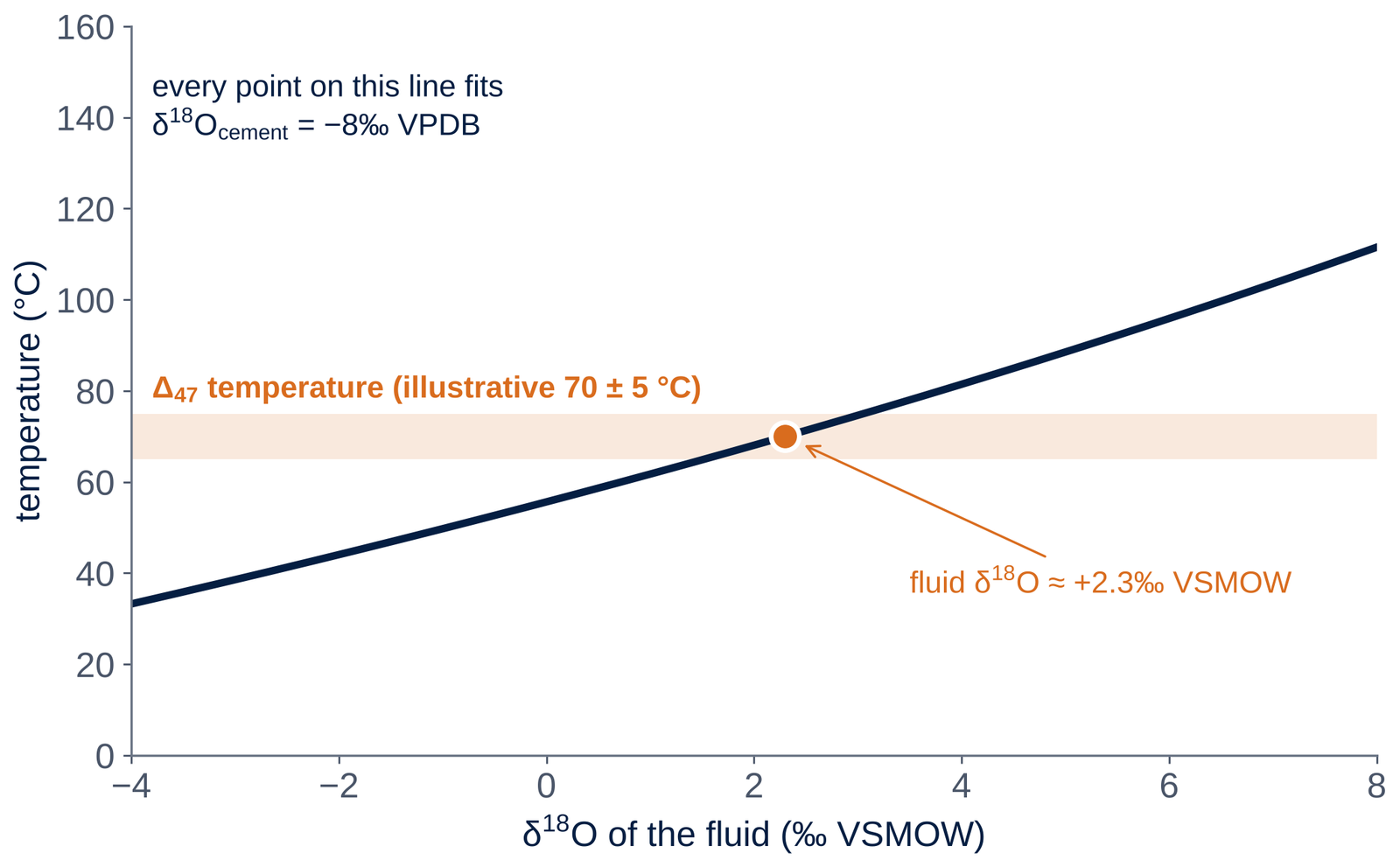
Every diagenetic δ¹⁸O needs a temperature and a water composition, but we measure only one number. Clumped-isotope analysis measures how often ¹³C and ¹⁸O sit together in the same carbonate ion, which depends on temperature, not on the water. With the temperature known, the line gives the water δ¹⁸O. The catch fits this module: at high burial temperatures the clumped signal itself can be reset, by recrystallisation or by atoms rearranging inside the solid crystal. Clumped isotopes are covered in a later lecture.Jedes diagenetische δ¹⁸O braucht eine Temperatur und eine Wasserzusammensetzung, wir messen aber nur eine Zahl. Die Clumped-Isotopen-Analyse misst, wie oft ¹³C und ¹⁸O im selben Carbonat-Ion zusammensitzen; das hängt von der Temperatur ab, nicht vom Wasser. Ist die Temperatur bekannt, liefert die Linie das δ¹⁸O des Wassers. Der Haken passt zu diesem Modul: Bei hohen Versenkungstemperaturen kann das Clumped-Signal selbst zurückgesetzt werden, durch Rekristallisation oder durch Umordnung der Atome im festen Kristall. Clumped-Isotope werden in einer späteren Vorlesung behandelt.
📌 Take-home points📌 Das Wichtigste
- Oxygen resets first: water is mostly oxygen and carries little carbon, so a little water resets δ¹⁸O and carbon needs very much more.Sauerstoff wird zuerst zurückgesetzt: Wasser ist überwiegend Sauerstoff und enthält wenig Kohlenstoff; wenig Wasser setzt δ¹⁸O zurück, Kohlenstoff braucht sehr viel mehr.
- Mineralogy decides what survives: aragonite and high-Mg calcite are replaced; low-Mg calcite skeletons are the archive.Die Mineralogie entscheidet, was überdauert: Aragonit und Hoch-Mg-Calcit werden ersetzt; Skelette aus Niedrig-Mg-Calcit sind das Archiv.
- Each setting has a fingerprint: marine stays near seawater; meteoric gives constant δ¹⁸O with variable δ¹³C; burial gives lighter δ¹⁸O with inherited carbon.Jedes Milieu hat einen Fingerabdruck: marin bleibt nahe am Meerwasser; meteorisch ergibt konstantes δ¹⁸O bei variablem δ¹³C; Versenkung ergibt leichteres δ¹⁸O bei geerbtem Kohlenstoff.
- One δ¹⁸O has two unknowns: temperature and water. The assumed water decides the temperature.Ein δ¹⁸O hat zwei Unbekannte: Temperatur und Wasser. Das angenommene Wasser bestimmt die Temperatur.
- Organic matter pushes carbon both ways: respiration and sulfate reduction make it light, methanogenesis leaves it heavy.Organisches Material verschiebt den Kohlenstoff in beide Richtungen: Atmung und Sulfatreduktion machen ihn leicht, Methanogenese lässt ihn schwer zurück.
- Screen with several independent tests; a δ¹³C–δ¹⁸O correlation is not a test.Mit mehreren unabhängigen Tests prüfen; eine δ¹³C–δ¹⁸O-Korrelation ist kein Test.
🧠 Test your understanding🧠 Testen Sie Ihr Verständnis
📚 References and further reading📚 Literatur und weiterführende Lektüre
- Banner, J.L. & Hanson, G.N. (1990) Calculation of simultaneous isotopic and trace element variations during water-rock interaction with applications to carbonate diagenesis. Geochimica et Cosmochimica Acta 54, 3123–3137.
- Brand, U. & Veizer, J. (1980) Chemical diagenesis of a multicomponent carbonate system—1: Trace elements. Journal of Sedimentary Petrology 50, 1219–1236.
- Brand, U. & Veizer, J. (1981) Chemical diagenesis of a multicomponent carbonate system—2: Stable isotopes. Journal of Sedimentary Petrology 51, 987–997.
- Brand, W.A., Coplen, T.B., Vogl, J., Rosner, M. & Prohaska, T. (2014) Assessment of international reference materials for isotope-ratio analysis (IUPAC Technical Report). Pure and Applied Chemistry 86, 425–467.
- Gonzalez, L.A. & Lohmann, K.C. (1985) Carbon and oxygen isotopic composition of Holocene reefal carbonates. Geology 13, 811–814.
- James, N.P. & Choquette, P.W. (1984) Diagenesis 9. Limestones—the meteoric diagenetic environment. Geoscience Canada 11, 161–194.
- Kim, S.-T. & O’Neil, J.R. (1997) Equilibrium and nonequilibrium oxygen isotope effects in synthetic carbonates. Geochimica et Cosmochimica Acta 61, 3461–3475.
- Lohmann, K.C. (1988) Geochemical patterns of meteoric diagenetic systems and their application to studies of paleokarst. In: James, N.P. & Choquette, P.W. (eds) Paleokarst. Springer, New York, 58–80.
- Marshall, J.D. (1992) Climatic and oceanographic isotopic signals from the carbonate rock record and their preservation. Geological Magazine 129, 143–160.
- Mook, W.G. (1986) ¹³C in atmospheric CO₂. Netherlands Journal of Sea Research 20, 211–223.
- Meyers, W.J. & Lohmann, K.C. (1985) Isotope geochemistry of regionally extensive calcite cement zones and marine components in Mississippian limestones, New Mexico. In: Schneidermann, N. & Harris, P.M. (eds) Carbonate Cements. SEPM Special Publication 36, 223–239.
- Romanek, C.S., Grossman, E.L. & Morse, J.W. (1992) Carbon isotopic fractionation in synthetic aragonite and calcite: effects of temperature and precipitation rate. Geochimica et Cosmochimica Acta 56, 419–430.
- Swart, P.K. & Kennedy, M.J. (2012) Does the global stratigraphic reproducibility of δ¹³C in Neoproterozoic carbonates require a marine origin? A Pliocene–Pleistocene comparison. Geology 40, 87–90.
- Vasconcelos, C., McKenzie, J.A., Warthmann, R. & Bernasconi, S.M. (2005) Calibration of the δ¹⁸O paleothermometer for dolomite precipitated in microbial cultures and natural environments. Geology 33, 317–320.
- Veizer, J. et al. (1999) ⁸⁷Sr/⁸⁶Sr, δ¹³C and δ¹⁸O evolution of Phanerozoic seawater. Chemical Geology 161, 59–88.