Read the transcriptTranskript lesen
Hannah: Welcome to the Sedimentary Geochemistry podcast. I'm Hannah.
George: And I'm George. This episode goes with Lecture four: clumped isotopes and the Late Ordovician extinction.
Hannah: Two topics in one lecture. A new method and a mass extinction. Why do they belong together, George?
George: Because the extinction is the problem and the method is the solution. If you only learn the method, it is a list of equations. If you see what it solved, you remember it.
Hannah: Then let's start with the problem. Take me back to the end of the Ordovician.
George: About four hundred and forty-five million years ago. Life is almost completely marine. There are no forests, and almost no life on land. Most species live in wide, shallow seas that cover the continents. And then, within a short interval called the Hirnantian, about eighty-five per cent of marine species disappear.
Hannah: That makes it the first of the five great mass extinctions.
George: The first of the Big Five, yes. And it has a strange feature. It comes together with an ice age. The large southern continent, Gondwana, lay over the South Pole, and we find glacial deposits of exactly this age on it.
Hannah: Why is that strange? Ice ages happen.
George: Because the Ordovician was a greenhouse world. Carbon dioxide in the atmosphere was much higher than today, and the tropical seas were very warm. An ice age in the middle of a greenhouse world is not what you expect.
Hannah: And the extinction itself, was it one event?
George: No, it came in two pulses. The first one at the start of the Hirnantian, when the ice grew. The sea cooled, and sea level fell, because the water was now stored on land as ice. The shallow seas drained, and the animals living there lost their habitat. The second pulse came at the end, when the ice melted. Sea level rose again, the water warmed, and the deeper water lost its oxygen. A fauna that had adapted to the cold was now the victim.
Hannah: So the same ice age kills twice. Once when it arrives, and once when it leaves.
George: That is the classic story. I should say it is still debated. Some researchers argue that volcanism, warming and loss of oxygen were more important than cooling. But every version of the story needs one thing: a reliable temperature.
Hannah: And we have a thermometer for that. We learned it two lectures ago. Oxygen isotopes in shells.
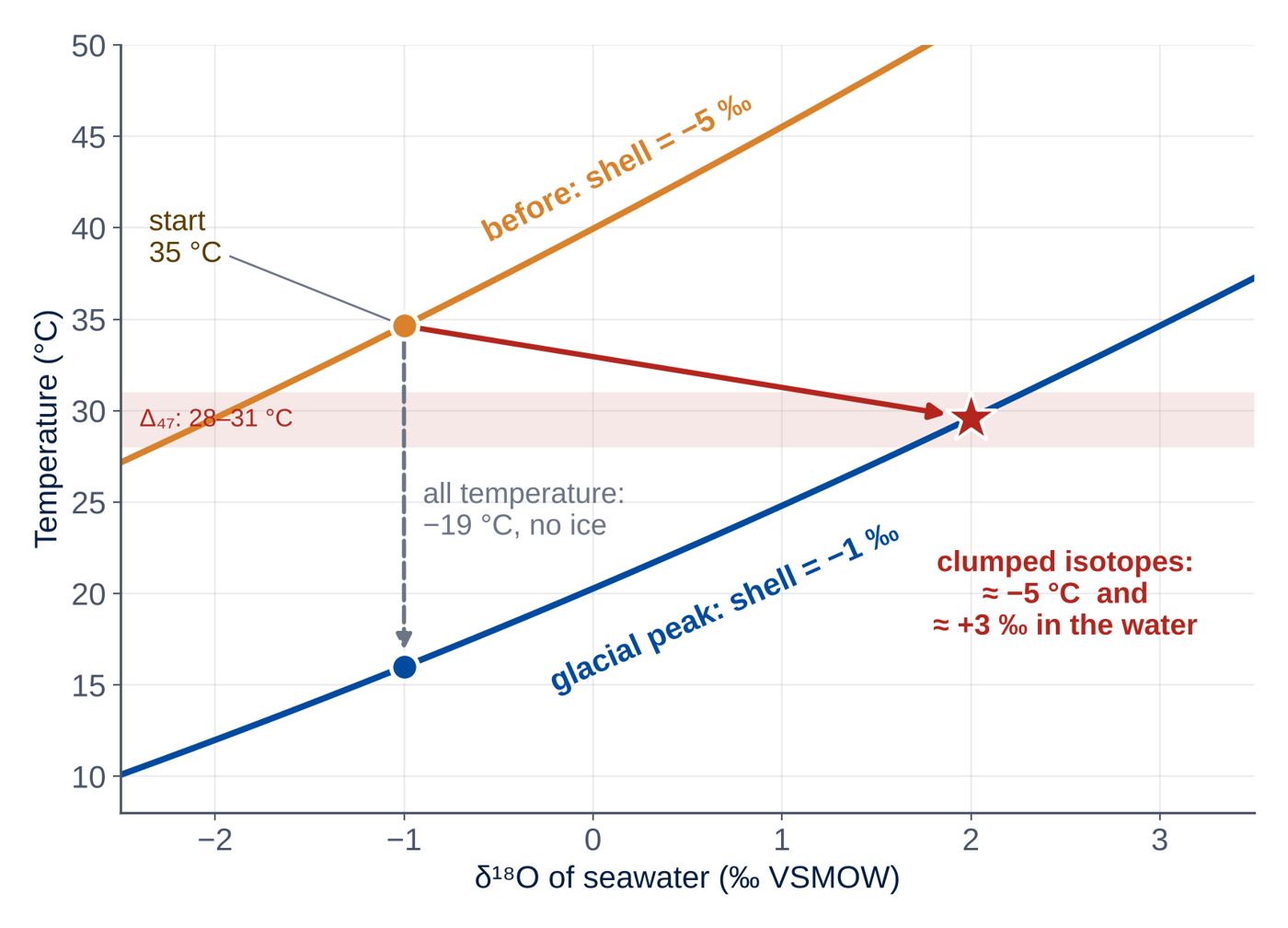
George: We do. So let us use it. Fossil shells from the tropics have been measured across this interval. Before the glaciation, the calcite sits at about minus five per mil. At the glacial peak, the values rise to between minus two and zero.
Hannah: So a shift of roughly four per mil towards heavier values. Heavier means colder.
George: If the water stayed the same, yes. And if you put those numbers into the standard temperature equation, with ice-free sea water, you get a tropical ocean that cools by almost twenty degrees.
Hannah: Twenty degrees. In the tropics. That sounds like far too much.
George: It is enormous. In the last ice age the tropical ocean cooled by only a few degrees. So something is wrong. And you already know what.
Hannah: The water. When ice sheets grow, they store light oxygen. The ocean that stays behind becomes heavier. So part of that shift in the shells is not temperature at all. It is the ocean changing.
George: Exactly. But how much? You can explain the same shell with a cold sea and light water, or with a warm sea and heavy water, or with anything in between.
Hannah: One measurement, two unknowns. We ended last week's lecture with exactly those words.
George: And measuring more shells does not help. You get a more precise number, but you still have one equation. What you need is a second, independent measurement.
Hannah: Which brings us to clumped isotopes. I have to say, the name does not explain itself.
George: It is quite literal, actually. Think of a carbonate group: one carbon and three oxygens. The carbon is nearly always carbon twelve. Sometimes it is the heavy one, carbon thirteen. The oxygens are nearly always oxygen sixteen. Sometimes one is the heavy one, oxygen eighteen.
Hannah: And those are the two isotope systems we already measure. Delta thirteen C and delta eighteen O.
George: Right. But here is a new question. If a mineral contains some carbon thirteen and some oxygen eighteen, how often do they sit together, in the same carbonate group, bonded to each other?
Hannah: I would guess it is simply chance. Multiply the two probabilities.
George: That is the random answer, and it is nearly right. In the carbon dioxide gas that we make from the mineral for the measurement, it comes out at about forty-six molecules in a million. But in a real mineral there are slightly more of these pairs than chance predicts. The heavy isotopes prefer to sit together. They clump.
Hannah: Why would they prefer that?
George: It comes from the vibration of chemical bonds. A bond is never still. Even at absolute zero it vibrates, and that lowest energy is called the zero-point energy. Heavy atoms vibrate more slowly, so a bond between heavy atoms sits lower in energy. Lower means more stable.
Hannah: That is the same reason we gave for all equilibrium fractionation in the first lecture.
George: It is the same physics. And the new point is this: putting two heavy isotopes into one bond saves a little more energy than putting them into two separate bonds. A very small gain. But the mineral takes it.
Hannah: And where does temperature come in?
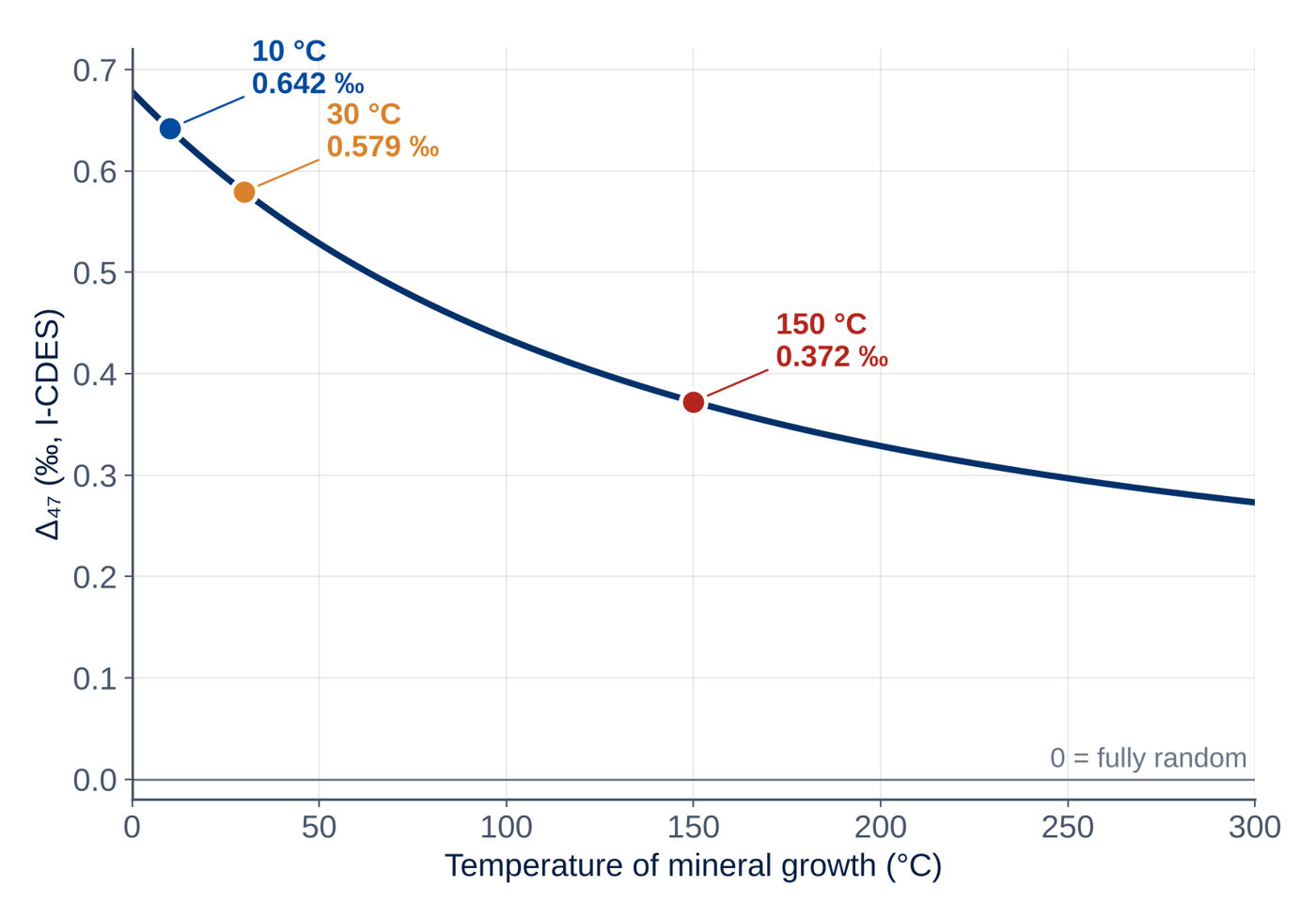
George: When it is cold, that small gain matters, and the heavy isotopes clump more. When it is hot, there is so much thermal energy that the gain makes no difference, and the isotopes are distributed almost at random. So more clumping means the mineral grew in colder water.
Hannah: Wait. That is a thermometer. But what makes it different from the oxygen isotope thermometer?
George: This is the beautiful part. In the classic thermometer, oxygen is exchanged between two phases: the mineral and the water. So the result depends on both. In clumping, the isotopes only rearrange themselves inside the mineral. The water does not appear in the reaction.
Hannah: So the result cannot depend on the water.
George: It depends on temperature only. The mineral carries its own thermometer.
Hannah: And then the old measurement becomes useful again. If I know the temperature from clumping, and I have the oxygen isotope value of the same shell, I can turn the equation around and calculate the water.
George: That is the whole strategy. Two measurements on the same piece of carbonate, two unknowns solved. First the temperature, then the water.
Hannah: It sounds almost too good. What is the catch?
George: There are several. The first one is the size of the signal. We report clumping as a number called capital delta forty-seven. It is the excess of the heavy pairs over a random mixture, in per mil. For one degree of temperature change, the oxygen isotope value of calcite changes by about zero point two per mil. Capital delta forty-seven changes by about zero point zero zero three.
Hannah: That is about seventy times smaller.
George: Yes. And we are counting something that makes up forty-six parts per million of the gas. So every sample has to be measured many times, and even then the uncertainty of one temperature is a few degrees.
Hannah: Is that why the method had a difficult start? I read that different laboratories did not agree.
George: That is right. The first calibration was published in two thousand and six. Then other groups built their own instruments and made their own calibrations, and for some years the same sample could give clearly different temperatures in different laboratories.
Hannah: How was that solved?
George: Not by a better machine. By an agreement. Since two thousand and twenty-one, laboratories measure the same set of carbonate standards and report on one common scale. When the old calibration samples were measured again in this way, the disagreement largely disappeared. Today there is one widely used calibration that covers everything from near zero to more than a thousand degrees.
Hannah: Good. So the catch of the small signal is under control. What is the next one?
George: The mineral has to keep its memory. And there are three ways to lose it. The first one you know from last week: recrystallisation. If the shell dissolves and new calcite grows during burial, the new calcite records the burial temperature, not the sea.
Hannah: So everything from the diagenesis lecture still applies. Thin sections, cathodoluminescence, trace elements.
George: All of it. The second way is new, and it is more dangerous. It is called solid-state reordering. If a carbonate is heated during deep burial, atoms inside the crystal slowly change places with their neighbours. The crystal does not dissolve. Nothing new grows.
Hannah: So under the microscope the shell still looks perfect.
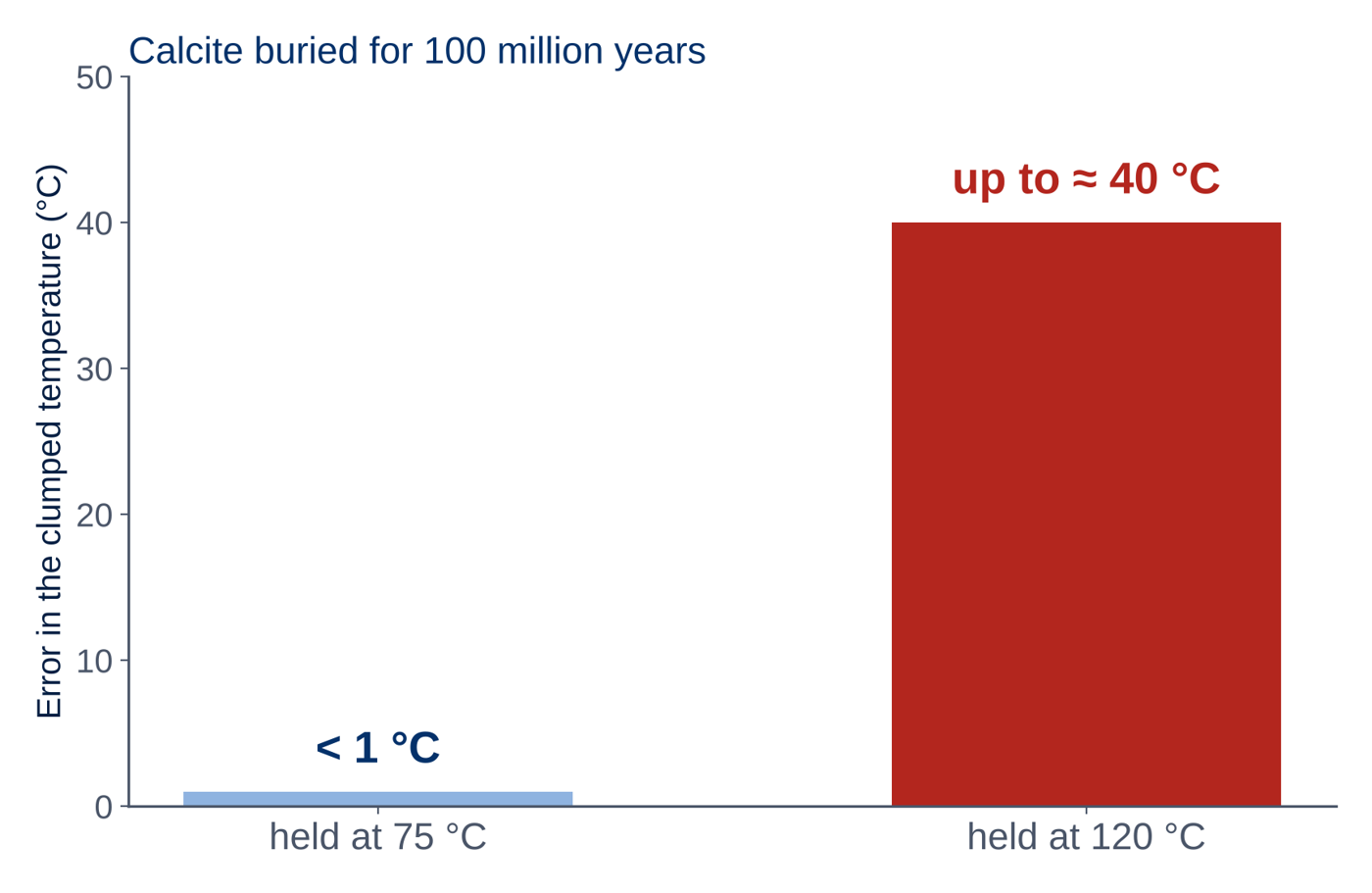
George: Perfect. But the heavy isotopes are no longer where they were, and the temperature you read is too high. Model calculations show how sensitive this is. Calcite held at seventy-five degrees for a hundred million years changes by less than one degree. Held at one hundred and twenty degrees for the same time, it can be wrong by up to about forty degrees.
Hannah: That is a narrow window. And for rocks that are four hundred and fifty million years old, very few will have stayed that cool.
George: Which is why the choice of locality matters so much. You need rocks that were never buried deeply. Dolomite, by the way, is more resistant than calcite.
Hannah: And the third way?
George: Growth out of equilibrium. Some organisms build their skeleton so fast that the isotopes cannot reach equilibrium. Modern reef corals are the well-known example. A newer measurement, capital delta forty-eight, made together with the first, can show whether that happened.
Hannah: So three questions before I believe a clumped temperature. Is the mineral original? Was it ever too hot? Did it grow in equilibrium?
George: That is the checklist.
Hannah: Then let's go back to the Ordovician. Who did the measurement?
George: Seth Finnegan and colleagues, in two thousand and eleven. They collected fossils from Anticosti Island in Canada and from the central United States. Rocks that were never deeply buried. They examined every sample under the microscope, and measured trace elements on a representative part of them.
Hannah: And what did the clumped thermometer say?
George: For most of the record, about twenty million years, the tropical sea was between thirty-two and thirty-seven degrees. Very warm. Then, in the Hirnantian, it cooled by about five degrees, to between twenty-eight and thirty-one. And then it warmed again.
Hannah: Five degrees. Not twenty.
George: Five. And five degrees explains only about one per mil of the shift in the shells.
Hannah: So the rest, roughly three per mil, has to be the water. The ocean became heavier.
George: Yes. When they calculate the water, it sits between minus one and plus one per mil for most of the time, and it rises above plus two at the glacial peak. That is heavier than the ocean at the Last Glacial Maximum. So their conclusion is: as much ice as in the last ice age, or more.
Hannah: So the answer to the puzzle is the opposite of what the shells seemed to say. Not a huge cooling with a little ice, but a modest cooling with a great deal of ice.
George: And only for a short time. The record also suggests some ice before the Hirnantian. So it was a long glaciation with a short, sharp maximum.
Hannah: What does that do to the extinction story?
George: It shifts the weight. The tropical seas stayed close to thirty degrees even at the peak. Five degrees of cooling is a real stress, but probably not enough on its own to remove most marine species. A very large ice sheet, on the other hand, means a very large fall in sea level. And remember where life was.
Hannah: In the shallow seas on top of the continents. Which drain when sea level falls.
George: So the temperature result makes the sea-level explanation stronger. And the fast change into the glaciation and out of it fits the two pulses.
Hannah: I want to push on this a little. How sure are we of these numbers?
George: You should push. The authors themselves say their temperatures are maximum values, because a little recrystallised material may still be present. And at the glacial peak they could measure only one group of fossils: rugose corals.
Hannah: Corals. You just named corals as the example for growth out of equilibrium.
George: Modern reef corals, yes. Rugose corals are a different, extinct group, and where they occur together with other fossils the authors saw no consistent difference. But it cannot be excluded. And a change of three per mil in the water is very large. From an ice-free ocean to the Last Glacial Maximum the water changes by about two per mil. The authors think unusually light ice is unlikely, but they cannot rule out that these shallow seas were not fully connected to the open ocean. That is still discussed. The direction of the result is clear. The exact numbers may move.
Hannah: That is a useful way to read any proxy paper. What was measured, on what material, and what could be wrong with it.
George: If students take one habit from this course, I hope it is that one.
Hannah: The lecture ends with dinosaurs. How do they get into a lecture about sea water?
George: To show that the method does not need sea water at all. Teeth are made of a phosphate mineral, but it contains some carbonate groups, and they clump in the same way. A tooth grows at the body temperature of the animal.
Hannah: So a tooth is a thermometer for the body.
George: In two thousand and eleven, a study of two very large Jurassic sauropods gave body temperatures of thirty-six to thirty-eight degrees. Similar to most living mammals. That is four to seven degrees lower than a model that scales body temperature with body mass.
Hannah: Does that prove dinosaurs were warm-blooded?
George: No. A warm body is not the same as a warm-blooded metabolism. A giant animal can stay warm simply because it loses heat slowly. The method gives you the temperature. The interpretation is a second step.
Hannah: Let me try a summary. Clumped isotopes measure how often the two heavy isotopes, carbon thirteen and oxygen eighteen, sit together in one carbonate group. That depends on temperature only, not on the water.
George: Correct. And combined with the normal oxygen isotope value, it gives you the water as well.
Hannah: The signal is very small, so it needs many measurements. And it can be lost: by recrystallisation, by reordering during deep burial, and by growth out of equilibrium.
George: And for the Late Ordovician it changed the picture. About five degrees of tropical cooling instead of twenty, and a very large ice sheet for a short time.
Hannah: One measurement, two unknowns. Two measurements, two answers.
George: That is the lecture in one line. In the assignment you will do the calculation yourself, first the old way and then the new way.
Hannah: Thanks for listening, and see you in the next episode.
🎯 Learning objectives🎯 Lernziele
- Describe the Late Ordovician glaciation and the two pulses of the mass extinctionDie spätordovizische Vereisung und die zwei Phasen des Massenaussterbens beschreiben
- Explain why δ¹⁸O of a shell cannot separate temperature from the δ¹⁸O of the waterErklären, warum δ¹⁸O einer Schale Temperatur und δ¹⁸O des Wassers nicht trennen kann
- Explain what clumped isotopes are and why Δ₄₇ depends on temperature onlyErklären, was Clumped Isotopes sind und warum Δ₄₇ nur von der Temperatur abhängt
- Calculate a temperature from Δ₄₇ and then the δ¹⁸O of the water from the same sampleAus Δ₄₇ eine Temperatur und anschließend das δ¹⁸O des Wassers derselben Probe berechnen
- Name three ways in which a clumped isotope temperature can be wrong, and how to check for themDrei Wege nennen, auf denen eine Clumped-Isotope-Temperatur falsch sein kann, und wie man sie prüft
Assignment 4:Übungsaufgabe 4: open the assignment on this moduleÜbungsaufgabe zu diesem Modul öffnen · deadline Monday 23 November 2026, 12:00 · password as for Assignments 1 to 3 · two case studies set against each other — clumped isotopes against uranium isotopes · Parts 1 to 3 are the same for every team and need no literature search; Part 4 is an extra, unmarked section for the Late Ordovician team only · discuss it with others if you like, but write and submit your own answers · to submit, press Submit assignment at the end of the page and keep the receipt code; if that fails, use the Email instructor button and attach the Word or text exportAbgabe Montag, 23. November 2026, 12:00 Uhr · Passwort wie bei den Übungsaufgaben 1 bis 3 · zwei einander gegenübergestellte Fallstudien — clumped isotopes gegen Uranisotope · Die Teile 1 bis 3 sind für alle Teams gleich und erfordern keine Literaturrecherche; Teil 4 ist ein zusätzlicher, unbenoteter Abschnitt nur für das Team Spätordovizium · Besprechen Sie sie gern mit anderen, schreiben und senden Sie aber Ihre eigenen Antworten · zur Abgabe am Seitenende auf „Submit assignment“ klicken und den Receipt-Code aufbewahren; falls das nicht klappt, „Email instructor“ verwenden und den Word- oder Textexport anhängen
1. One measurement, two unknowns1. Eine Messung, zwei Unbekannte
At the glacial peak of the Late Ordovician, δ¹⁸O of tropical shells rises by about 4 ‰. If all of this were temperature, the tropical ocean would have cooled by almost 20 °C. But growing ice sheets also make the ocean heavier. Every point on the blue line fits the same shell: a cold sea with light water, or a warm sea with heavy water. Clumped isotopes give the temperature on their own (red band), and only one point remains.Am Höhepunkt der spätordovizischen Vereisung steigt δ¹⁸O tropischer Schalen um etwa 4 ‰. Wäre das alles Temperatur, hätte sich der tropische Ozean um fast 20 °C abgekühlt. Wachsende Eisschilde machen den Ozean aber auch schwerer. Jeder Punkt auf der blauen Linie passt zur selben Schale: kaltes Meer mit leichtem Wasser oder warmes Meer mit schwerem Wasser. Clumped Isotopes liefern die Temperatur unabhängig (rotes Band), und es bleibt nur ein Punkt übrig.
2. The thermometer inside the mineral2. Das Thermometer im Mineral
In a carbonate, the heavy isotopes ¹³C and ¹⁸O sit in the same carbonate group slightly more often than chance predicts. This excess is called Δ₄₇. It is larger when the mineral grows in the cold and it does not depend on the water, because the isotopes only rearrange inside the mineral. The signal is very small: about 0.003 ‰ for one degree.In einem Karbonat sitzen die schweren Isotope ¹³C und ¹⁸O etwas häufiger in derselben Karbonatgruppe, als der Zufall erwarten lässt. Dieser Überschuss heißt Δ₄₇. Er ist größer, wenn das Mineral in der Kälte wächst, und hängt nicht vom Wasser ab, weil sich die Isotope nur innerhalb des Minerals umordnen. Das Signal ist sehr klein: etwa 0,003 ‰ pro Grad.
3. Where it fails3. Wo die Methode versagt
Three questions come before any clumped temperature. Is the mineral original, or did it recrystallise? Was it ever heated so much during burial that atoms changed places inside the crystal (solid-state reordering)? And did the skeleton grow in equilibrium? Reordering leaves no trace under the microscope; only the burial history can exclude it.Vor jeder Clumped-Isotope-Temperatur stehen drei Fragen. Ist das Mineral primär oder rekristallisiert? Wurde es bei der Versenkung so stark erhitzt, dass Atome im Kristall die Plätze getauscht haben (Festkörper-Umordnung)? Und ist das Skelett im Gleichgewicht gewachsen? Die Umordnung hinterlässt unter dem Mikroskop keine Spur; nur die Versenkungsgeschichte kann sie ausschließen.
📚 References and further reading📚 Literatur und weiterführende Lektüre
- Anderson, N.T. et al. (2021) A unified clumped isotope thermometer calibration (0.5–1,100 °C) using carbonate-based standardization. Geophysical Research Letters 48, e2020GL092069.
- Bernasconi, S.M. et al. (2021) InterCarb: a community effort to improve interlaboratory standardization of the carbonate clumped isotope thermometer using carbonate standards. Geochemistry, Geophysics, Geosystems 22, e2020GC009588.
- Eagle, R.A. et al. (2011) Dinosaur body temperatures determined from isotopic (¹³C-¹⁸O) ordering in fossil biominerals. Science 333, 443–445.
- Finnegan, S. et al. (2011) The magnitude and duration of Late Ordovician–Early Silurian glaciation. Science 331, 903–906.
- Sheehan, P.M. (2001) The Late Ordovician mass extinction. Annual Review of Earth and Planetary Sciences 29, 331–364.
- Stolper, D.A. & Eiler, J.M. (2015) The kinetics of solid-state isotope-exchange reactions for clumped isotopes. American Journal of Science 315(5).