
ℹ️ Background reading (WS 2026/27)
The diagenesis block (Weeks 9–12) is taught in Modules 5.1–5.4. This page is kept as background on how diagenesis modifies the provenance signal. Heavy-mineral analysis is not part of the 2026/27 syllabus; the heavy-mineral sections below are optional reading and are not examined.
🎯 Learning Objectives
- Understand the stages of diagenesis: eogenesis, mesogenesis, and telogenesis
- Explain how diagenetic processes modify framework grain composition
- Recognize petrographic evidence of diagenetic alteration
- Distinguish provenance signals from diagenetic overprints
- NEW: Understand mineral dissolution kinetics and the factors controlling dissolution rates
- NEW: Apply the crystal structure approach to predicting mineral stability
- NEW: Interpret heavy mineral assemblages considering diagenetic dissolution
- NEW: Understand how burial depth and pore fluid chemistry affect provenance preservation
Part I: Diagenesis Fundamentals
1. What is Diagenesis?
Diagenesis encompasses all physical, chemical, and biological processes that affect sediments after deposition and before metamorphism. These processes operate at temperatures up to ~200°C and can fundamentally alter sediment composition, texture, and porosity.
| Stage | Depth/Temperature | Key Processes |
|---|---|---|
| Eogenesis | Near-surface, <70°C | Compaction, early cementation, microbial activity, oxidation/reduction |
| Mesogenesis | Burial, 70–200°C | Pressure dissolution, mineral transformations, feldspar dissolution, authigenic clay growth |
| Telogenesis | Uplift/exhumation | Secondary porosity, oxidation, near-surface weathering |
2. Diagenetic Effects on Framework Grains
Framework grain composition can be significantly modified during burial diagenesis:
- Feldspar dissolution: Creates secondary porosity; can remove 50–100% of original feldspar in deeply buried sandstones
- Lithic fragment compaction: Ductile lithics (mudstone, volcanic) are squeezed into pore space, becoming pseudomatrix
- Quartz overgrowth: Syntaxial cement obscures grain boundaries; can make recycled quartz appear first-cycle
- Carbonate replacement: Can partially or completely replace silicate grains
- Albitization: K-feldspar → albite transformation; changes P/K ratios
⚠️ Critical Implication for Provenance
In deeply buried sandstones, the observed composition may bear little resemblance to the original depositional composition. Feldspar dissolution alone can shift a sample from "arkose" to "quartzarenite"—a fundamental change in apparent provenance.
Part II: Mineral Dissolution Kinetics
This section draws from Oelkers (2018) and related kinetic studies to present the fundamental controls on mineral dissolution rates.
3. The Crystal Structure Control
Mineral dissolution rates are fundamentally controlled by crystal structure—specifically, the arrangement and bonding of atoms determines how easily they can be detached by aqueous fluids.
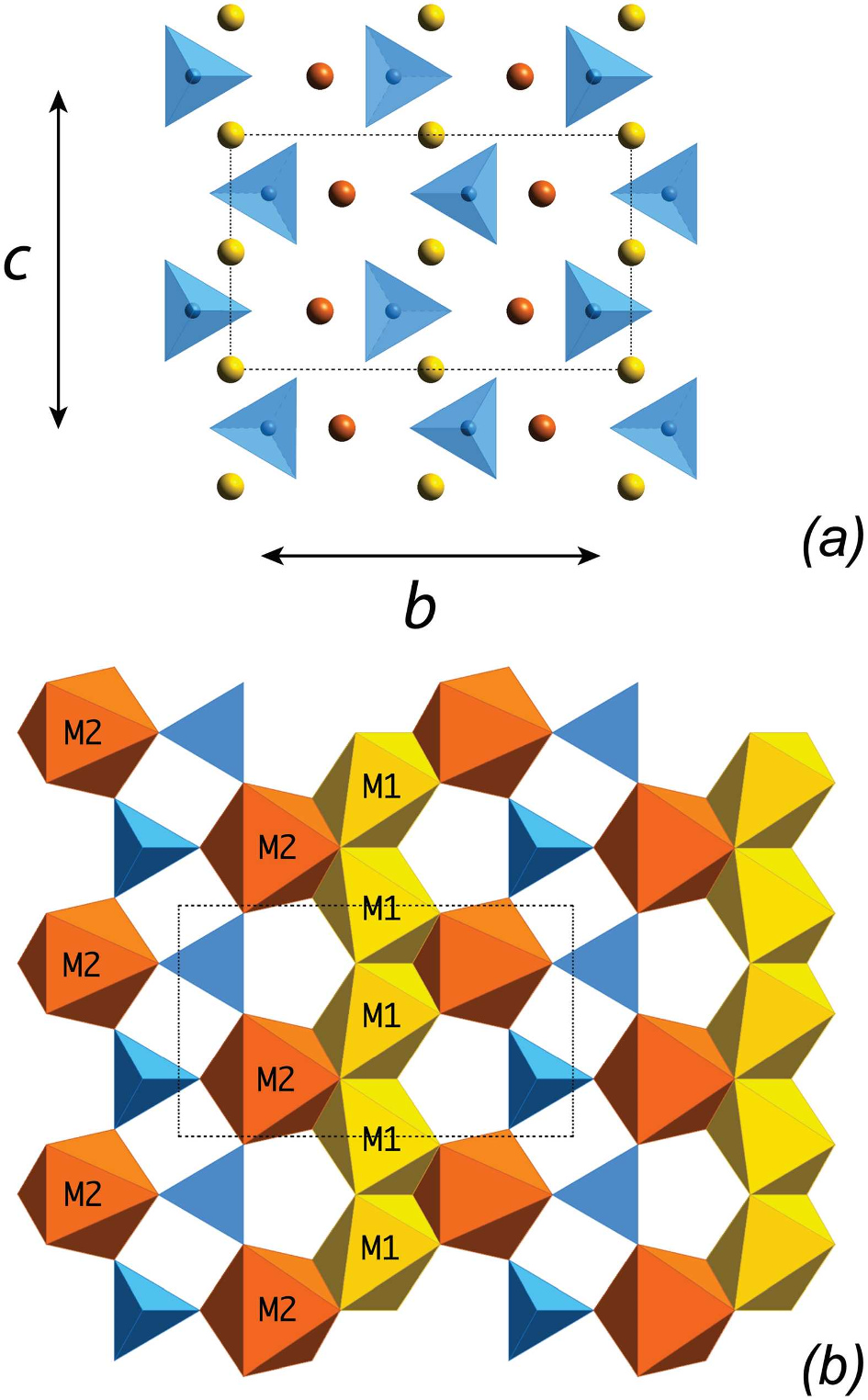
(a) Projection showing isolated SiO₄ tetrahedra (blue) and divalent cation sites (Mg, Fe). (b) Polyhedral representation showing M1 and M2 octahedral sites. The isolated tetrahedra make olivine highly reactive—unlike chain or framework silicates, breaking one bond releases the entire SiO₄ unit.
From Oelkers et al. (2018)
🔑 Key Concept: Why Olivine Dissolves Fast
Olivine is an orthosilicate (isolated SiO₄ tetrahedra). Each silicon atom is surrounded by only 4 oxygens that connect to nothing else—breaking any single Si-O bond releases the entire silica unit. In contrast, feldspars and quartz have continuous 3D frameworks where each oxygen bridges two silicon atoms, requiring many more bonds to be broken for dissolution.
The Goldich Stability Series Explained
The classic Goldich dissolution series reflects crystal structure:
(Orthosilicate → Single chain → Double chain → Sheet → Framework)
📊 Dissolution Rate Comparison (at 25°C, pH 7)
4. Controls on Dissolution Rates
Beyond crystal structure, several factors modulate dissolution rates in natural systems:
| Factor | Effect | Magnitude |
|---|---|---|
| Temperature | Exponential increase (Arrhenius) | Rate doubles per ~10–15°C |
| pH | U-shaped curve; faster at low and high pH | 10–100× variation |
| Fluid composition | Organic acids accelerate; high salinity retards | Variable |
| Surface area | Linear relationship | Finer grains dissolve faster |
| Flow rate | Faster flow removes products, accelerates dissolution | Limited in tight sandstones |
🔬 Key Finding: The Lab-Field Discrepancy
Laboratory dissolution rates are typically 10²–10⁵ times faster than rates measured in natural systems. This "lab-field discrepancy" results from: (1) reduced reactive surface area in soils due to coatings and aging, (2) approach to saturation in natural pore waters, (3) preferential flow paths bypassing most mineral surfaces, and (4) secondary mineral precipitation armoring surfaces.
Part III: Heavy Mineral Dissolution During Diagenesis
5. The Diagenetic Heavy Mineral Sequence
Heavy minerals record diagenetic history through progressive dissolution. The stability sequence during burial differs from the weathering sequence because temperature and pore fluid chemistry become dominant controls.
| Stability Class | Minerals | Typical Loss |
|---|---|---|
| Very unstable | Olivine, pyroxene | Lost in eogenesis (<1 km) |
| Unstable | Amphibole, epidote, titanite | Lost by 2–3 km burial |
| Moderately stable | Garnet, staurolite, kyanite | Partly dissolved by 4–5 km |
| Stable | Apatite, monazite, chrome spinel | Preserved to 5+ km |
| Ultrastable | Zircon, tourmaline, rutile | Survive to any burial depth |
🔑 Key Concept: ZTR Increases with Stratigraphic Age
The ZTR index (zircon + tourmaline + rutile %) systematically increases with stratigraphic age in the sedimentary record—not because of transport maturation, but because of progressive diagenetic dissolution of less stable minerals during burial (Garzanti & Andò 2007). This is a major bias that must be considered when comparing ancient and modern sands.
⚠️ Critical Distinction: Weathering vs. Diagenetic Maturity
| Type | Process | Indicator |
|---|---|---|
| Weathering maturity | Chemical destruction of unstable minerals at surface | Fresh alteration features; occurs BEFORE burial |
| Diagenetic maturity | Burial dissolution creates "forced" maturity | Etched/skeletal grains; occurs DURING burial |
Best Practice: Use ZTR as a diagenetic indicator, not a source/transport indicator, in ancient rocks. Compare with petrographic assessment of framework grain dissolution to distinguish true provenance from diagenetic overprint.
Recognizing Diagenetic Dissolution
Petrographic evidence of diagenetic heavy mineral dissolution includes:
- Etched grain surfaces: Pits, channels, and irregular outlines
- Skeletal grains: Hollow shells where cores dissolved preferentially
- Authigenic overgrowths: On surviving stable phases
- Ghost grains: Clay-filled molds preserving original grain shape
- Anomalously high ZTR: In young or shallow-buried sandstones
📍 Case Study: North Sea Jurassic Sandstones
Morton & Hallsworth (1999) documented systematic heavy mineral dissolution in North Sea Jurassic sandstones:
- Amphibole is absent below ~2.5 km burial depth
- Epidote disappears below ~3 km
- Garnet begins to dissolve at ~4 km
- Only ZTR survives at depths >5 km
This progressive loss creates apparent "provenance changes" upsection that are entirely diagenetic—the source remained constant, but the mineralogical record was progressively destroyed.
Part IV: Feldspar Dissolution and Secondary Porosity
6. Mechanisms of Feldspar Dissolution
Feldspar dissolution during burial is one of the most important diagenetic processes affecting provenance interpretation. It creates secondary porosity and fundamentally changes sand composition.
Key Controls on Feldspar Dissolution
| Factor | Effect |
|---|---|
| Temperature | Accelerates dissolution; most intense at 80–120°C |
| Organic acids | Generated during kerogen maturation; enhance dissolution |
| CO₂ | Acidifies pore waters; released during organic matter breakdown |
| Feldspar composition | Ca-plagioclase > Na-plagioclase > K-feldspar (dissolution rate) |
| Grain texture | Perthitic and microporous feldspars dissolve faster |
📊 Feldspar Loss During Burial
7. Recognizing Diagenetic vs. Depositional Composition
⚠️ The Diagenetic Trap
A deeply buried "quartzarenite" may have been deposited as a feldspar-rich arkose. Without careful petrographic analysis, diagenetic quartz enrichment can be mistaken for mature, cratonic provenance—leading to fundamentally incorrect paleogeographic reconstructions.
Indicators of Diagenetic Modification
- Secondary porosity: Oversized pores, moldic porosity, partial dissolution features
- Ghost grains: Authigenic clays (kaolinite, illite) replacing feldspar with preserved grain outlines
- Corroded grain margins: Irregular, embayed boundaries
- Inconsistent heavy minerals: Unstable detrital minerals present (pyroxene, amphibole) but feldspars absent
- Stratigraphic trends: Increasing Q/F with burial depth within same formation
Part V: Strategies for Provenance Interpretation in Diagenetically Altered Sandstones
8. Resistant Provenance Indicators
When framework grains are extensively modified, provenance information can be recovered from more resistant phases:
| Method | What Survives | Information Preserved |
|---|---|---|
| Detrital zircon U-Pb | Zircon (ultrastable) | Crystallization ages of source rocks |
| Detrital zircon Hf isotopes | Zircon | Crustal vs. mantle source; crustal evolution |
| Rutile geochemistry | Rutile (ultrastable) | Metamorphic grade of source; Nb/Cr ratios |
| Cr-spinel composition | Chrome spinel (stable) | Ophiolite provenance; mantle composition |
| Tourmaline chemistry | Tourmaline (ultrastable) | Source rock type (granitic, metapelitic, etc.) |
| Monazite geochronology | Monazite (stable) | Source terrane ages; metamorphic events |
🔑 Key Concept: Multi-Proxy Approach
In diagenetically altered sandstones, reliable provenance interpretation requires integration of multiple methods. Detrital zircon geochronology on deeply buried sandstones can reveal source terranes that are completely invisible in standard petrographic analysis because feldspars and lithic fragments have been destroyed.
9. Burial History Considerations
Interpreting provenance requires understanding the sample's diagenetic history:
- Maximum burial depth: Determines degree of compaction and dissolution
- Thermal history: Vitrinite reflectance, clay mineralogy, fluid inclusions
- Pore fluid chemistry: Controls which minerals dissolve vs. precipitate
- Timing of oil emplacement: Early oil inhibits further diagenesis by excluding water
- Telogenetic overprint: Meteoric water during uplift can cause additional dissolution
10. Diagenetic Pathways by Composition
Original depositional composition controls the diagenetic trajectory and reservoir quality:
| Sand Type | Dominant Process | Porosity Evolution | Provenance Implication |
|---|---|---|---|
| Quartzose sands | Quartz overgrowths dominant; limited compaction (rigid framework) | Porosity loss primarily through cementation | Provenance preserved; minimal secondary porosity |
| Feldspathic sands | Feldspar dissolution → kaolinite/sericite; late illite/chlorite at depth | Secondary porosity from feldspar dissolution; silica released fuels quartz cement | Apparent shift to "quartzarenite"; P/K ratios reset by albitization |
| Lithic sands | Ductile lithics (shale, volcanic) compact extensively; carbonates dissolve/dolomitize | High compaction = low preserved porosity | Lithic counts reduced; pseudomatrix formation obscures original texture |
🔬 Key Insight: Provenance Controls Reservoir Quality
A volcaniclastic turbidite will compact more than a cratonic quartzarenite at the same burial depth. Understanding original sand composition is essential for predicting both reservoir quality and interpreting provenance from ancient sequences.
📌 Key Points Summary
- Diagenesis operates in three stages: eogenesis (shallow), mesogenesis (burial), telogenesis (uplift)
- Feldspar dissolution can shift arkoses to apparent quartzarenites—fundamentally changing apparent provenance
- NEW: Crystal structure controls dissolution rates: orthosilicates (olivine) >> chains >> frameworks (quartz)
- NEW: Lab dissolution rates are 10²–10⁵× faster than field rates due to surface coatings and saturation effects
- NEW: Heavy mineral ZTR index increases with stratigraphic age due to diagenetic dissolution, not transport
- Temperature, organic acids, and CO₂ are the main drivers of feldspar dissolution during burial
- Secondary porosity, ghost grains, and corroded margins indicate diagenetic modification
- Deeply buried sandstones may preserve no feldspar despite original arkosic composition
- Resistant minerals (zircon, rutile, tourmaline) preserve provenance through extreme diagenesis
- Multi-proxy approaches combining petrology, heavy minerals, and geochronology are essential for altered rocks
- Burial history reconstruction is critical for evaluating how much original composition has been modified
📚 Key References
Mineral Kinetics: Oelkers, E.H. et al. (2018) Chemical Geology 500, 1–19 • White, A.F. & Brantley, S.L. (2003) Chemical Geology 202, 479–506
Heavy Mineral Diagenesis: Morton, A.C. & Hallsworth, C.R. (1999) JSR 69, 1085–1098 • Garzanti, E. & Andò, S. (2007) Developments in Sedimentology 58
Feldspar Dissolution: Worden, R.H. & Burley, S.D. (2003) Sandstone Diagenesis, Blackwell • Taylor, T.R. et al. (2010) AAPG Bulletin 94, 1093–1132
🎯 Self-Assessment Quiz
Test your understanding of diagenesis and its effects on provenance interpretation.